Archive for the ‘Stress’ category

What to do when the Dark Cloud descends….

June 13, 2010

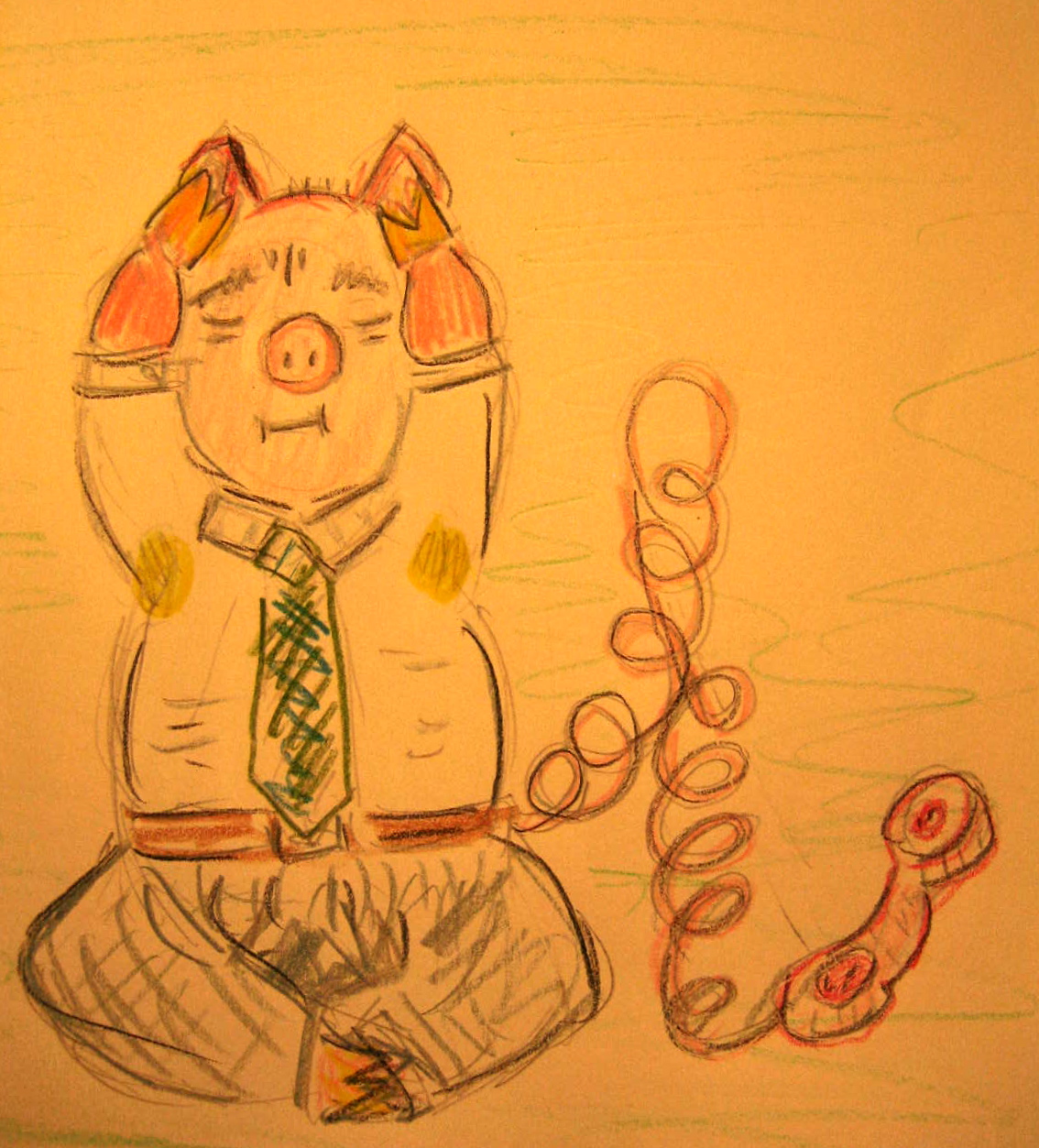
Pushing Away Dark Cloud With Cold Water and Interpretive Dance

A week or so ago I announced that the long-term, if slightly, obscure focus of this blog has been stress and creativity.  (I could not quite steel myself to call it the interface between stress and creativity, which, I admit, would sound a lot more zooty.)

One follower of the blog suggested that the true sub rosa topic was something more obvious—the issues associated with being manic-d daily.   This suggestion brings me to today’s particular topic:  what to do when the black mood strikes.

By the black mood, I mean, that cloud, ache, depression that sometimes forms because of very specific sadnesses, other times because of a more generalized sadness (a sudden, deep, awareness of non-specific suffering).

This cloud may also simply result from a quirk of your personal chemistry, some habitual combination of molecules and electrical impulses that arises from your genetics, conditioning, and whatever you’ve just ingested.

Those with a more religious bend might considered this type of low to be a swerve in one’s tilt towards the universal, God, the Self, with a capital S.

Whatever the cause, when the black mood descends, a very practical question arises: how to get rid of it.  Frequently, the sad circumstances, whether specific or general, are not things that can be changed; what can sometimes be changed though is your chemistry, and, possibly, your spiritual or psychic tilt.

Perhaps the initial most important tool is to try to keep in mind that the black mood, no matter how deep and murky, will not last forever.  (Nothing does.)   So, even when you don’t know how to make it go away, tell yourself that it will go away—at some point—perhaps even if you do nothing.

Once that’s understood, you may as well try something.  If you tend towards the spiritual, you might go for meditation, prayer, a solitary walk.  If you tend towards the chemical, there are plenty of different choices.

Or, if you are like me, and tend towards the manic, you may like to try cold water (as in jumping into rather than adding to scotch.)  A pond or swimming pool is best—but if you don’t have one of those, and you do have a lot of grit and faith—an ice cold shower or bath may do the trick.

The point of the cold water is to get the blood flowing, the skin to stand on end;  to shake up all those teensy-weensy nerve endings.   Once that has been done, a certain hectic frivolity usually becomes possible.

Hectic frivolity may not be the right words for the state I am urging you towards—how about a certain loss of physical dignity?    By this, I am suggesting that you simply move, in silly unusual energetic ways.

In setting out on these movements, I would suggest an initial focus on the upper body.  Silly leg movements (“silly walks) are fun but can be dangerous.  (You don’t want to trip.)   But even a relatively straightforward walk or two-step can become quite silly, and correspondingly uplifting, if combined with strenuously interpretive arm motion, and curious body swings.

Think Isadora Duncan here—not strangulation but angulation, as in bold, possibly rhythmic (possibly not)  gestures.

I do understand that the black mood may constrain your interpretive dance.  The trick is to try to separate your conscious mind (the depressed part of your brain) from the coordination piece, the silly “why-not-just-let-go-a-bit?” piece.

It may not be possible.  Or, what’s more likely, your dark mood may only be alleviated while you are actually waving your arms about, and then fairly rapidly descend again.

In that case, you will at least have gotten some good exercise.  And anyone watching may find their spirits lifted considerably.
iPad Sunnyside Up–Let Me Just Check My Mail

June 7, 2010


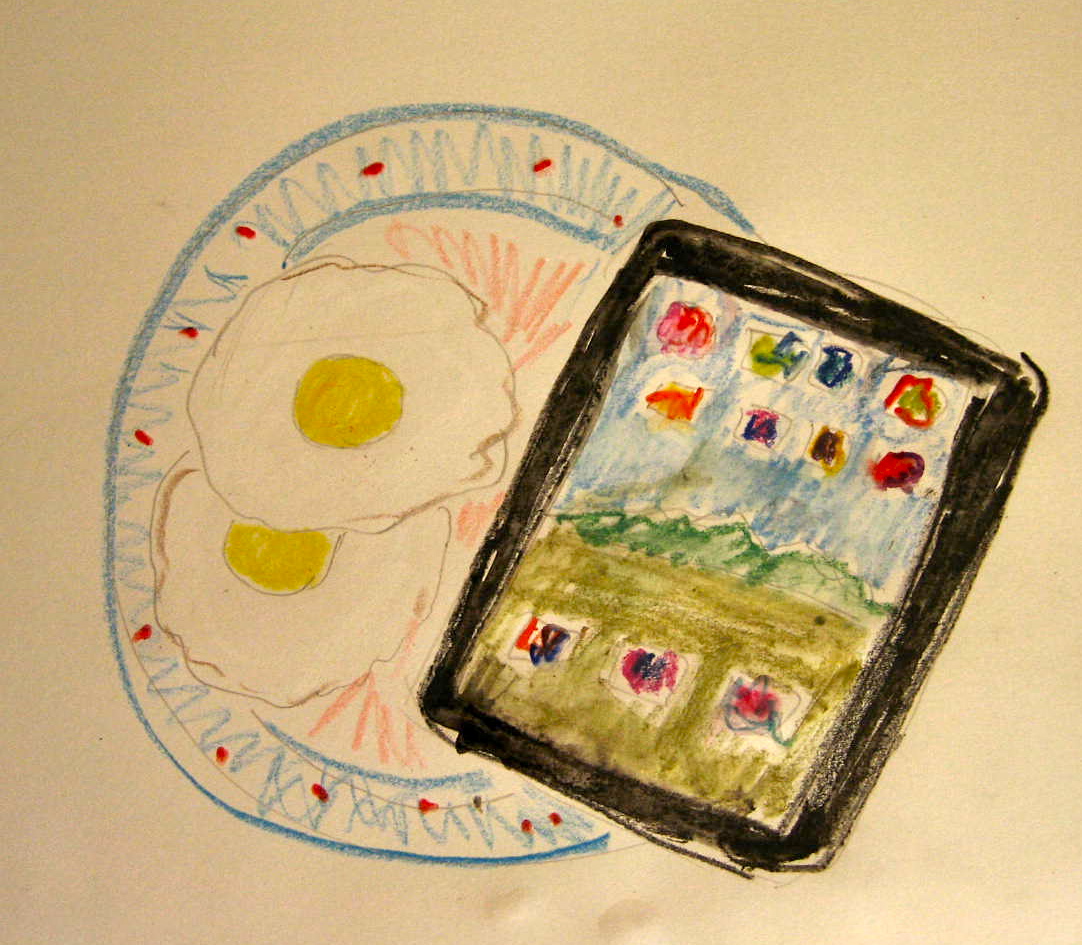
iPad Sunnyside Up

The  New York Times has a couple of articles this morning on how technology is re-wiring our brains; you can find them if you check online—excuse me a sec, I’ve got a new gmail coming in.

The articles talk about the mental and emotional price of a life hooked into, and hooked on—oops—there’s my cell….gizmos.

(Sorry, sweetie, I’m writing my blog.  Can I call you back in two minutes?)

Some people think multi-tasking makes them more productive, but studies show it makes people actually accomplish less, and encourages a kind of shallowness.

Did you know, btw, that Robert Pattinson won MTV awards for best actor, global star, and perpetrator of best 2010 screen kiss last night?   (Does ManicDDaily have her finger on the popular pulse, or what?)

One article depicts a software executive (hey, what do you expect?  The guy’s a software executive, head of a start-up, in Silicon Valley), who “works” in front of three or four large video screens.

In the photos of the guy’s family , they all have iPads.  Even the kids.  The guy even reads Winnie the Pooh on an iPad to his littlest kid.  In bed. (I know it’s kind of awful, but the graphics are also amazing!)

I can’t help wondering if the article will be good for Apple stock.

(I’m just going to check that, okay, it’s bookmarked, so won’t take a mo.)

The guy’s wife say it’s hard for him to be fully in the moment, that when the emotional going gets tough, he escapes into computer games.  But then one of the articles cites a kid who texts a lot in school and that kid says that the “the moment”–that is all the time she spent in school before she had texting–was incredibly lonely and isolating.

I feel sympathy for the kid, but isn’t loneliness and isolation part of what school is all about?  Childhood?  Has she not read Jane Eyre?  Virtually any Dickens?   (I’m sure they are on Kindle.  Maybe even for free.  Or Google Books?  Let me check a sec.)

Oops, there’s my other email, office, you know, my crackberry, the red light is blinking—do you mind?

Why People Hate Banks

June 5, 2010

Bank Phone Customer Service (Hear Nothing, See Nothing, Do Nothing)

We all know the big reasons why people hate big banks.  They were major players in the recent destruction of the U.S. economy;  they were supposed to be slow, plodding, cautious, institutions, but instead tried to behave like growth stocks.  However, their “products” were not actual innovations like iPads or Lattes, but beguilingly packaged jigsaws of future losses, i.e. unsecured debt. ( As Lloyd Blankfein put it, they were packaging “risk.”)

Then, of course, there’s the fact that they needed to be bailed out so that would not sink the rest of us.

But still got bonuses.

All of the above has made me plenty mad, but what’s made me actually hate banks is something much more mysterious and mundane:  their amazingly inept compartmentalization.  That is,  the zillions of separate departments, none of which (even if reached) can ever help you (because it’s not their department).

I don’t mean to attack bank officers in branches.   In my experience, actual people in actual banks try to be helpful.  But often, they can’t help you, because they, like you, are relegated to searching, on the phone, for the right department.

The large banks are like countries, no, continents.  Drifting continents full of separate bureaucracies, none of whom know each other’s name (or language).  They are united, if at all, by a single computer system, which they consult like a gospel.   But while the gospel has actual TEXT, descriptions, lessons and commentary, this computer system has only options, little boxes that are checked. The system allows for no commentary; no context; and no record, it seems, of the ten previous conversations that you have had with the bank on the very same subject.

The phone system of the bank is even worse than the computer system;  any variation from set words gives rise to an outraged robotic voice, then disconnection.

Last year, I had interactions concerning identity theft, committed through (and possibly by) a bank teller.  (The bank would never tell me, or the New York City Police Department, the exact circumstances.)     Even weeks after the initial complaint, after weeks of laborious paperwork, I would find out, in my dogged follow-up that a particular required form had not been given to me; or did not cover everything, or was not sent to the right place.  The bank officers at my local branch were frankly as clueless as I was, and, like me, with every call to some distant Fraud Department, needed to go through a full re-explanation of circumstances.

In my more recent dealings with a large bank, days have been spent trying to reach one employee whose name was given on a regular bank statement as a contact person, but who apparently follows a practice of never actually picking up his phone;  it was only after several days of emailing and messages that he let me know he didn’t actually deal with questions related to the account on the statement and that the bank had no incentive for helping in any case.  He then gave me a number for customer service, which, unfortunately, was actually customer service for WalMart.    (Not a bank subsidiary, last time I checked. )

Since then I have been on the phone with bank employees more times that I’d like to count.  One person put me on hold for a few minutes, during which my call was picked up by a completely new person (Dixie in Manila), who once more needed to be filled in on my inquiry.   Letters I have faxed and emailed to about five different bank employees have not yet been noted on the holy computer system.   One fax number I was given failed to accept faxes.  (Now, there’s a way of reducing paperwork.)

The New York Times had a recent article about people in foreclosure who simply stopped paying their mortgages, and stayed in their homes, forcing their bank to go through the laborious legal process of trying to get them out.  Many people seemed to feel a certain satisfaction about this situation, first because they are saving money, and secondly, because they’ve finally found a way of sending a message to a bank that is being heard.

Promoting Non-Self-Promotion–Whitman, Dickinson, (Jim) Joyce and Armando Galaragga

June 3, 2010

Self-promoter?

Yesterday, I wrote about stress and success, but what I really wanted to write about was my antipathy towards self-promotion.

Self-promotion is a major currency in our culture.  Many believe that fame, celebrity, translates into wealth; that notoriety is an achievement of its own.  (See e.g. Richard Heene, father of balloon boy.)

I personally have an exceedingly hard time with self-promotion.  I don’t mind it so much in others;  I well understand that a certain kind of self-touting is necessary to get attention in our culture, and that, for all my wish to deny it, attention can translate into a kind of power (book sales, ticket sales, advertising and endorsement contracts, appearances on “Dancing With the Stars”).

But, the idea of my self-promotion, that is, my own self-promotion, seems acutely, horribly, embarrassing.

What can I say?  I was raised as a Lutheran (which seems to instill, in its adherents, an overwhelming sense of inadequacy), admire Buddhism (which finds triumph to be illusory in any case), and I’ve been formed (culturally) by the stiff upper lip of English literature.  Besides all that, I am a woman.  (In my generation, feminine modesty did not just mean keeping your clothes on.)

(When I think of historic restrictions on women’s self-promotion as compared to men’s, my mind turns automatically to Emily Dickinson and Walt Whitman ; while Walt, sounding his “barbaric yawp,” openly identifies himself as “Walt Whitman, a kosmos, of Manhattan the son,….Divine am I inside and out, and I make holy whatever I touch or am touch’d from,” Dickenson writes, “They shut me up in Prose–/As when a little Girl./ They put me in the Closet—/Because they liked me “still”—”)

Agh!

Putting me aside (thankfully), I have been heartened by the recent hubbub around two wonderful non-self-promoters—Detroit Tiger pitcher, Armando Galaragga, and supremely penitent umpire, Jim Joyce.  Nothing could have been more graceful than the rueful smile of Galaragga when his perfect game was blown by the wrong call of Joyce, umpire at the first base line during the critical 9th inning third out.   Joyce’s open and sorrowful admission of his mistake was equally refreshing.   (Even the reporters listening to Joyce’s apologies were taken aback, one of them actually telling the ump that he was only human.)

Given our culture’s quest for both celebrity and happy endings, both men will probably get more fame and fortune from Joyce’s wrong call and Galaragga’s acceptance of unfairness than they would have gotten had the perfect game been achieved without incident.  (Society loves a story!  Society loves meaning!  Maybe the whole incident will result in the use of instant replays!)

Still, that doesn’t diminish the men’s grace and sincerity, and the wonder of a modern, heartfelt, and very public, apology.   A pretty perfect interlude no matter how the game is ultimately classified.

Stress and–TaDa!

June 3, 2010


Bridge over River Kwai (Sort of)

I’ve written a lot on this blog about creativity and stress, and also about just plain stress. I’ve also written a fair amount about rhyme.  But what about something that rhymes with stress (sort of)?

Success!  (TaDa!)

Some people consider stress and success as opposite sides of the coin; some (particularly those who have good physical health) even seem to believe that success—I mean here, financial success, or, its great proxy in our culture, fame—will solve major problems.  We all know this isn’t really true;  we all know many successful people who are neither relaxed nor happy.   Still, if you are a creative person, success can feel like one sure way to reduce stress, especially if it means that you no longer need to hold onto your “day job”  and can, instead, devote your energies totally to your creative/artistic endeavors.

It’s certainly true that time, as well as acknowledgement, interest, praise, are great goads to creativity.  But if you do not have success, there are a few compensatory factors which it may help to keep in mind–factors other than a sense of martyrdom and/or the illusion that truly original art is never recognized in its time.

First, of all, day jobs (other than, perhaps, those that involve the postal service), often keep people sane. They tend to get you out of the house (unless you are a housekeeper), put roses on your cheeks (unless you are an office worker), keep your feet on the ground (unless you work for the airlines.)  Most people’s “day jobs” also involve some accommodation of others on a relatively frequent basis.  This interaction with people makes one more human (if more frustrated), and (unless you work for an investment bank) less grandiose.   The skepticism, impatience, and sometimes downright contempt, of co-workers, customers, students, can promote deep self-examination, always a useful pastime for the artistic.

Creative work, on the other hand, is often both solitary and unstructured, which can lead to real head-aches by late afternoon when you either simply have to (i) stop working, or (ii) get working.

Moreover, while a day job may involve a certain amount of self-discipline (i.e. getting there), it often (once you’ve held it for a while) requires little self-promotion.  Achieving and then maintaining even a modest artistic success, in contrast, seem to require vigilant self-aggrandizement; the image must be burnished; the door to opportunity propped open; staleness stubbornly refuted.   While the embarrassing failures of the unsuccessful can just sink into oblivion, the failures of the successful are known and mocked by all.  (Note, in this regard, Sex in the City 2. Even someone like me, who has never seen a single Sex in the City show ever, is making fun of it).

All of which goes to say (as was said in The Bridge Over the River Kwai, a really great film about the conflicted nature of achievement), be happy in your work.  Be glad of what you don’t have (yet.)

Stress and Creativity–Making Choices (Arranging the Lives of Characters Not Family Members)

June 1, 2010

Space

My newly discovered focus on stress and creativity has energized the part of me that loves to give advice.  The one caveat I would make to those reading my advice:  “do as I say, not as I do.”  It is infinitely easier to dish out good counsel than to follow it.

Life is stressful, particularly in the modern world where many play multiple roles; there are the stresses of all that must be done to maintain a job, home, family;  then, there is the added stress of distraction, so many possibilities for avoidance.  Right at the tips of our fingers are the means to while away huge amounts of time—email, Facebook, worldwide news services, horoscopes, blogs, video clips, even favorite TV shows.

In my experience, creative people find it extremely easy to justify giving in to distraction.  We characterize it as “inspiration,” “research.”   We persuade ourselves that it is necessary “keeping up,”  important “networking.”

Some of these justifications may be valid, up to a point.  But the problem is that creativity needs space, a bare spot in the brain to flop around in.  Sure, a brainstorm can arise during a tumult of activity and distraction, but accomplishment (that is, finishing something) generally needs a bit of concentration; time; solitude.

Even if we can restrain our fingertips, nipping computer distraction at the knuckle, there is also the problem of … people; the real live human beings in our lives.  Creativity thrives on people; it wants to speak to people, to impress people, entertain them, awaken them.  Even the most narcissistic artist usually has some genuine sensitivity and empathy.

Still, usually you can’t actually make something (other than perhaps a baby), if you do not cultivate a certain reserve.   By reserve, I do not mean coldness or apathy.  I mean, once again, time, space, quiet, focus.   Given such needs, you may sometimes have to distance yourself from people, to make a choice not to be involved in every family or community drama; to try not to “fix” people (other than your characters).

I should step back here: creativity comes in many different forms.   Some people find their creative expression in mediation or entertainment, in, for example, preparing the perfect family reunion or dinner party.  I had an aunt like this who expressed herself through her elaborate celebrations; I have a cousin who manages to send cards to a wide variety of people not only for their birthdays, but for Christmas, Easter, Thanksgiving, Mother’s Day, etc.

But if you want to focus on something more egotistical– poetry, writing, painting—and you are not making a living from this work—then you simply have to make choices.  Arranging other people’s lives, or even the perfect dinner party, may not always be possible.  Accept that.   (And you may just find that the other people in your life benefit from this choice as much as you do yourself.)

Longterm Focus – Stress and Creativity – Pearl!

May 31, 2010

Pearl - Habit and Engagement

The other day I worried that I really didn’t have a focus for this blog; something to orient  both me and any readers I may be lucky enough to snare.   What have I been I writing about?  What subject do I even have to write about?

Then I suddenly realized that the general subject of this blog has been stress and creativity.  If I wanted to sound official, I’d say the interface between stress and creativity, but since I can’t say that with a straight face (or interface), I won’t.

What does this mean?  I guess the question for me is how one, in this manically depressed stressful modern world, maintains some kind of creative effort?  How can one use stress as a source for creativity rather than as a wet blanket for its termination?  (How, also, can the manic avoid using creativity as a further source of stress?)

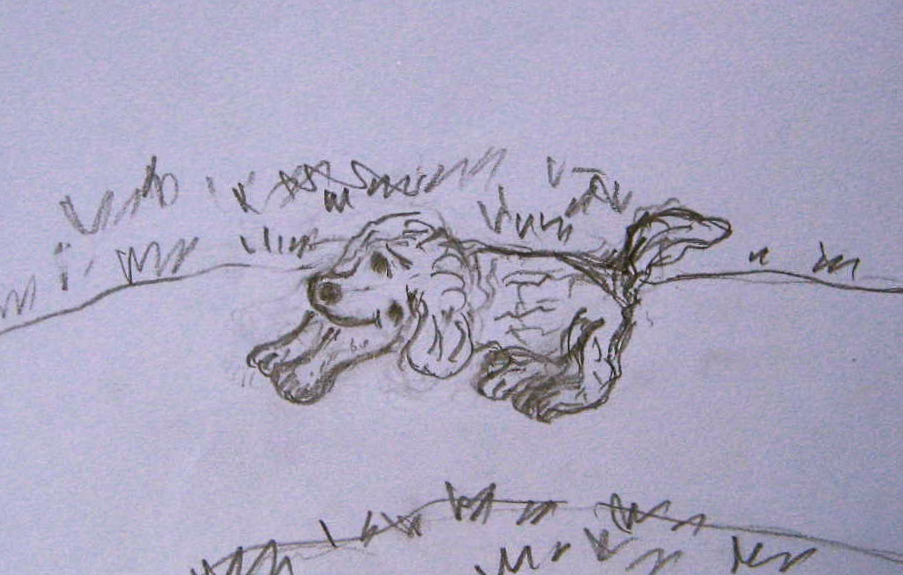
For my first conscious exploration of this subject, I turn to the teachings of my old dog Pearl.  Pearl was struck by a sudden spine problem a couple of weeks ago that paralyzed her from the dog-waist down, rendering her hind legs both insensitive and immobile.  Amazingly, with the help of steroids, she has recovered some use of her legs: she can wobble along now, though she moves like the proverbial drunken sail—dog.  (BTW, after reading several Horatio Hornblower books last week, I now feel enough “expertise” to understand that the unsteadiness of a drunken sailor is archetypical because it arises from at least two sources—(a) alcohol and (b) sea legs, i.e. legs accustomed to the sway of waves that are suddenly posited upon dry land.)

Pearl’s up in the country this weekend, and her reaction to it is a lesson in the maintenance of creativity under stress.  (For these purposes, I’ll consider Pearl’s outdoor explorations and general cuteness her “expression.”)

Pearl still has trouble even walking, and yet, here, in a country place she has loved since puppydom, she wobbles, skips, trots.  What motivates her, what keeps her going, seems to be two factors:  habit and engagement.

There are certain places (a long dirt driveway), and certain times of day, in which Pearl has always run here.  That habit (plus steroids) is so strong that when I put her down on these spots, and at those special times, her legs just move.

Where habit runs out, engagement takes over.  The scent of a place where a deer has recently bedded down will lure Pearl, sniffing, into tall grass, pull her through reeds, propel her into Heraculean effort.  I can only derail her lopsided enthusiasm by physically picking her up and putting her back on her track, where, out of habit, she quickly wobbles off again.

Which brings me back to the creative human mind dealing with stressful obstacles–all those drags upon the consciousness.  How to avoid paralysis?  How to dart and trot, dig and ferret?  How to just keep going?

This (I think) is this blog’s inquiry.

Thanks so much to those who have been following.  Stay tuned.

Looking For Cheer (With a Sick Dog)

May 19, 2010

Sick Dog

I was ready tonight to write about the wonderful reserve of the old-time British hero, Horatio Hornblower (created by C.S. Forester);  this is a character that knows how to pack a great deal of meaning into a very few words; who is masterful at mastering his feelings, careful to mask and make do with discontent, sadness, anxiety.   But I come home from work to find my very old dog suddenly immeasurably older.   Something is very wrong with her, and suddenly reserve feels immediately like a much less interesting quality to me.

When your old beloved dog is sick, you really are not looking for a friend to say, crisply, “hard luck.”

Certain types of cheerfulness are even worse than the crispness of a stiff upper lip.  For example, when you are anxious or grim, it’s not always helpful to have someone tell you, brusquely, to cheer up, or to not give up hope yet.

Maybe it’s just me.  Perhaps I am of an argumentative nature.  (Actually, there’s probably no “perhaps” about that.)  But, when someone tells me cheerfully not to give up hope, I want to respond tearfully, (i) that hope is already far gone, and (ii) just leave me alone.

I find that instead what helps when I am truly anxious or upset is some kind of commiseration–an echoing or mirroring of the upset feelings.  Yes, I know this sounds  like wallowing–or, even worse, getting your friends to wallow with you–but instead of strengthening bad feelings, this kind of commiseration seems to give a stepping stone for getting out of them.   This could be my peculiarly argumentative nature.  All I know is that if I am upset, and someone agrees that my situation is pretty awful, my kneejerk impulse is to say that it’s not so bad, and to actually feel some kind of  hope.   (It’s as if the sympathy gives me enough strength to become my own comforter.)

In a similar play of opposites, many look for someone to take care of them–financially, emotionally, physically–while the being that most readily captures their heart is one that they take care of.

A dog.

Here’s hoping.

Running Late – Exercise On the Go

May 15, 2010


Running Late (and Slightly Elongated)

Followers of this blog know of my earnest, if multi-tasking, devotion to Astanga Yoga and the elliptical machine, but I’ve yet to discuss my most efficient method of getting regular exercise.  This is to leave a bit late for nearly everywhere I go.

I am not sure that this exercise method would be effective in more car-friendly environments (where you might only accumulate speeding tickets), but if you are running late in New York City, you usually are also trotting, jogging, speed walking, scooting, maneuvering, and dashing, late.

There’s nothing like that “whiled-away fifteen minutes” after your pre-set time of departure –you know, that time spent not departing when you are hopelessly trying to find something to wear that feels “right”, sweeping your kitchen, taking your vitamins, circling back to your apartment to turn off your iron—to get the old legs moving, and that regretful heart pumping.

In addition to the physical benefits of running as quickly as possible, for as long as possible, along a crowded street, there are also certain psychological benefits to a chronic lack of punctuality.  If, for example, you are trotting alongside your husband, who is also perennially late, you will find every single unresolved issue between you coming to the fore and absolutely ripe for frank discussion.

Even if you are chasing along on your own, you will happen onto epiphanies.  Chief among these is a clear understanding, usually (eventually) reached while waiting for a subway train (which, because you need to make time, is delayed) of the impotence of your individual decisions; your relative puniness in the universe; the fact that you are subject to great forces—fate, the MTA, your own inability to leave on time–forces that are determined to always make you late, forces that you must simply accept.

Hopefully, around the time you reach this understanding, you will find yourself in a place with cell reception.

Shrink-free Ways To Shrink Inadequacy

May 13, 2010

Stuck

A chronic issue for ManicDDaily types is how to handle gnawing (as in ravenously persistent) feelings of inadequacy and imperfection–not how to address the reasons for such feelings (whether temperamental or circumstantial), but how to lessen them.  This is a subject upon which I’ve done much research, and I’ve developed  the following four more or less, do-it-yourself methods; methods that do not require professional help.

Four Shrink-Free Ways To Shrink Inadequacy

1. Be perfect at all times.

2.  Failing that, think of yourself as absolutely perfect at all times.  (I hate to sound sexist, but this seems to be an easier method for men than women, or at least for baby-boomer women.)

3.  If you can’t be perfect, and you can’t think of yourself as perfect, own up to the imperfection; resign yourself to it:  you made a mistake; you have certain failings.   So what?

Try not to get stuck in a mire of analyzing, denying, justifying, defending, self-mortifying, not to be a tire in mud, spinning spinning spinning the same old muck around.  Yes, you may have made a mistake; no, you may not have.  Whatever.  The fact is that skillful conduct and good intentions don’t always translate into happy results, no matter what.  (Think of all the times you organized a picnic and then it rained.  Don’t, like me, be the kind of person who apologizes for storm clouds.  And then to storm clouds.)

4.    Maintain old friendships.   When you are chewing the rawhide (your raw hide) of a failing, an old friend is probably the best person to help you digest it.    Family members may also help, but they are more likely to veer between the overly candid, as in “why in the world did you do that?”, to the solicitously duplicitous as in: “of course, it’s not your fault: it’s never your fault.” Husbands or wives can be particularly difficult;  they will often give advice on how to resolve whatever is troubling you instead of just listening to you go on (and on and on) about it.

Old friends, in contrast, will listen, cluck with true, but discerning, sympathy, and then move on to the next topic.  Which is exactly what you need to do.

What about new friends? It’s a bit harder to trust them.  Oh, they probably will not spill your confidences—but will they like you when they know how imperfect you are?!?

While old friends… old friends… they have known that you were imperfect for a very long time, and still will take your call.