Archive for the ‘poetry’ category

Not really Comic or Super Poem (For dVerse Poets Pub “Comic” Prompt) (But at least has elephant)

December 3, 2011

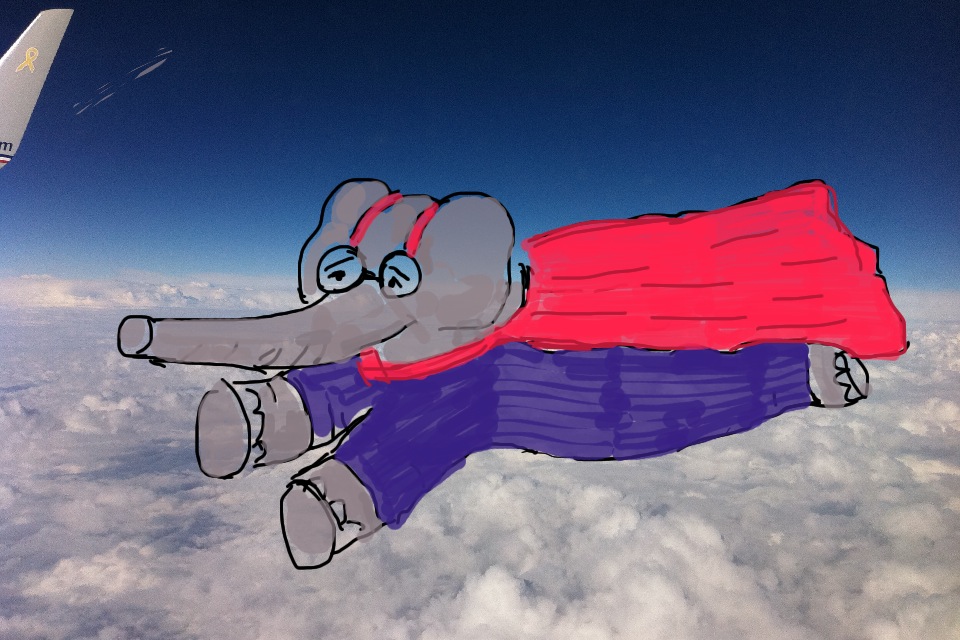
Here’s a new poem (too long–sorry–and still very much a draft), written for dVerse Poets Pub “Poetics” challenge relating to comics.    The drawing (done on my iPhone) doesn’t really suit the poem, but I couldn’t resist using it.

Power of Choice or Need

My childhood comic of choice was Archie and heroine
Betty, (fellow blonde and would-be
do-gooder), even though doing good,
in those comics, seemed
synonymous with disappointment.

Of course, the disappointment, was only in the long-lashed eye
of the short-sighted; those impatient
grasping sorts who did not
understand that good-hearted losses,
like all karmic set-backs, must turn golden (i.e. blonde)
at the end, as the universal
balance of good and evil (i.e. Betty’s cute turned-up nose vs.
Veronica’s snooty turned-up nose) righted itself, and a date
with Archie was achieved.

But now that I have no hope of cinched-in waist,
parabolic breasts, or a date with even a
rather bumbling teen throb, my sites turn to the super, those
tragic but helpful figures, only I think
that if I could grow a super power of choice or need, it
would sprout not in my limbs, but inside my heart, taking
the crud of resentment
as its Krypton;
transforming the sting (recurrent)
of abandonment into
the spark of a magic spider’s
teeth.  (With what else
do they bite?)
Morphing the hurt that embeds the claw
into the wide yaw
of empathy; telescoping
that chopped controlling beat into
a galaxy of embrace whose
planets orbit some other sun, where
there are no black holes, and where love, like other
universal forces, can be found in the radial outreach
of just about everything (sound waves from dropped pin,
ringed water round skipped stone, mossy antlers on
rutting stag, maple branches in
wet snow, the listening
consciousness).

It would be a strength, I think,
inked in the unhealed, unhealing heart, allowing it
to flow with the currents of uncertainty,  to
fly vulnerable.

Image, Simile, Metaphor in Poetry–A Keel To Float Your Poem–(“Family Finishes”)

December 1, 2011

20111201-040614.jpg

DVerse Poets Pub has a prompt today by Gay Reiser Cannnon asking for poems that trade in image, simile, metaphor, allegory, figure.  The poem below was based on an exercise that tended to force one into metaphor (though frankly almost any poem has some basis in these elements.)  The picture, done on my iPad 2, was “filtered” on the Photogene App above.  (Below is the unfiltered image.)

Family Finishes

I.

The perfectionist sands her offspring to her image, or
an image, filing away the
unsightly, the angry, the unspeakable.
Drills a face fit for a pageant, as
smooth as balsam, as modeled as
a keel; then (the child carved
to measure), she steps

down into that keel, careful
of any unseamed tar.

II.

A family levels itself to just folks with enough distance;
an occasional pageant – picnic or funeral – joins the blood,
a biennial application of glue,
occasions muddled with the stickiness of blood;
mother hammering the grandmother, son
nailing father, the family portrait gathering a rich patina.

III.

Steeped in the traditions of the portrait hall,
the young mother thought

to measure out love in spoonfuls,
smoothing away excess, screwing it into a tied-up sock.
Blasphemy to mount to ecstasy over your child.  No.
Passion
 fit the furniture
like a bowl of tulips or tea set, shaped to
its interval.  But the small white fist that gripped her finger
leveled training,

proper restraint transmuting aged wine to deep wellspring,
casks burst to loose a flow of sparkling clarity. 

20111201-041027.jpg

Important Numbers To Any Generation

November 30, 2011

20111130-112055.jpg

Important Numbers

My parents, nearly ninety, have a paper posted on the wall just above
the phone on the kitchen counter.
I typed it myself a couple of years ago.
“Important Numbers” it says, and leads off
with 911.
Below that comes the number of a saintly neighbor, then all my various phones,
my brother’s, the local GP–

On this visit, I’ve noticed a new paper–a small purple index card really–
taped up just next to the phone numbers; it reads,
scribbled in my mother’s thin hand:
“50 million – WII.
20 mill Russians
6 mill Poles
6 mill Jews.”

As my mother trudges into the kitchen
increasingly trying to catch up to
the reason she’s there this time,
her eye lands upon the purple card:

“Do you know how many people died in World War II?” she asks
expectantly.  “50 million–can you imagine that?” her voice rises in both
horror and wonder.   Her voice becomes almost strident
with deserved significance—“20 million
Russians, 6 million Poles, 6 million Jews–can you imagine it? And
that doesn’t even include the Japanese.”

(My mother, having lived a couple of years
in Japan shortly after the War, is particularly partial
to the Japanese.)

“I think it does,” I say.

“Oh yes,” she says, leaning over the jars of nuts, the foil bags
of dried fruit, the salt and pepper, to stare more deeply into the card–

“Yes,” she says quietly.  “I guess that’s right.  50 million
in all.”

P.S. Posted for Imperfect Prose for Thursdays.  in the hush of the moon

What’s Best Not To Be Caught Doing In the Stairwell (Middle-Aged Version)

November 29, 2011

20111129-024930.jpg

Here’s an older poem for dVerse Poets Pub Open Link night and Thursday4Poets Rally, apologies to those who’ve seen it before.  (The drawing at least is new.)

In the Stairwell

Descending the building’s stairs, she tests her breast,
fumbling beneath her bra to get to skin,
palpating (as they say) but in a mess
of here and there and not all within
the confines of an organized exam.
Silly to do it here, not time or place,
someone else might come, have to move her hand,
and yet fear seems to justify the race,
as if by checking each time it crosses mind,
especially checking fast, she can avoid
ever finding anything of the kind
that should not be found.  And so, devoid
of caution, but full of care nonetheless,
she steps slowly down the stairs, feeling her breast.
PS – A version of this and other poems can be found in my poetry book on Amazon called “Going on Somewhere.”  But, for real fun, check out my new teen novel, NOSE DIVE (written by Karin Gustafson, illustrated by the wonderful Jonathan Segal.)

MagPie Tales 93 – “When The Couch Was Saved”

November 27, 2011

20111127-083421.jpg

Here’s a piece for Magpie Tales 93, a writer’s blog hosted by Tess Kincaid, and also GooseberryGoesPoetic.  I have made my version of Tess’s photographic prompt above. The first piece I did for the prompt was about “Hello Dolly!”, but then I started thinking of Novembers in years past, and ended up with the piece below.

When the Couch, at least, was Saved 

It was a time in which couches were saved for company,
their cushions, if not under actual wraps, under threat of maternal bemoan.

It was an age of short white gloves for Sunday School, and
a brand new outfit at Easter–hats with brims if a child, a prim
round edge, if not.

It was a period when the National Anthem was played in movie theaters, and we would stand, conscious, in the projected ripple of stars and stripes on the screen and the echoing thrill in our chests, of the seats at the backs of our knees, the brush of velvet cushion, the chill of metal frame.

It was a day when we parked at McDonalds, its arches like a movie theater too, and from the radio of our white-finned Olds, heard the news about Jack Ruby and his sawed-off shotgun in Dallas.

It was a day we had spent much of standing, down at the Capital, in grieving awe at the jagged prance of the dark riderless horse, the turned-back polished boots.

The news of Ruby, Oswald dead, hit like a third anvil, an odd blank thud on the already crushed. My mother leaned from the car door as if sick, “what in God’s name is happening to this country?”

It was a whisper she would repeat several times over the next few years as we sat on the living room floor before the ultraviolet of aging TV, my mom in a kitchen chair (the couch still saved for company), praying for someone we had loved from afar not to have been shot, or at least, not to die, watching too the riderless wave of what came next and next and next, a velvet place in our aching chests more and more conscious of metal.


Poetics Prompt- Wild Poem – “Kali”

November 26, 2011

20111126-062039.jpg

I’ve posted this for DVerse Poets Pub “poetics” prompt “wild” and Gooseberry Garden’s poetry picnic.  It’s an older poem about the Indian Goddess, Kali.  Kali is a  Goddess of Destruction, often depicted in a fairly violent, i.e. wild form,  but it is my understanding that this destructive force is also an energy that can be channeled in a protective manner–against obstacles!  Blocks!   Enemies!  (She seems to me to be kind of like a life coach mother bear.)  At any rate, here’s my effort and a new iPad drawing above.

Kali

Dear Kali, you are my favorite goddess.
It is your krazy hair,
and all those men that you wear
at your waist.
It is the way that you waste
them with your big mouth,
that you break them in two with your teeth, 
that you bear down hard.

Dear Kali, you are my favorite goddess.
It is the way that you slit,
the way that you split,
the way that you pit
them against each other, heads against heads,
and that sharp spear that you hold
in your hand.

Dear Kali, you are my favorite goddess.
Make me your third eye.
Make me the clasp at your waist.
Give me the weight of fifty men, the hook of the chain.
Dear Kali, you are my favorite.

(PS the poem is in a collection of my work GOING ON SOMEWHERE available on Amazon.)

(PPS – I’m so sorry that I’ve not been in a good position to return comments the last few days.  Thanks to all who’ve commented.  I will get back to your work.)

A Flash 55 of Thanks

November 24, 2011

20111124-082018.jpg

Here is a poem for Thanksgiving–dVerse Poets Pub prompt on what one is thankful for, and also, since it is 55 words, for the G-man, Friday Flash 55.

The Luck (and thanks) that come with Parenthood

What I am thankful for:
First, this birth.
(Second, their births.)
The resulting constitution–one that
Can accommodate
The sickness of babes, also of
The old; that, when faced with a dog’s
Tick, pulls it out; reaches into a blocked drain;
Cries readily, laughs quicker, allows
Itself to dance. How
Did I get so
Lucky?

Same Strokes, Slightly Different Folks. (“Buddha Hands”)

November 22, 2011

20111122-122516.jpg

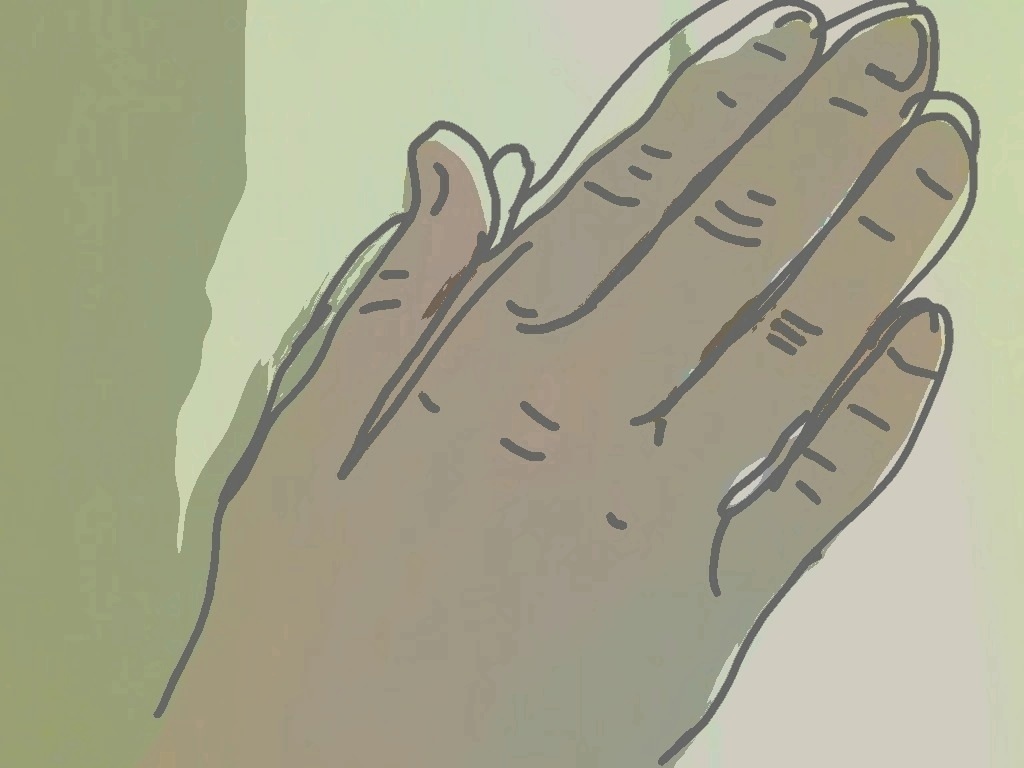
Last week, as part of the dVerse Poets Pub Poetics prompt, I posted a poem on the theme of “change,” which spoke of mothers stroking heads.  I was struck by how many commenters mentioned their memories of this experience.   This brought me to re-write an earlier poem (posted as a draft some time ago) about the same subject,  but with a slightly different take.

Buddha Hands

My mother was a demanding child,
“right now,” her favorite phrase, though
her father egged her on, she says, liking
to see her get a rise
out of her own mother, a tease.

“Terrible,” she says, and I picture
her father, whom I don’t truly remember,
as a man with bits and pieces
of her same face–
determined nose, staunch forehead,
bead eyes.

Yet, when she was tired, my mother goes on,
her mother (to whom she could be so ornery) would let her
put her head upon her lap, and, without mention of
the day’s spat, gently
wipe back her hair.

It felt so good,
my mother sighs, that now, nearly 90,
she sometimes wipes her own hair
back in just that way,
and, as she stands
before me, she palms
the grey strands from the still dark
widow’s peak, again
and again.

And I think, watching the path
of her palm,
how she used to do exactly
the same to me: how, in the back seat of a long drive,
where no tasks could be tended, my pointed
busy mother stroked my head.

I suddenly think  too
of Buddha hands,
a temple market in Mandalay,
where they were lined up–spare parts–
the loose stares of single eyes on the
shelf above–
tapered wooden fingers
flaked with gilt–

And I know, standing before that far counter,
and lying in the seat of that ghost car, that if ever
there were such a thing on this
Earth as freedom from suffering, freedom
from desire,
it could be found (for me at least), in that space
upon my forehead where my mother, her mother too,
ran their hands–
without grasping,
without clinging, without even
holding on.

(P.S.  I’ve edited this poem some since first posting–really just the beginning.)

Magpie Tales 92 – He loved Fellini–“Like a Cello (or Two)”

November 20, 2011

20111120-103443.jpg

Here’s my offering (fresh off the press) for Magpie Tales 92, a very cool writing/photo blog hosted by Tess Kincaid.  I’ve modified Tess’s wonderful photo, and I’m afraid my offering may show my age.  (If you don’t know the references, check them out!)

Like a Cello (or Two)

He loved Fellini;
She tended towards George Cukor:
Mastroianni led the forward skip of
his self-style–hers Audrey, champagne
lightness in black flats, though she also
kept Marcello in the loop. (And how!)
Like a cello, each body curved–
a cello clothed in case for protective
carry through black/white streets till
he carried her to sheets too soft
for his tweed jacket, her bare arms
making up the smoothness gap.
Like a bow was the straight line of their connection–but
how can two cellos be played upon at once?
They managed it.


(P.S. – edited this very slightly since sending out–taking out “a” before case.   And I really feel like something about reverberation should be added. Any ideas.)

Change Poem – Mother/Daughter/Sister/Hands (“Making It Better”)

November 19, 2011

20111119-032618.jpg

DVerse Poets Pub has a “Poetics” challenge to write about change today which set me to thinking of both the new and old.  Here’s the resulting poem:

Making it Better

I think today, the anniversary of my daughter’s birth,
of my mother’s grace–
how she came to my hospital bed at 8 a.m.,
two hours after leaving her sister’s,
her favorite red blouse catching
the robin’s egg fluorescents, the curled tips
of her brown hair carefully
slipped back as she
bent over over the bassinet,
exuding unshadowed wonder.

My mother, who never made any
decision without vocal re-thinks,
not asking me
at that time
how she should dress
her sister–whether the funeral home’s gown
would not be too frilly–she worked after all,
had a career

carrying only in the back of her dark eyes
the echos of that laboring pant
that strains so to keep on–

My mother, cupping
my daughter’s still-damp head,
in the same cool hands that had
stroked my forehead as a child, as her mother
had stroked hers, and that now,
when she’s been sisterless
and motherless for many years,
stroke her own forehead, wiping
the thinned hair back.

Like this, like this, she shows me,
running her palms over the
join of face and crown–
her particular self and her
universal self–I just find
that it makes me feel better
.