Archive for the ‘poetry’ category

Watcher of Charles G. Taylor Trial, From Sierra Leone

April 27, 2012

20120428-120928.jpg

Watcher of Charles G. Taylor Trial, From Sierra Leone

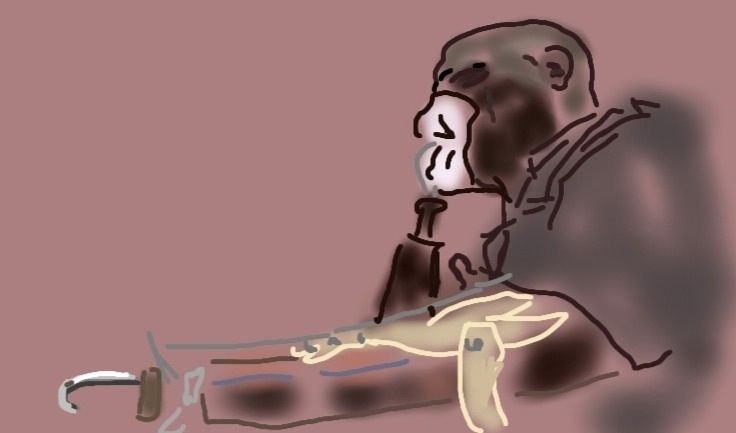
He raises with hook a bunched white handkerchief;
it is not a flag of surrender.
Still presses it to lips to catch at least
pieces of sobs that linger, that sunder
him in two–before and after, then
and now–when already he’s been trimmed
down to his core, both of his arms sliced off when
the slicing was good, so that now he’s rimmed
with sling, limbed with plastic counterparts.
He misses hands, mourns more those who are gone–
he wants to see their shine of faces, hearts–
not smeared with blood and not with bodies shorn.
He wants to take them in lost arms, to enfold,
he wants them back, and then to hold, to hold.

*****************************************

The coverage of the trial of Charles G. Taylor, brutal dictator of Liberia, is horrific and moving.

“Dust to Dust” (Dust to Sisyphus)

April 26, 2012

20120426-104619.jpg

Dust to Dust

I roll this rock
up up this hill,
trying to remember
where I put
my….

The rock is large, chest-high–not like some
marble you can thumb at all the world.
I lean into it as I push, as if it
were the dais of my existence–

though I also pinch my lips
into a tight shut fist against the dust
thrown up by our erosive path,
our close connection–

Of course, I want it to
crumble–the rock to pulverize, the
hill to subside.  How else will I dis-solve
this problem
of path and footing?

But still chest stumbles; dust
seeping through every refusal–
Because I just can’t breathe
when holding breath, can’t rest
when pushing.
(And not-pushing is not
an option–I’m pretty sure
they were clear on that much–)

Oh where–
did I put–
my–
rock….

**************************************************

I am posting the above poem for dVerse Poets Pub “meeting the bar” challenge, hosted by Victoria C. Slotto.  The challenge was to write an allegorical poem.  I went for the obvious (sort of.)

The 26th day of National Poetry Month!

“Autonomic Onomatopoeia”

April 24, 2012

Autonomic Onomatopoeia

Certain words onomatopoeically
pluck meaning from innate sound–
evolved sound, sound that we have
very long inhaled–their consonants frets
on the neck of our consciousness, their vowels keys
to our xylobones; their syllabication
autonomically strutting
across the bass of our brains.
They sneak 
their tongues
into our ears – kiss;
strum tenderly the harp
of tuned
 tendons; zither
our various plexi; nipple songs
of
hip (pocampus) as if
on a dulcimer
of reflexive-fuck
percussively; susurrate love
like the near silence

of twilit breeze; and when you are far,
and I am farther still,
they
 make up poems
that both of us
know
by heart.

********************************************
Draft poem for 24th day of  National Poetry Month.  I like it!  I hope you do too.  (Sorry to those who are offended by profanity for the profanity!)  Also updated since first posting – could not resist the hippocampus.

This is not linked to any other site, so, instead, I’ll plug some of my books!  (Second Sorry!)  Comic novel, NOSE DIVE,  book of poetry, GOING ON SOMEWHERE, or children’s counting book (with elephants)  1 MISSISSIPPI.   Check them out! 

“Reverie on Duty (Taps)”

April 23, 2012

Reverie to Duty (Taps)

There’s a certain sequence of notes, not exactly a scale–let’s say “Taps”–that resonates in chords in the striving soul.

One harmonic sounds in sadness.  Maybe, even, shuddering.  We can’t help but think of endings–

Another harmonic sounds (if we’re lucky) in satisfaction, and another – the third tone of the chord–as thrill: the thrill of fitting into a tradition, like the first wearing of white gloves, first billfold in back pocket.

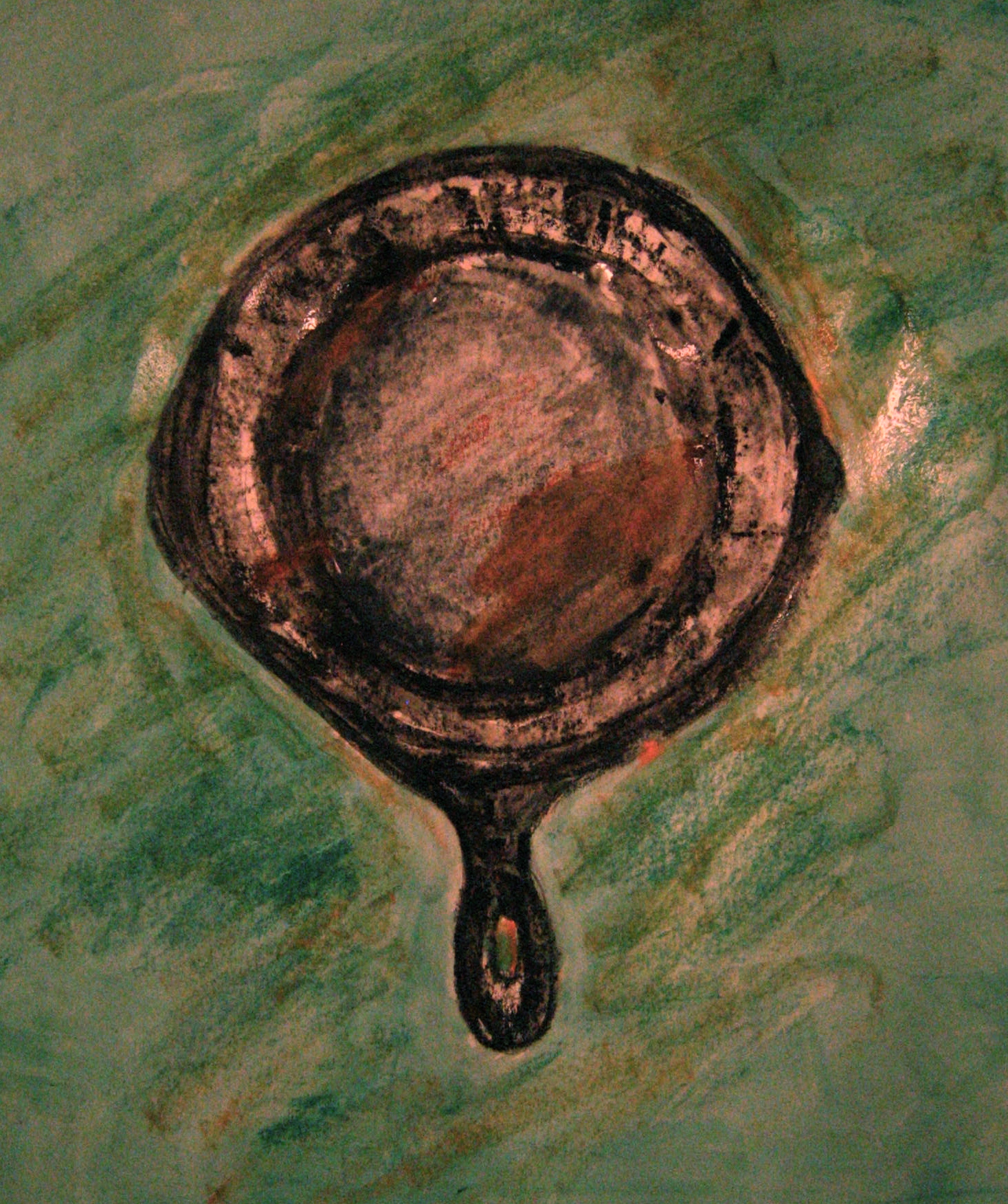
But tonight I think of Duty, and that, in turn, brings up fried fish–the story of the daughter who watches her mother, throughout her childhood, cutting off the two curled edges of a fillet–like so, like so—-before committing it to the frying pan.

The daughter then teaches her own daughters, that–like so, like so–they must cut off the ends of all fish before cooking; that this is the proper way to cook fish; that they are women who cook fish in this proper way.

Years later–when the daughter sits beside her mother (now grandmother, maybe even great)–knitting perhaps, or, more likely, bemoaning the decline of current days, and asks how this tradition was handed down, the mother/grandmother pauses, thinks, and explains that she just always had a very small frying pan.

Duty, traditional duty–we like to think of it as an obligation owed to nothing but an undersized skillet.

But now I hear the harmonics of Taps again–and fear, listening, that its sombre notes mean the loss of light and of all light’s twists and turns, those rainbows we want to pursue, be.

Still, one tends to child, parent, damaged child, damaged parent, person who feels like child, parent or just damaged–a fish out of water–

One tends also to things—-job, house, list–that feel a bit more like the squared-off fillet–

All I can tell myself is that rainbows can be found on fish too, if you look carefully–

Even fillets once had them–

And that, in the mind, there are surely all kinds of scales to be seen, seen through, weighed, balanced, listened to–

*********************************************************

Because this is April, National Poetry Month, I am calling the above a prose poem and also my 23rd poem this month.  (For some reason, I seem to feel that it’s my duty to write a new poem every day this month, so at this point, I am calling almost everything I write a poem!)   Thanks for your patience!

I am also linking this poem to dVerse Poets Pub’s Open Link Night and to Imperfect Prose, both very supportive sites full of interesting writers.   Check them out!

“Wood Be Harry (Caught by Houdini’s Lure)” – Mag 114

April 22, 2012

20120422-110419.jpg

Wood Be Harry (Caught by Houdini’s Lure)

Caught by Houdini’s lure
before he even heard the name–
he climbed from crib, rolled from
stroller, finessed
his way from fingertips, magicking red
the faces of his parents once again, when, as
six-year old, he found the manacles
in their bedroom drawer and showed them
how he could release his pale clasped
wrists without even a nudge of
the coupled key.

But to teach his lungs to burst
their bounds
would take some work.  And privacy.  How
could he practice
in a public pool?  A pond aligned with
a window?  A river by any road?
No.  He took his tank–aquarium
salvaged from dentist’s dumpster–
to a high far glen, where sounded only
the spark of bird, the knock of woodpecker, the rare
ullulation of wild turkey blustering through
the bush.  Carting up
the water had been a bitch.

But worth it, he thought, lowering head
beneath the slosh, as a reverse bubbling slipped
between the press of lips, and freedom itself,
escaping the crimp
of the wide world, took refuge in
his second-counting soul,
and bloomed.

He could go on this way,
he thought, forever–until,
suddenly, captured wave caressing
his proud teen’s musclebound
limbs, the image of his parents’ manacles
came to mind, the fraught stillness of
their years-ago bedroom drawer, and, with a spluttered
cough half-trapped in his
tight throat, he realized, ruefully,
that much much more practice
would be necessary.

********************************************************

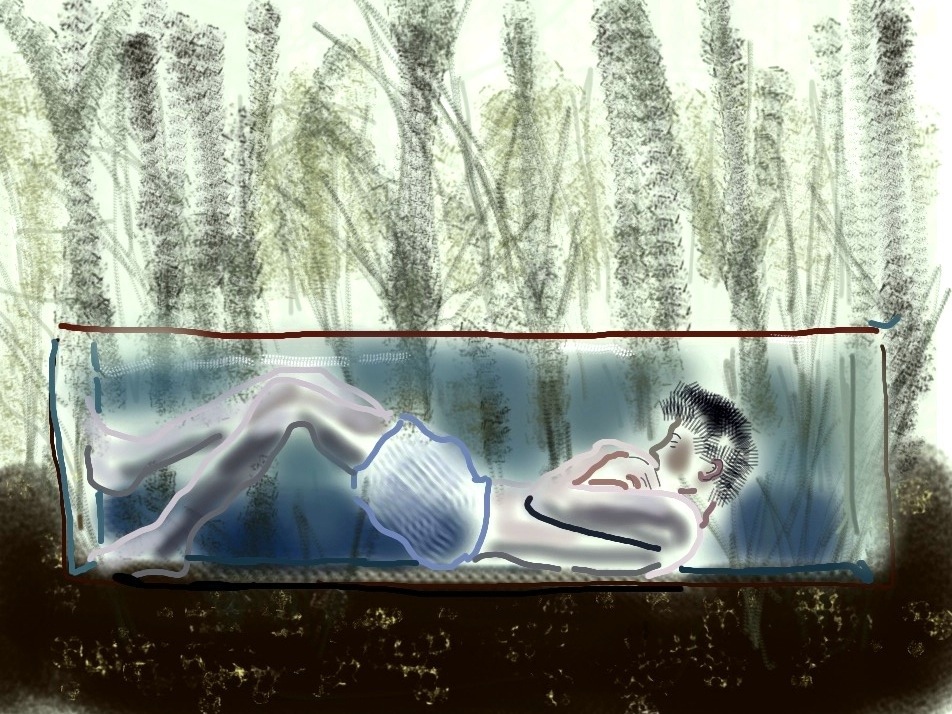
Here’s my offering for Tess Kincaid’s Magpie Tales, 114.   My iPad painting is based on Tess’s prompt, an image by Alex Stoddard.  This is also my 22nd poem – I’ll call them that, though some have been very prosey – for National Poetry Month!

Duty/Free

April 21, 2012

Duty/Free

Waiting for my flight/JFK.  Only wandered in because I had time. The Swiss shampoo on special did too–thyme, rosemary, a dirndl of herbs and alpine flowers pristinely depicted in a sleek green bottle way too costly even on sale, even duty-free.

Still, a whiff of Switzerland might be handy, I thought, already pretty sure that India (where I was headed to do research) would not be a bushel of Edelweiss.

To be fair, not all smells were stench–a deeply stabilizing pungency emanated from burning cow patties; the waft of sweet milky tea always uplifted; the rose chutney (that I, at first, confused with betel nut) smelled like love in spring; but there were also quantities of mustard oil (that, when rancid, stinks like sardines), bunched sweat, and, on far too many walls and footpaths, the soak of urine.

I love India, but it is hard without regard to its scents, and, after a while, I became so exhausted by the chaotic jam of bodies and needs, by the frustration of trying to do my work that a few dabs of Swiss shampoo below the old schnoz would no longer make me feel as if order and efficient freshness were actual possibilities in the world.  So (research going nowhere anyway), I escaped to the beach, Goa, the place where the 1960’s took refuge, a tie-dyed coast filled with backpacking Westerners.

All seemed like paradise until I realized that the powder a lot of the Westerners were non-stop rolling into their bidis was actually smack.

And that my relaxing beachside ashram, run by missionaries, housed only a few, like me, who could pay, but was mainly home to those who’d somehow gotten lost along their journeys–

Her name was Shanti–”which means peace,” she smiled–and, when I asked where she was from (I could tell U.S.), said, “the world.”

Shanti, a girl with kaleidoscope eyes, and sunburnt skin, long hair with swathes both stressed and coconut-oiled, body corded as a rope, showed me the showers–rough cubicles made of burlap and green vine–stamped her bare foot repeatedly because, she said, rats sometimes went for the nearby compost, cried “heeyah” to scare them off.

Shuddering, I stepped in, and slowly began pouring water over salty shoulders, trying to unwind as I heard her sing softly just outside, till she smelled my Swiss shampoo, and peeling off skirt and halter, stepped in beside me, kaleidoscope eyes spiraling wider, “what is that smell?”

I squeezed some into her palm and then another palm, and again, as kaleidoscopes closed in the bliss of dancing veda, she lathered repeatedly, even after the water bucket had run out; the moist tropical air, the scents of cumin and rot and mud too beneath our feet, overwhelmed with Alpine flora.

And I, who still had traveler’s checks in my backpack still had, in fact, a backpack and visa and passport and plane ticket, and a home to have plane ticket to, made myself say ‘ here, do you want to keep the whole bottle?”

What else was there to say?

Though I don’t think the words came from generosity exactly, or even a sense of duty to my fellow countrywoman, but from this sudden burning envy for that streaming sudsy bliss, the shine of satisfaction in Shanti’s shut eyes, a courageous trust in the random–this moment, and too, the next–the gift of my Swiss shampoo just a way to barter for a piece of that.

******************************************************

I’m not sure the above can really be called a poem, but I wrote it for dVerse Poets Pub Poetics challenge “Duty Calls,” which I am hosting today.  I urge you all to check out dVerse and the wonderful poets posting there, and try the challenge yourself!

Also, if you have time and inclination, check out my books!  Very fun novel, NOSE DIVE,  book of poetry, GOING ON SOMEWHERE, or children’s counting book 1 MISSISSIPPI. )
Grief One Has No Claim To – Renewed Sadness over Etan Patz

April 20, 2012

20120420-081835.jpg

A Grief

There is grief we have no claim to,
yet it claims us.  It is the reverse
of the view of a landscape owned by another,
a place we drive
or walk by, taking in with sigh the checkerboard
of fields, the cirrus sunsets.

But grief–this grief–is nothing at all
like that.  It’s the reverse, I said–
the metaphors of the bystander just
don’t come–the knife
to a nearby heart, the reverberation
of sob, the dank well
of loss that one has not, in fact,
been forced down to.

A child gone missing==it’s
a blade I have not felt, thank God–but even
the mere thought slices from forehead down–physically hurts–even as I
know that it’s a grief I have no claim to–thank God thank God thank God–
it claims me, physically hurts, even as I know my hurt
is nothing, nothing.

*****************************************************

Have been thinking about Etan Patz and his parents since yesterday’s reports of the fresh search below a basement floor in Soho.  Etan’s disappearance  was an event that saddened  and frightened all New Yorkers (and probably all parents) for many years.  Still, I was shocked at how painful it’s been to read about it all again.  I send my deepest sympathies to Etan’s parents.

“Music Lovers” – Framed Couplets

April 19, 2012

Music Lovers

Fingers at her side begin their tap;
linger at upper thighs then start to map,
by octaves, the flesh of hip, waist,  breast,
sidestepped scale that breaks for a short rest.
Three beats perhaps.  His touch in 3/4 time,
she feels a waltz unwind upon her spine.
Shivers–laughs, then turns to face the man
living the music carried in his hand.
He nods, he smiles, eyes half-closed in song;
she kisses, then plays silently along,
portrays an oddly labile harpsichord,
that sways against his fellow sounding board.
Laughing both now–they feel so full of schmaltz,
tapping out their own skin-skaters’ waltz.

**************************************************************
The above poem, my 19th in these first 19 days of National Poetry Month (!), is posted for dVerse Poets Pub “Form For All” challenge hosted by Gay Reiser Cannon.  This week’s challenge is to write a poem in “framed couplets”, a form developed by Gay’s friend, Hector Gutierrez.  The form has rhymes at the beginning and end of each line–I have not completely kept to it–but close.  

Yes, the poem is a bit silly.  If you like silliness, then check out my comic novel Nose Dive, a foray into phone sex and self-improvement.  (Disclaimer–not very much phone sex, but a great deal of self-improvement.)  

“Damage – All Kinds (L.A. Times Photos)

April 18, 2012


Damage  – All Kinds (On Reading About L.A. Times Photos of GIs Posed with Body Parts)

I started to write this morning about good guys–that if you want to be the good guy, you have to be the good guy. (Which in my garbled piece meant  not being the puerile guy or the vicious guy or the depraved guy.  Also that even if you have, at times, to make corpses–and a part of me hated to give even that concession–you could not play with the corpses.)

As I wrote, I pictured the faces of soldiers–the  roundness of youth framed by no-hair smiling sheepishly over camo’ed shoulders and too much gear.  Faces whose trained stocky bodies carried children, fed stray animals, tried to comprehend old men in headdress.  Sometimes, down cheeks hollowed, sometimes smeared with strain.  Soldiers so young each separate eyelash showed up dark and individual.

I saw smirks too on some of those faces.  (Smirks from other hateful photos came to mind.  Abu Graib.)   Smirks that turned  faces into baboon bottoms as they sat over the double folded limbs of prisoners, stripped.

More photos came in to the picture–faces marked with worry , loss; photos of metal shins, plastic knees; recent one of a vet, looking used up, lying on a rug beside his dog.  (Did I say loss?)

And though I myself still had a pretty clear idea about some of the parameters of good guys  – i.e.that  they cannot play with corpses, that they absolutely cannot play with corpses–all my words began to jumble in a kind of rubble, smoke, and all I really could picture were ricocheting pathways through the brain, ricochets maybe of bullets, but maybe only of power, loss, fear, rage.  Resulting in great damage, both direct and collateral.

******************************************************

Having a very hard time today writing my 18th draft poem for National Poetry Month.   I am also posting this for Imperfect Prose.

What’s prompted this is today’s news about the 2010 photos (just coming out now in the L.A. Times) of  U.S. soldiers posed with body parts of Afghan suicide bombers.  (I haven’t seen the photos.)  

What I’ve come up with is not in any way intended to be disrespectful of our troops overseas.  I know that the soldiers in the photos are not typical, nor is their conduct.  But I’m first very worried  about whether that conduct (i.e. the photos) will put other soldiers in further danger.  And also I’m just concerned, sickened.  It’s a terrible situation, gone on too long, and for some deployed again and again–especially too long.  

Pickaxe – Poem for An Ineffective Tiller

April 17, 2012

20120417-105706.jpg

Pickaxe

There is that in me that delves in
pointless suffering–as in today
when I wake to an ache
in the small of my back.
The pickaxe–
yes, it had a point of sorts–a
sharpish wedge
of heavy edge–but did I really need
to bang it upon the ground
so many times?
The goal: to loosen earth
but I was so unsystematic
as to not give birth to anything but…
loose earth (not even one soft bed
ready for seed).

So it is
when I pick on you–
pick fights–pick piques–
Afterwards, the small
of my heart hurts, and I ache
to take all back.
Luckily for me, in our soft bed,
you know that.

 
******************************************************************
The above is my draft poem for the 17th day of National Poetry Month!