Archive for the ‘poetry’ category

“Schadenschaden” (Why NOT Me? – Gig of the Would-Be Victim)

June 23, 2012

20120623-050759.jpg

Schadenschaden

Like a golfer in search of a handicap,
he found himself mired in schadenschaden–
sadness at another’s sorrow, a slap
face-felt at the sight of their tear-sodden
victimhood, superior martyrdom;
schadenfreude cast to the old school, those
who did not, in the night-dark of some
disappointed sheets, self-scold, “you fool,” then pose
as Rimbeaud’s more tortured kid brother, the “should-
have-been-even-greater than–, but-for’ kind
of guy, some sad sod so clearly struck by
circumstantial lightening that no one could bind
him to words like “his own fault.”  If fucked by
life quite obviously, you had a real gig,
he thought, like that poor bugger there, the pig.

******************************************

It’s always dangerous to write a poem from a voice that is not exactly admirable, but also, I hope, fun.

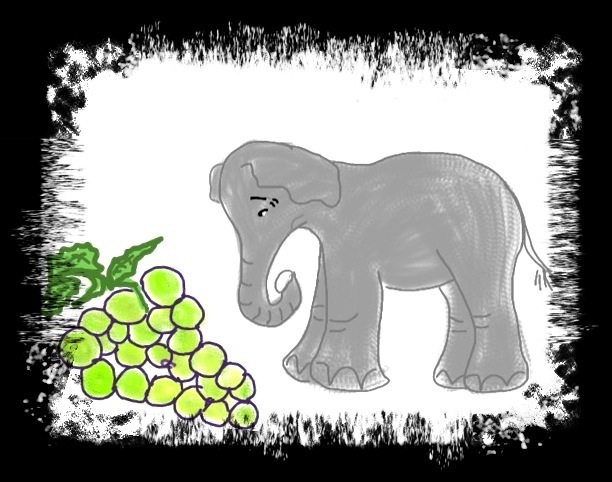
The above was inspired by the dVerse Poets Pub “Poetics” prompt on “logophilia” hosted today by Anna Montgomery and Claudia Schoenfeld.  Anna, a great wordsmith, challenged us to write something relating to words, perhaps even coming up some new ones.   I do not actually know if schadenschaden is a new word since it is, more or less, German, a language that I do not speak.  The idea is that it’s the inverse of schadenfreude (taking joy in the misfortune of others).  In English, we often talk about “sour grapes,” yet another variation.

Have a great day, check out dVerse and all the great poems based on this prompt.

AND if you get a chance, check out my books!  Children’s counting book 1 Mississippi -for lovers of rivers, light and pachyderms.  Or, if you in the mood for something older, check out Going on Somewhere, poetry, and Nose Dive, perfect for a pool or beachside escape.
“Mind Wave (For Virginia Woolf)”

June 22, 2012

20120622-091313.jpg

Mind Wave (For Virginia Woolf)

One bemoans but understands
the stones,

thinking of a mind that, like
a wave, washed crevices, even
those not known
to be inlets, seeping between grains
of sand, nuances
of dust; a fractal mind that
traced a perimeter so much bigger than
its area (a coastline infinite, if intricately
measured, no
matter the isle’s square miles)–

A beam-from-a-lighthouse mind that
in its illumination of
what was writ got all
the way to “q”–a quadratic of empathy–a mind
that could put itself in the shoes of
any person, beast, street, room–its floorboards
creaking–shaping the handle of a pen knife, the tug
upon a mustache or
heart, a woman’s carried bag, time, space and, finally,
ash, the blitz
of two generations.

One thinks
of the fatigue of
impersonation, the burden of voices
heard, articulated, not
drowned out–

A mind that got to “q” but not perhaps
to “r” as in relief or respite, that, sleepless, heedless, seething
as a wave, sought weights against such
weight–

one hates the stones–

****************************************

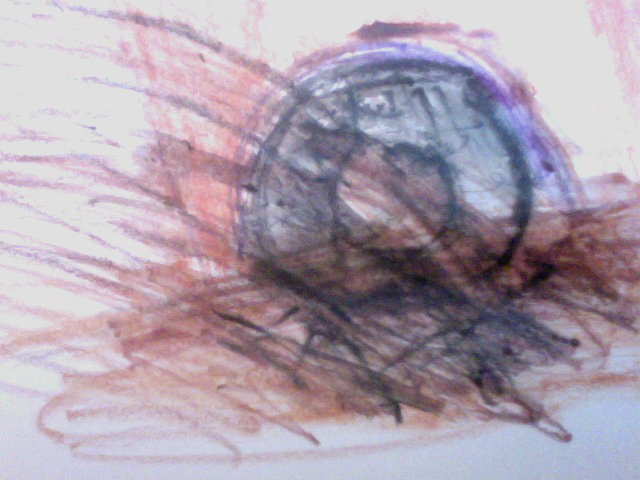
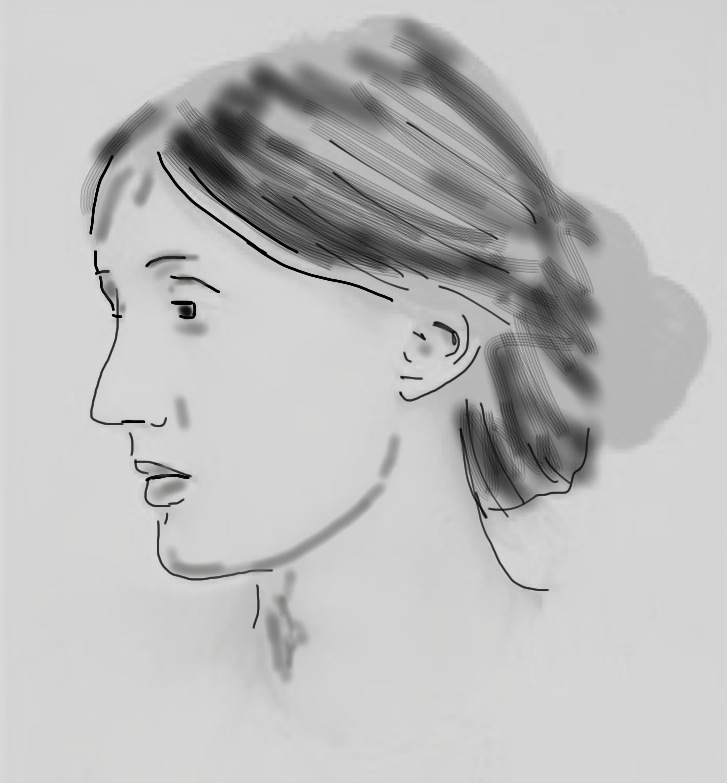
I wrote the above poem (and made the drawing) for a prompt made by Fireblossom to write about a famous person for the poetry blog Imaginary Gardens with Real Toads.  Virginia Woolf, great lyrical writer of the twentieth century, and certainly one of my favorites, died by drowning herself, after filling her pockets with stones.

“Butler” (Poem about “Place/Setting”)

June 21, 2012

Place Setting (Napkin, Knife, Butler)

His hands a monument in themselves,
the fingers Trafalgar columns, tensile
dolmens, though not monumenting beauty
so much as making it. There was nothing
not worth doing, if done well.
A deep well was the
laundry sink, one whose whitewash
rusted blood-blue about the drain, though
he used shallower basins for
the napkins, a glisten
of salt, and, too, a secret substance (champagne) for
the stubborner stains, a fluid he also applied to
shoes aside the polishes, – cordovan, ebony,
jet– words rolling
off the tongue like pitches surmounted–those napkins,
once de-stained, folded,
sculpted, pressed, an origami of named magnificence–such
decadence to sit on a sodding lap–but he didn’t really
care for that part, it was
the spectacle. the gleam
and flow upon
the board–the mitre: linen trained to pray; the
mortarboard:
napkin squared
upon napkin frame; the lotus, petals starched; fashioned
one by one upon
an ironing board anvil, felted white
above chintz cover, a flowery green/peach that might have graced
the wallpaper of a boarding house hyphenated on sea; his silver
knife blades mirrored
your nose sniffing the acrid de-tarnisher that blackened flesh and possibly
someone else’s soul–not, seemingly, his–the ink of the Magna Carta still
fluid in his veins, and beating
Hitler.  What he craved was
excellence and, yes,
its particular acknowledgement,
(which his linen marvels drew)
raised in a London orphanage,
where kerchiefs looped necks, and
corners tucked, and praise, perhaps, was
doled out, if at all, like biscuits at tea, sparingly. The evening pumps
he shone upon the enameled washing machine
and proudly showed off (as worn
by hand)–the crafting
of beauty always something
of which to be proud–glinted
like Andromeda in opera’s
velvet night;  the water glasses
sparkled too, every single bit
as much as the wine.

***************************************

The above draft poem  (revised this AM again) was written for the wonderful prompt by Victoria C. Slotto for dVerse Poets Pub to write about “place/setting.”   (Yes, I know; I’m not sure this is what Victoria meant.)  It is based upon Leslie Lowndes, who made a living as a chauffeur/butler, was originally a Cockney from London, and also one of the most wonderfully kind and talented persons I’ve ever known.

The picture is of a light sculpture by Jason Martin, which, when lit up (in a not very good photo)  looks something like this:

Two Step (Completely Revised, Renewed, Sorry)

June 20, 2012
Revised Two Step

For those interested in a writer’s process:  writers (at least writers like me) sometimes overwork things and completely mess them up – especially at 2 in the morning.    So below is a poem previously posted in a much different version.  I’ve gone back to something more like the original; it’s a Father’s Day poem which is probably why it was difficult. 

Two Step

You could never really manage more than a two-step and even that stumbled to its own chuckled beat, your movements accented with a panache of abashment.

And I would watch from the sidelines, sometimes with my own more snarky embarrassment, being young and indentured to the Gods of Cool.

But the truth is I didn’t snipe much, knowing even as a teen that I could never embody such goodness, my edges just too sharp, like my mother’s nose, my own elbows.

The only time I even came close was later, when you could no longer walk, barely stand, and I brought you those old songs (Glenn Miller, your remembered sound of hope in hard times, having made it across the Channel ’44), and your feet, though unable to truly press the floor, would shuffle in that same old just-off beat, arms lifted.

And whether or not heaven is an actual place–I hate to say that I have my doubts== at least I’m not sure about one with dance floors–I feel your pulse in my head today, Father’s Day, the air around me as tuneful as those hollowed instruments = and am mindful of the resurrection of love, that incredible two step of gift and receipt only in your case it was giving mainly –that’s what you did, and perhaps why your movements always seemed a bit unbalanced, dancing.

*****************************************************
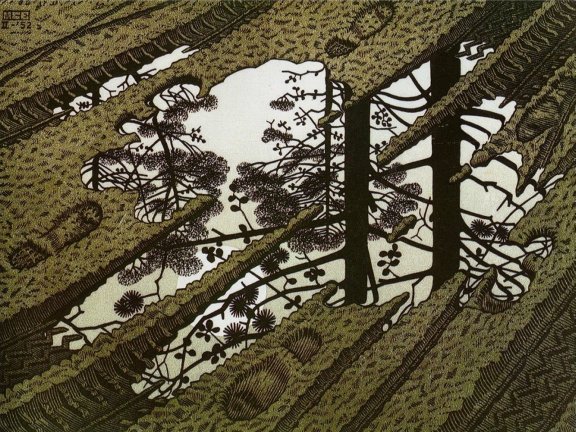
(I am reposting this for dVerse Poets Pub Open Link Night and  Tess Kincaid’s MagPie Tales.  The picture is Tess’s prompt by M.C. Escher.  I am also linking to Emily Wierenga’s Imperfect Prose .)

Two Step (Go to Next Revised Post)

June 20, 2012

At Joyce’s Tower, Dublin; Happening Onto a Robust Woman – Celtic Quatrain

June 17, 2012
20120617-082956.jpg

Supposed to be Irish Soda Breads

At Joyce’s Tower, Dublin; Happening Onto a Robust Woman
Who’d Just Bathed In the Sea

Irish soda bread for real
lined shelves at shops’ rush hour;
clothes, that she had shed or peeled,
buffed feet, Martello Tower.

Pink her cheeks as plum blossom;
dimpled her skin about the midst.
Ah….  Ah… (her fulsome bosom)–
to call it else would be remiss.

‘Twas–did I forget to say?
Winter–even sun was damp,
gave us not a lot of day.
She, she shone, her own dugs lamps–

Whiteness shimmering shimmied
by a hand towel that she rubbed
staunch (like that ringing hymn we’d
sung when “Onward” sounded scrubbed

and squeaky clean), her panties
stretching wide like grin-full face,
hair wet in sea-curled shanties,
thick bare legs a true soul place

beyond Joyce, at least, for me,
that day, that year, that winter,
when what had been a history
of whole slipped into splinter.

How I got there? Roundabout.
From up to down, high to low.
Though by that sea, brown as stout,
somehow footing firmed below.

Failure, that had tolled my doom,
seemed instead part of life’s flow,
which would make a bold try room,
allow hope oar along strife’s row.

At my side, a waxen pouch,
fingered crumbs that shed or peeled–
caraway, raisins (yes, and such)–
Irish soda bread for real.

**********************************

The above is supposed to be a poem drafted in Celtic Quatrains in response to a challenge from Kerry at Imaginary Garden With Real Toads.  I don’t think it’s so successful, but it was great fun to try.   Thanks also to Hedgewitch (Joy Ann Jones) who wrote a great one and encouraged me to try.

At any rate, this form, the Celtic Quatrain, is supposed to have interlocking rhymes – with triple rhymes  (i.e. three syllables) in the first and third lines; and double rhymes in the second and fourth.  Also, there are supposed to be seven syllables a line.  I tried to stay true to the rhyme scheme (more or less( but found the syllabic limit very difficult and I’m not sure that enjambment is allowed!  At any rate, try one yourself!   To learn more, check out Kerry’s informative post.

“Banishing Act” – The “X-Aisle”

June 16, 2012

Banishing Act

Refusing
to grant her even a corner of his gaze,
he sent her into the X-aisle, not
the realm of the somewhat magical, but the dim
dead-end of the inferior–all those Brands X that
always fail, that
will forever be passed over.

The only way that she could tell
that she too was still in the room
(and not stocked in that
far corridor) was the slight swell of the carotid
at his throat, and, periodically, a shadow grasping
the skin that sheathed
his temple.

She tried to use
that stretch of artery as
a lifeline; that glisten at his brow
as a compass to replace
eyes’ mirroring; but even
the autonomic
seemed to turn its back on her, not easy
for someone raised
to please.

When he relented, admitting her again
into his realm, she found that she could not
readily reclaim her spot, but
rather like the wife of Lot (not able to not
look back) would dissolve periodically into salt
and distance, re-collection
a double-edged sword.

****************************************
The above is my offering for the Poetics Challenge on Exile (and other things, some of which have to do with James Joyce and Bloomsday) at dVerse Poets Pub.  I am hosting!  Check it out!

Also, if you have time, please please please check out my books: Children’s counting book 1 Mississippi -for lovers of rivers, light and pachyderms.  Or, if you in the mood for something older, check out Going on Somewhere, poetry, and Nose Dive, escapist but very fun fluff.

“Writing Exercises” – Triversen?

June 14, 2012

Writing Exercises

The wheel cannot willfully–
not new as still-nude dawn–
be invented every day.

Still we work our brains,
poetry our chin-up bar,
re-wrought words our reps.

Expecting (regularly) Inspiration–
she, gartered, glad-handing,
as we, gripping pens, grapple.

Whips away, stockings running;
our words whistle after,
wheezing poetic (at least in part).

We moon till next dawn dawns,
but this time wisps of sibilance
blinker pink and blue.

Thumping rhythmically below,
a flat–tired, but still rolling–
yet another poem.

 *****************************************************
What do you write about when you have nothing to write about?  Writing!
A triversen is a form I’ve never heard of that was apparently developed by William Carlos Williams.  The above is my attempt (ha!), inspired by the challenge (very well-explained) by Gay Reiser Cannon at dVerse Poets Pub for as  part of its “Form for All” series.  If you are interested in the form, check out Gay’s wonderful article.

“Untucked”

June 12, 2012

20120612-102721.jpg

Untucked

When he’s away (increasingly,
these days), she
sleeps at the foot
of the bed.  It’s for the light, she
tells him, or rather
the turning off  of the light,
the lone lamp that sits on a
dwarfed file cabinet at the bed’s
bottom, not the best configuration, but rooms
are not always perfect for the
furniture people bring to them.

It was hard at first
to find a spot down there; hard to tug the top
sheet from its tuck, and even once uprooted,
to squeeze into its tight pocket, her limbs
a swaddled ricochet of angled waist, hips,
knees, aimed to keep her feet from
the opposite dangle.

I miss you too, he replies,
but he, someone who sleeps when tired, eats
when hungry, does not quite understand her fidget
around burning vacancy, the twist and turn of one
so defended she
can only meet need through
a maze, or over
a parapet.

It’s for the light, she tells him, the turning off
of the light, trying to describe the purgatory of
the doggedly dwindling, but
the truth, of course, is
more complex.

**********************************
Here’s an older poem posted for dVerse Poets Pub Open Link Night, hosted by the wonderful Hedgewitch a/k/a Joy Ann Jones.  I am also linking this post to Imperfect Prose, hosted by Emily Wierenga.

“Missives Accomplished”

June 10, 2012

Missives Accomplished

There is an entwining twirl
in the script of certain centuries, a circlet
of the deliberate that, like the spiked
trim of armor, serves
a purpose beyond the
decorative.

The crossed “S” of Sworn, the ribboned
“B” of Beloved, the Ionic pillar that
leads into Forthwith–an unwinding calligraphy that, like
a curl lodged in
a locket, binds us
no matter how difficult the general flow
of characters,

tethering us to the half-moon brow
soon to be lost in childbirth, the shifting smoke of
gunpowder, the blue-black breast of
a recorded slave, a quill
that once took flight;

even the parchment, like the globe itself,
(or time), refusing to stay flat
and simple,
the swirling letters dark
wicks upon its lanterned waves.

***************************************************

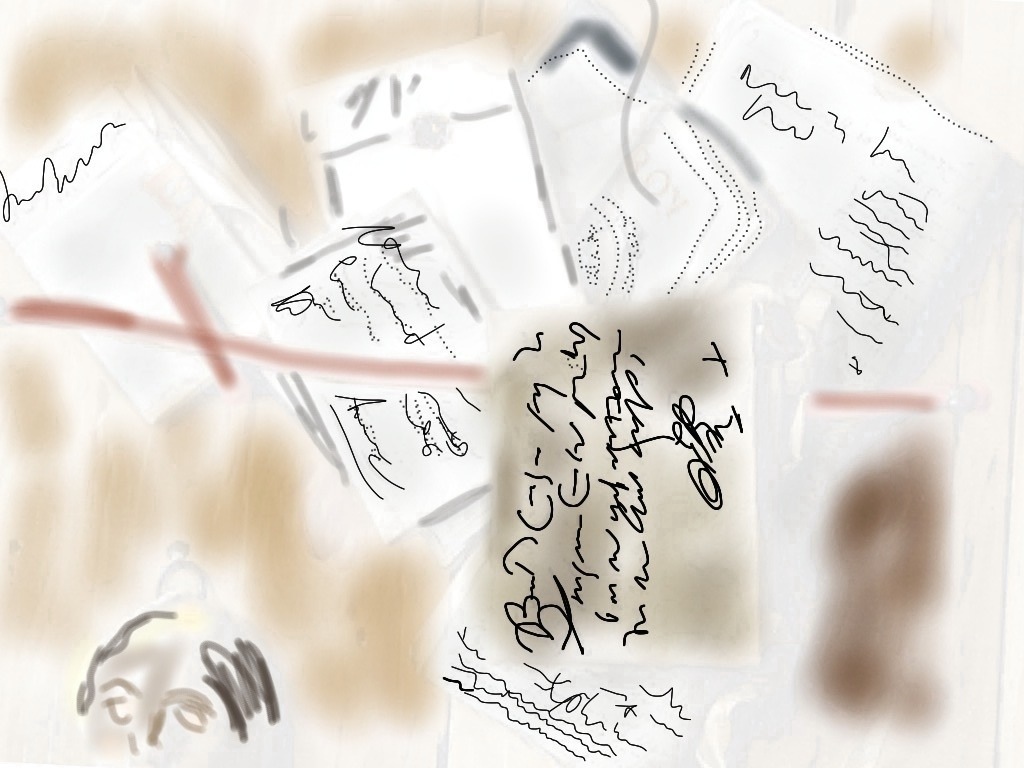
Agh!  The above is my draft poetic offering for Tess Kincaid’s the Mag.  Tess posts a picture prompt, and the picture is my version of the this week’s, a painting, Still Life, 1670, detail by Jean François de Le Motte.                                 .