Archive for the ‘poetry’ category

As I Went Moonwalking With Einstein (And Auden and Bunnies)

May 26, 2011

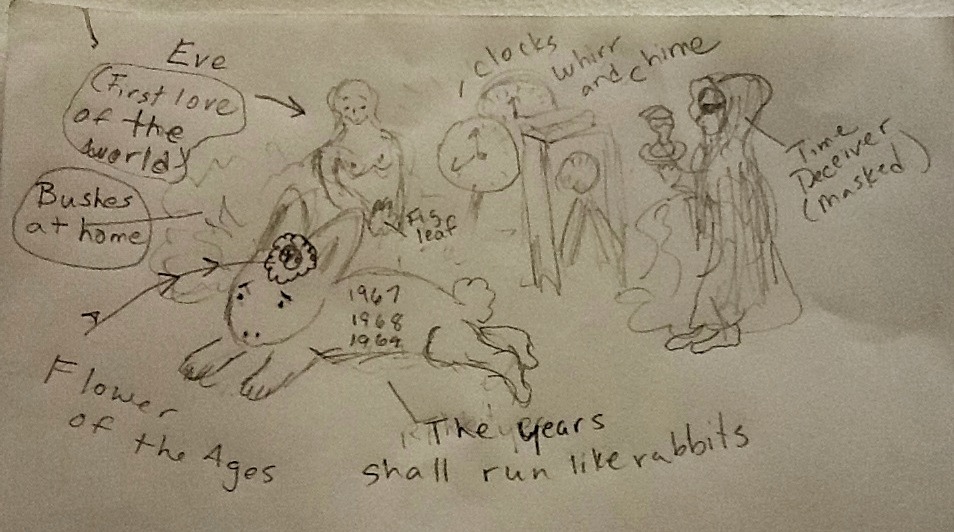
20110526-045340.jpg

Continuing this morning with the fascinating (if exhausting) exercise of memorizing poetry, using age-old memory techniques outlined by Joshua Foer in his new book, MOONWALKING WITh EINSTEIN. The preliminary results have been quite amazing to me. (Granted, I’ve chosen poems with which I am extremely familiar (and tried to learn before.) Even so, since yesterday I’ve gotten down Andrew Marvell’s “To his Coy Mistress”, T.S. Eliot’s “The Love Song of J. Alfred Prufrock”, and W.H. Auden’s “As I Walked Out One Evening”. (The Auden and the Eliot are long!)

Foer’s classic mnemonic techniques–creating some kind of memory palace or locus, and populating it with visual images or cues to remind you of lines and segues–is tiring, for me at least. I have to really think hard as I try to learn the lines rather than just repeat them On the other hand, once that extra mental activity is expended, the work of memorizing is incredibly shortened.

And it is quite interesting to watch one’s head strain to come up with mnemonics. I could only learn the Auden this morning by hopscotching up the front walkway of my childhood home (jumping over China and Africa shaking hands as they were doused by rivers and salmon, noticing rabbits bedecked with flowers and numbers around the bushes by my childhood front door, a naked judge curled up in my old front closet (under the coats and next to a ghastly Father Time). As the poem continued, my mother lay, arm over head, on our deep green couch, which quickly cratered into a valley filled with some powder that looked suspiciously like cocaine. I ended up with toy cars in our old moveable dishwasher, looking out the window at the man who had once been our red-faced and very bow-legged neighbor, adjusting the sprinkler by his hedge.

Here’s the real poem:

As I Walked Out One Evening
by W. H. Auden

As I walked out one evening,
Walking down Bristol Street,
The crowds upon the pavement
Were fields of harvest wheat.

And down by the brimming river
I heard a lover sing
Under an arch of the railway:
‘Love has no ending.

‘I’ll love you, dear, I’ll love you
Till China and Africa meet,
And the river jumps over the mountain
And the salmon sing in the street,

‘I’ll love you till the ocean
Is folded and hung up to dry
And the seven stars go squawking
Like geese about the sky.

‘The years shall run like rabbits,
For in my arms I hold
The Flower of the Ages,
And the first love of the world.’

But all the clocks in the city
Began to whirr and chime:
‘O let not Time deceive you,
You cannot conquer Time.

‘In the burrows of the Nightmare
Where Justice naked is,
Time watches from the shadow
And coughs when you would kiss.

‘In headaches and in worry
Vaguely life leaks away,
And Time will have his fancy
To-morrow or to-day.

‘Into many a green valley
Drifts the appalling snow;
Time breaks the threaded dances
And the diver’s brilliant bow.

‘O plunge your hands in water,
Plunge them in up to the wrist;
Stare, stare in the basin
And wonder what you’ve missed.

‘The glacier knocks in the cupboard,
The desert sighs in the bed,
And the crack in the tea-cup opens
A lane to the land of the dead.

‘Where the beggars raffle the banknotes
And the Giant is enchanting to Jack,
And the Lily-white Boy is a Roarer,
And Jill goes down on her back.

‘O look, look in the mirror,
O look in your distress:
Life remains a blessing
Although you cannot bless.

‘O stand, stand at the window
As the tears scald and start;
You shall love your crooked neighbour
With your crooked heart.’

It was late, late in the evening,
The lovers they were gone;
The clocks had ceased their chiming,
And the deep river ran on.

Drawing On Memory (“Moonwalking With Einstein” On the Way “To His Coy Mistress”) )

May 25, 2011

20110525-102001.jpg

I just finished this morning Moonwalking with Einstein by Joshua Foer. This wonderful book details Foer’s journey from journalist covering a U.S. memory championship competition to competitor and actual winner of the same U.S. memory championship one year later.

Foer, both “mental athelete” and terrific writer, not only describes his training for the memory championship and the crazed and blinkered world of competitive mnemonists, but also explores the historical place of memory as archiving and creative tool, and also (to the extent known) its scientific place in our personalities and brains.

This post is not intended as a review, but to mention that the book has set me off on a project of memorizing poetry.

Unfortunately, memorizing poetry is slightly less amenable to the memory tricks detailed by Foer. This, it seems to me, is because a lot of these tricks involve the use of a “memory palace” or locus, and odd visual cues and puns placed about this memory palace. These tricks are frankly not that easy for a newcomer (who is also becoming an oldtimer), but they can be especially difficult to use for poems because the memorable visual cues sometimes run directly counter to the sense of the poem.

The tricks do work though, and are especially useful for lines or segues that are hard to keep in mind.

I started this morning with two poems I already know well – To his Coy Mistress by Andrew Marvell, and The Love Song of J. Alfred Profrock by T.S. Eliot. The tricks worked much better with the Marvell, maybe because coming up with images for things like “vegetable love” and (as seen above) “youthful Hue” seemed much less irreverant than mucking about with Eliot.

The picture above includes some of the images I used to keep the last stanza of the poem in mind. My memory place was my backyard, my youthful Hugh a guy I once knew (who sat in a pear tree in my yard ), the torn “Lucky Strikes” were my visual attempt to keep torn”rough strife” in mind. Treasure substituted for pleasure. (Yes, I know it sounds crazy–but it worked!)

To His Coy Mistress
by Andrew Marvell
Had we but world enough, and time,
This coyness, Lady, were no crime.
We would sit down and think which way
To walk and pass our long love's day.
Thou by the Indian Ganges' side
Shouldst rubies find: I by the tide
Of Humber would complain. I would
Love you ten years before the Flood,
And you should, if you please, refuse
Till the conversion of the Jews.
My vegetable love should grow
Vaster than empires, and more slow;
An hundred years should go to praise
Thine eyes and on thy forehead gaze;
Two hundred to adore each breast;
But thirty thousand to the rest;
An age at least to every part,
And the last age should show your heart;
For, Lady, you deserve this state,
Nor would I love at lower rate.

   But at my back I always hear
Time's wingèd chariot hurrying near;
And yonder all before us lie
Deserts of vast eternity.
Thy beauty shall no more be found,
Nor, in thy marble vault, shall sound
My echoing song: then worms shall try
That long preserved virginity,
And your quaint honour turn to dust,
And into ashes all my lust:
The grave's a fine and private place,
But none, I think, do there embrace.

   Now therefore, while the youthful hue
Sits on thy skin like morning dew,
And while thy willing soul transpires
At every pore with instant fires,
Now let us sport us while we may,
And now, like amorous birds of prey,
Rather at once our time devour
Than languish in his slow-chapt power.
Let us roll all our strength and all
Our sweetness up into one ball,
And tear our pleasures with rough strife
Thorough the iron gates of life:
Thus, though we cannot make our sun
Stand still, yet we will make him run.

Leaves, Buenos Aires, Draft Poem

May 12, 2011

20110512-093642.jpg

I am in Buenos Aires, a beautiful and extremely leafy city. I may be particularly conscious of the leaves because it is Fall here, a time in which one is always very conscious of leaves. Fall, and Buenos Aires, also have a wistful quality, which, as a kind of wistful, Eeyorish, person, I am quick to glom onto. Here’s the draft poem of the morning:

My world without you – Leaves

My world without you
is like a tree fallen in a forest;
without you there to hear it,
like a tree that may have fallen
in a forest somewhere, without you
next to me, a tree possibly falling somewhere,
out of my range too; nothing,
in short, feels real
without the warmth of your hand
at my back.
So when we talk of leaving, let it be of leaves (mine)
pressed up to leaves (yours); let it
be of leaves only, grown, blown, each to each,
their veins nearly in line, their
outlines coupling, leaves of a tree
not fallen, swaying gently, mightily.

All rights reserved, as always. Suggestions welcomed.

20110512-094353.jpg

National Poetry Month – Day 28 – “Relic”

April 28, 2011

20110428-111658.jpg

Relic

Poets write of rust, decay, time wearing out or thin,
but time’s spin makes for a preciousness too, imparts
like dew, an aura, as seen around
Ty Cobb’s dentures, still firm, at The Baseball Hall
of Fame, George Washington’s at Mt. Vernon.
Even the belongings of the obscure
acquire the gild of treasure–the small green
rubber boots bought as a joke for my dog
found fifty years later in my mother’s garage.
And then there are objects that become relics
even before time’s passage.  I think of
the chocolate Easter egg, kept in the freezer, that my grandmother took a nibble
from every night before her fall; she’d gotten less than
half-way through; my mother saved the remainder, still foil-wrapped
in blue, for years afterwards, the surface of the
chocolate whitening like the cataract over an eye, making it
harder and harder to see what was once so clearly
in front of you.

All rights reserved.  Suggestions welcome.

National Poetry Month – Day 27 – “A Passionate Long-Distance Caller To Her Love” – and GOING ON SOMEWHERE reviewed!

April 27, 2011

I was having a hard time coming up with a draft poem tonight when suddenly the opening of Christopher Marlowe’s wonderful poem “The Passionate Shepherd to His Love” came to mind. (“Come live with me and be my love.”)

A variation on the theme:

A Passionate Long-Distance Caller To Her Love

Come live with me, my sweet, my dear,
and we shall never echoes hear
of anxious longing, fearful cries,
of ‘why me?‘ woes or angry lies–
our ears won’t burn with cellphone’s ray,
our brains won’t change their matters gray
to tumors fed by conversations
that only serve to try our patience.
Oh please come here; stay right by me
so I can see you when I see
the sky, the window, the chair, the bed.
the pillow there beside my head,
for you are all of these and more,
my sun, my moon, my ceiling, floor,
the one I talk to, the one
for whom I’d be still–sweet Hon,
I know my silence is not much known–
it just won’t transmit on the phone–
but come here soon and stay forever
and we’ll lay quietly together.

All rights reserved. Suggestions welcomed, particularly as to last line–yes, I know “lay together” is not quite right, and should the quietly come earlier in the line?  (Agh!)

On another poetical matter, my recently published book of poetry, Going on Somewhere, was very carefully and thoughtfully reviewed by fellow WordPress blogger Ashley Wiederhold on her blog Trees and Ink.  Please check out Ashley’s review of my book (and other books) as well as checking out the book itself on Amazon and Barnes & Noble.

National Poetry Month – Day 26 – Posting To The Other Side ( A Dog Poem)

April 26, 2011

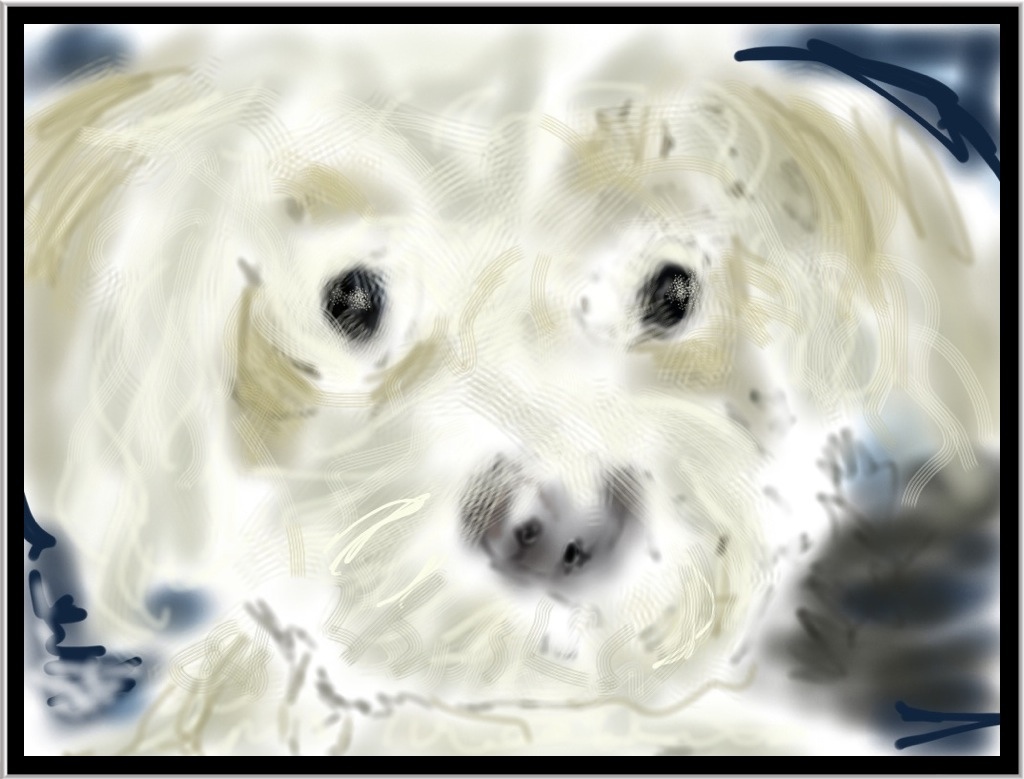
Very pleased with my iPad 2 drawing above!  This one is of my dog Pearl, an old dog but very much extant.  Draft poem of the day below.

Posting To The Other Side

You talk to me of waterfalls.
I think not so much of spray–well, yes, I think of
spray, splash, droplets, glasses bespeckled–
but what I think of most
is this side and that,
the icy flow of everchanging wall, the stillness
behind that wall, and how,
as a child, when my dog died
my first beloved dog, that is, the first
dog who felt truly younger than me, needful of my protection,
I tried, like Demeter, to reach beyond such a wall, to
communicate, as it were, with the other side–no easy task with a canine–
and how, since I was already being mystical, I wrote the dog a letter,
and since I was desperate in my grief, I posted that letter
in one of my Junior Britannicas, a cherry red series of volumes,
under the letter D, praying that the Dog (Deceased)
would find it, and how, for many months afterwards,
I was afraid to open that volume, to retrieve that carefully
folded piece of lined notepaper,
in case it was still there.

All rights reserved.  Suggestions welcomed.  (One question – “retrieved”.  I like it because of the dogginess–but may be “seek” or “look for” would be better?)

National Poetry Month – Too Tired To Write A Poem Poem – or How I arose to the occasion of Day 25

April 25, 2011
I felt pretty sure today that I could not go on with my self-imposed commitment to post a draft poem every day of this April, national poetry month.  (Yes, I know, I’ve already missed some.)
Finally, I followed an old rule:  when lacking in inspiration, try a sonnet!   A poetic form is incredibly useful when you are having trouble writing.  It creates an automatic thread, which, in turn, leads you to some kind of shape and meaning.

Rose

I’m just too tired to write a poem tonight.
The old synapses lie limp and lumpy,
clotted with the vernacular; no sprite
darts from nerve to page, rather a frumpy
dim drags over observation, blotting
out comparison (much less caparison–
the embellishment of the plodding.)

In defense, I say my garrison,
my true home, is found in prose that cares not
how a rose would smell by other name,
but even my dull brain knows what is what,
and that a rose can never smell the same
once read, once heard, once lit by other’s light.
Oh–oh–oh, how I long for that insight.

All rights reserved.   Suggestions welcomed.

National Poetry Month – Day 22- “How to draw an elephant”

April 23, 2011

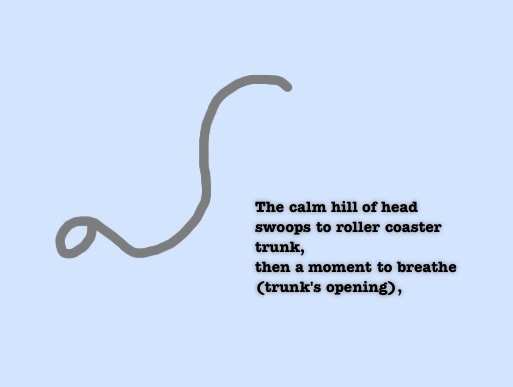
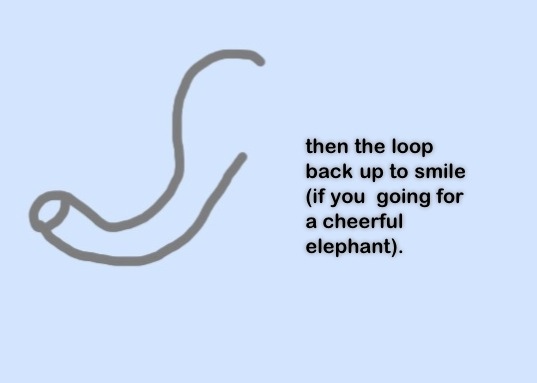
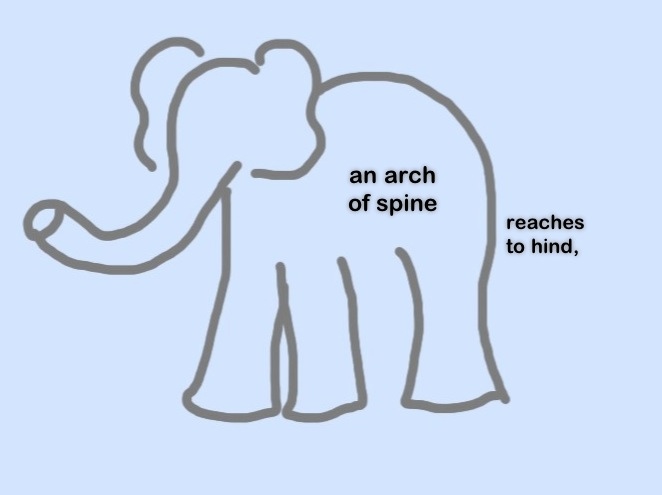
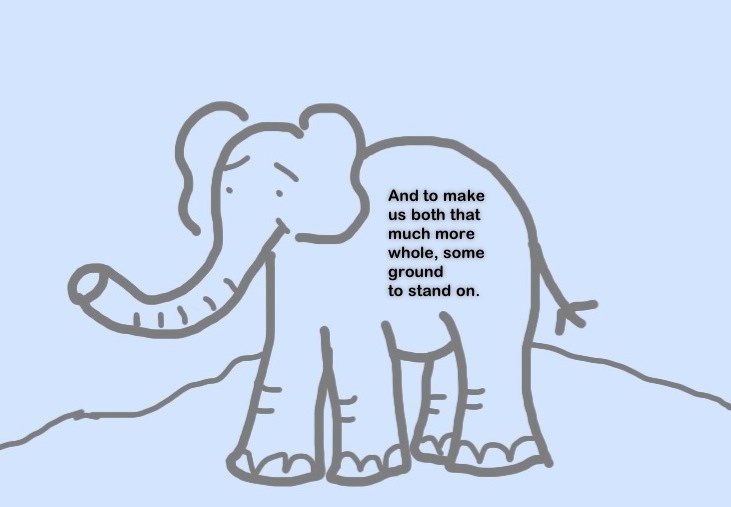
Agh!!!!!  Today was a very busy day in which I also tried to experiment with different ways of typing text into drawings.  I really don’t have the right application for this yet, or don’t know how to use what I have.    Any suggestions are welcome.

20110423-100200.jpg

20110423-105137.jpg
20110423-101834.jpg

20110423-100520.jpg

20110423-100545.jpg

20110423-100622.jpg

20110423-105152.jpg


20110423-101027.jpg


20110423-100743.jpg

National Poetry Month- Day 21- “Sleep-Deprived Ride”

April 21, 2011

20110421-080519.jpg

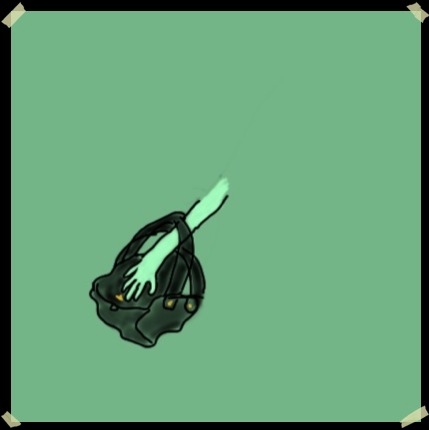
Here’s another poem written in my favorite venue and time – New York City subway car, a.m. just past rush hour. Today, however, I was not in the best mood. Here’s today’s draft poem, again in honor of National Poetry Month.

Sleep-deprived Ride

Three days of 2 AM
makes for a wan
morning commute.
Brain is mute;
colors blur along edges.
When a child screams–SCREAMS–
at the hedge of his
stroller, the brain
twists at its own edge,
or just pushed over,
‘my purse!’ it panics next;
awareness jerks
to the strap
over arm, wrist, lap,
that stolid mass of care that never
stays up past midnight, holds all.
Still there, thank God
(though barely sensed),
still, there.

All rights reserved.  Suggestions welcomed

National Poetry Month – Day 20 – “Some Things For Which There Is No Compensation”

April 20, 2011

20110420-084359.jpg

Here’s a kind of grim poem written in my favorite venue–the New York City subway system.  It’s not about the subway system;  I was actually thinking of Marthe Jocelyn’s book Scribbling Women, and Sei Shonagon of Imperial Japan who wrote The Pillow Book, which includes compendiums of insightful and charming lists.  I’m not sure what I wrote qualifies, but the list idea did help me come up with the draft poem of the day.   (Note that the numbers are part of the poem.)

Some Things For Which There is No Compensation

  1. Not feeling loved.
  2. Or loved enough.
  3. One’s own cruelty.
  4. Burial.
  5. Cremation.
  6. Flowers in any of those circumstances.
  7. No flowers.
  8. Loss of memory/memories.
  9. Of one’s own.
  10. Or others.
  11. Worse, neglect of them:  (a) memories, (b) others, (c) flowers.
All rights reserved.  Suggestions welcomed.