Archive for the ‘Obama’ category

Anecdotal Connections: Assault Weapons – Push-up Bras.

June 29, 2010

I’ve heard two interesting stories about stores lately.  One, from my husband about a sports shop in upstate New York.  To give context to the story, my husband is a hunter, has been a hunter from the time he was a boy, was at one point (presumably before dues were required) a member of the NRA.

His memory of upstate sports stores from his youth, and even from ten or fifteen years ago (okay, dear—from his continuing youth), was of showcases filled with hunting rifles.  There might be a few pistols, but even those were, primarily, implements for hunting game–something someone might take on a camping trip.

On a recent visit to a sport store, however, in a very small, seemingly peaceful town, in the Catskill Mountains (prime hunting territory), my husband noted that about half of the store’s showcase was now given over to assault weapons.  These, he said, are not the types of guns one would use hunting animals==that is, non-human animals.  They are weapons modeled on the M-16s carried by soldiers, too heavy, too violent for game.   A couple of times in the store, my husband also heard the name “Nancy” as in “Pelosi” as in “getting one before she takes ’em away.”

The second store story arises from a friend’s recent trip to Victoria’s Secret in search of a bra on sale.  My friend has liked Victoria’s Secret in the past, not so much because of the sexy lacey-ness of its gear (well, maybe a little because of that), but mainly, supposedly, because of its large inventory of sizes and styles, particularly of bras.  On her recent trip, however, she found it impossible to buy:  every single bra was a “push-up” – so wired and padded that it was unclear how a human breast was supposed to fit in.    (It’s supposed to hover, presumably, someplace above the fabric, cushioning, metallic whalebonesque polymers.)

These are second-hand stories from reliable sources (I swear!), but, nonetheless, anecdotal.

Still, I can’t help but wonder about the connection: a seeming rise in assault weapons; a seeming rise in cleavage.

What does it mean?    That U.S. society likes things that are considered, non-aggressive, reserved, even less than usual?

That U.S. society is more than ever obsessed by bombast? Bimbobast?  Blastbast?

It worries me. (I’m sorry, I can’t help it–even the Victoria’s Secret stuff worries me–I’m a child of the Sixties.)

Whatever it means does not seem to bode well for Obama’s mid-term election results.

PS–the drawing above is not meant to imply that women in bras were buying the assault weapons.  I just wanted to put them both…errr.. all… in a single drawing.
From the Back Seat of A Broken-Down Impala: Long View of Bobby Jindal, GMO Salmon, Murphy’s Law

June 27, 2010

Back Seat of Chevy Impala

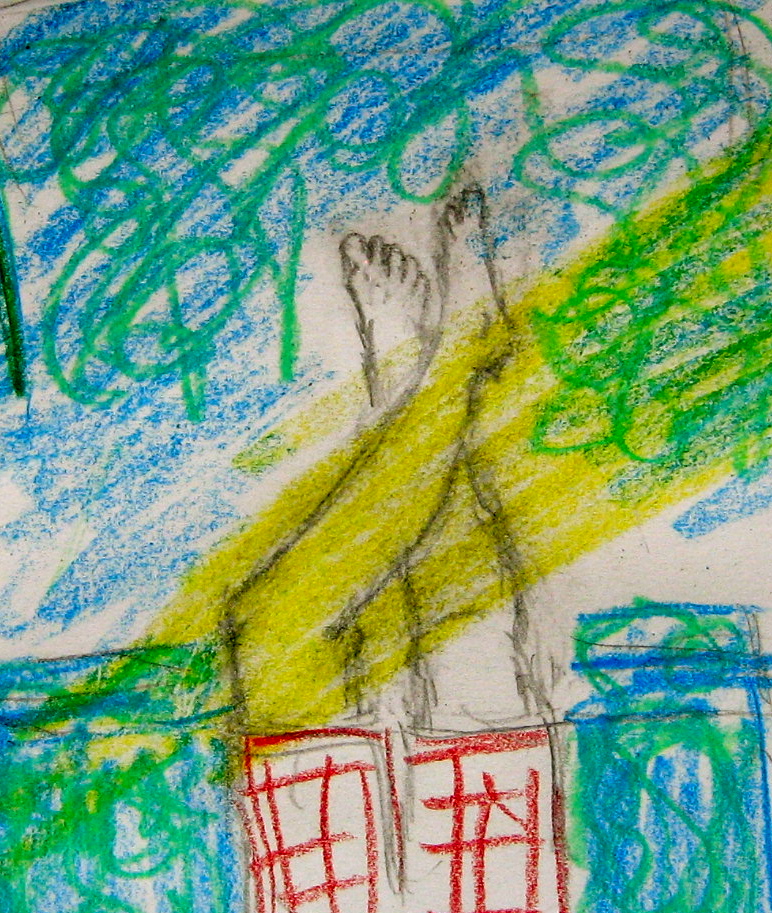
When I was a child, my parents bought a new white Chevy Impala with a sea green brocaded interior—by brocaded, I mean, covered with a roughly embossed pattern meant to repel or disguise the spills, crumbs, and other tidbits that attach like limpets to the insides of family vehicles.

The morning after the purchase, we set out on our annual summer trek from home in suburban Maryland to grandmothers in Iowa/Minnesota, a two-day drive.  Later, that same day, we sat by the side of the hot whizzing Ohio interstate someplace near Elyria, waiting for a tow truck.

This was a huge upset to my mom.  First, we were only in Ohio—Eastern Ohio!—when we needed to make it at least to Indiana to do the journey in the requisite two days.

Second, how much was it going to cost?!!  What if we were stuck?  Would the warranty cover anything?

More importantly, she fumed (in an increasingly accusative and hot-from-sitting-in-a-stalled-car way), the breakdown proved that the car was a lemon–a lemon!–which would need years and years of nonstop repairs and still never be right.

This brought up its own cycle of despair.  Why, she moaned (through a litany of  family machines) did these things always happen to us?

My father (increasingly defensive and hot from bending over a stalled motor) tried to explain to her that things just sometimes don’t work.

I knew my mom was being extreme.  Still, as the sea green seat covers imprinted their pseudo paisleys on the backs of my sweating thighs, so my mother’s sense of familial despair imprinted itself on my consciousness, enough so that any contemplation of a future major purchase in my own life has been clouded by a sense of doom.

In the last few years, however, I’ve slowly come to realize that my dad was right.  It’s not just my stuff that breaks down; everyone’s stuff breaks down.  The material/man-made world simply doesn’t work on demand.

There are many reasons for this problem–shoddy workmanship, cheap materials, careless delivery practices, “planned obsolescence,” questionable Chinese (but also global) cost-cutting and manufacturing measures, and (my increasingly curmudgeonly brain is certain) modern carelessness.   But even when products are presumably built with care—as in the containment cap of BP or the NASA space shuttle—the unexpected will have its day, Murphy’s Law endlessly waiting to enforce its mandates.

This brings up all kinds of age-old wisdom: don’t put all your eggs in one basket, small is beautiful, look before you leap, but also, today, two new thoughts: (i) Bobby Jindal is idiotic; and (ii) so is the idea of genetically modified salmon.

I bring up Jindal (amazingly still Governor of Louisiana) because of his whining complaints about the federal bureaucracy not jumping aboard his spill-containment plans, which appear to be flawed ab initio.   Jindal’s plans involve massive building projects which (i) will take too long to do any good (even under best case scenarios), and (ii) have serious risks of funneling the flow of oil in a manner that will make environmental damage more rather than less pervasive.   People complain about Obama’s caution; I personally am glad that he has not decided simply to nuke the well.    (To be fair, nuking is not Jindal’s proposal.)

I bring up the salmon because—geez—do you want to eat genetically bloated salmon?  How can fish farmers actually determine, in their short-term studies, that salmon engineered to have non-stop growth hormones will be safe for human consumption?  (Isn’t everyone already complaining about bovine growth hormones?) Also, how can the industry truly keep these salmon from the infecting the general population of salmon, much less, the non-genetically-modified marketplace?

Whenever I think of the possibilities of genetically modified livestock, all I can do is feel lucky that I genuinely like beans.

(As a final note—the white Impala was fixed by the next day; it did not break down more than usual in its lifetime; and for years afterwards, whenever we went by the exit for Elyria, Ohio, my father waxed nostalgic.)

Few Choices Re McChrystal – Not McClellan

June 23, 2010

General George McClellan

For all the talk about Lincoln keeping General George McClellan in his post as head of the Union Army despite his abuses and insubordination (at least until Lincoln finally replaced him with Grant), I don’t think Obama had any choice but to get rid of McChrystal.

It’s probably true that virtually all military top brass disdain their civilian superiors.  It’s probably also true that virtually all military low brass, or below brass, disdain their military superiors.   As the immortal Terry Pratchett writes of Sergeant Colon in Discworld: “-[t]he sane core of Colon was wondering if the purpose of officers wasn’t to stand between the sergeants and all this sh—this slush[i.e. paperwork], so that they could get on with sergeanting.”

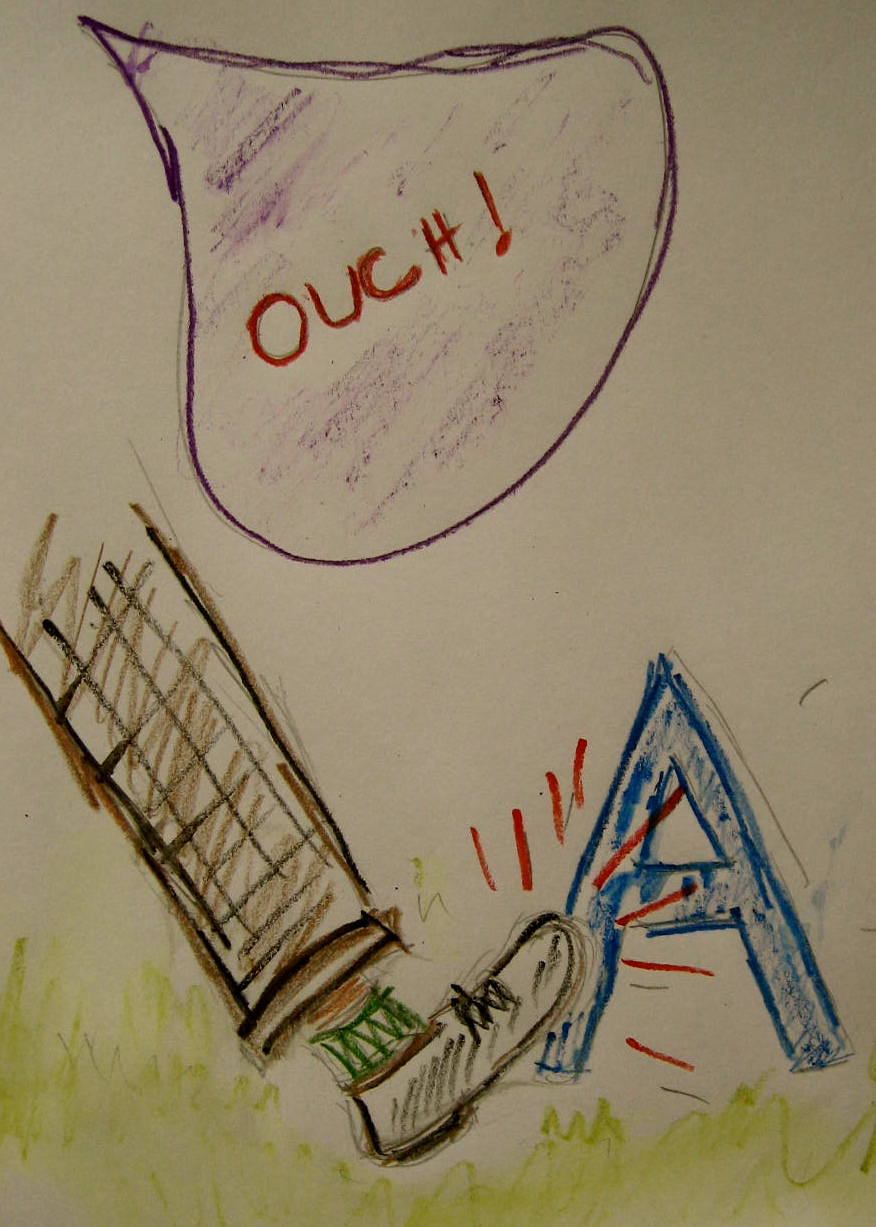
When the shoe steps, floorboards squeak.  But McChrystal was a general who’d expressed his disdain just too many times, too publicly, too acidly.

Frankly , it seems to me that anyone who prides himself—or at least lets people know—that he only sleeps four hours and eats only one meal every day he seems custom-made for “disdain”.  McChrystal, however,  having problems connecting with his soldiers as well as his superiors, is not in a position to afford such disdain.

Even if McChrystal were more successful, his actions seem calculated to make it impossible for O’s team to continue to work with him with any kind of trust and confidence.  His presence would reflect a serious and continuing lapse in Obama’s authority.  (I feel somehow certain that people like Karzai, while pleading for McChrystal, would also not respect Obama for keeping him.)

The timing was especially unfortunate.  How could Obama let McChrystal stay, when, in the face of accusations of ineffectiveness, he has just proclaimed his ability to kick a–.  (He can’t get rid of  the leaking well, but he can damn well get rid of the leaking general.)

The whole situation  is just too bad for all concerned.

Obama’s Speech – The Need to Speak Outside the Box (And Desk)

June 16, 2010

Part of the Problem?

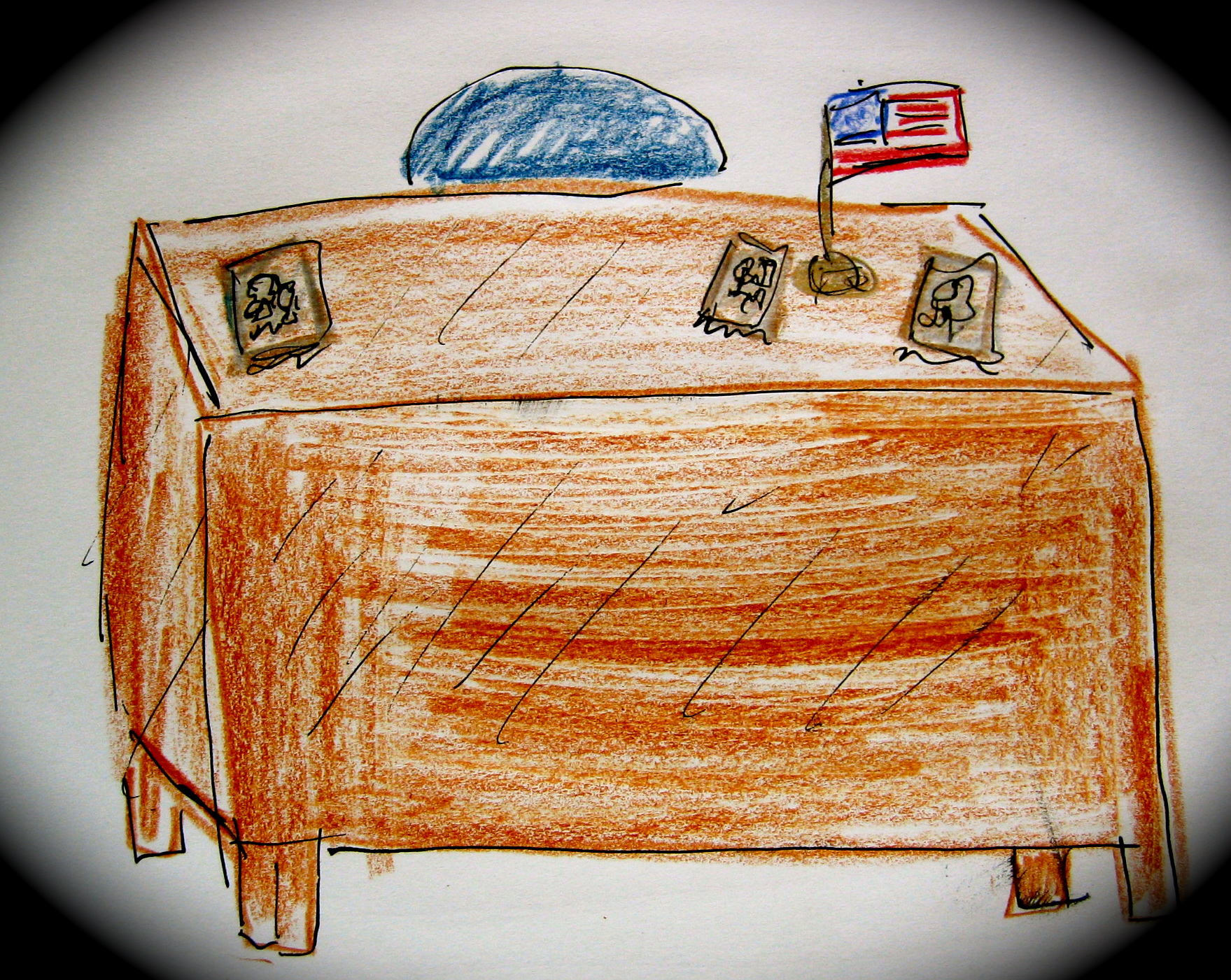
I have to say that I find almost any presidential speech made from the Oval Office desk immediately suspect.

I can remember Nixon looking shifty (even before we were sure he was), his face shining with sweat and the nervousness of sweat; Johnson managing to combine both elephant and basset hound in one sorrowful gaze; Reagan with the actorly aw-shucks confidence of the perfect-haired;  Carter, lips moving less than a ventriloquist’s, irritated arrogance barely hidden by humble bangs.  I can even summon up a few traces of Kennedy, elegance nearly obscuring message.   (Johnson weirdly enough is one of the most compelling memories;  there is something about a massive and slightly rumpled head that counters the irritatingly punctiliousness of the desk’s carefully staked-out surface.)

My dislike does not particularly target the Oval Office desk;  I dislike desks generally.   I am a floor sitter (or bed sitter) by nature.  When I do sit at a desk, I tend to squat or sit cross-legged.  (Thank God for  “modesty panels.”)

Desks are automatically a little disempowering—the person is foreshortened;  their breath doesn’t flow right;  their gestures are crimped.  (How many opera singers do you see singing from desks?)

A desk is particularly bad for Obama whose youthful appearance and natural neatness already give him an overly-studenty aspect.

What’s on the desks bugs me too.  (Enough, I know….)  I can understand wanting photos of one’s wonderful family as talismen for one’s self, but when I see the photos facing out to the audience, I feel, well, manipulated.

Given my feelings about desks, I was a bit put off by Obama’s speech at the start.

I was also put off by the end, the story of the fishermen’s prayer ritual.  Obama may be a genuinely religious person (I think he is), and he may be right that a collective consciousness of suffering, a collective prayer, is worth some promotion (though a little of this goes an awfully long way.)  But an extended discussion of prayer tends to make one feel as if there is no hope for human solutions.

Now for the middle of the speech.   Yes, I know problems need to be studied, but arranging for a commission sounds  like “sending something off to committee”—a way to keep change from happening rather than to make it happen.

So what part of the speech sat well with me, as it were (though not at a desk)?   We simply have to change the way we consume and produce energy in this country, and the ways in which we regulate exploration and production.  Obama has got it absolutely right here, and, hopefully, in the wake of all of the despoliation and waste, in the midst of the desk and prayers, people will sit up and listen.

Dear President O: Sorry, But Talk Of Kicking A– Just Sounds L—

June 8, 2010

With All Due Respect, It Just Hurts You

Dear Mr. President,

I don’t blame you for being p—–.  You were down there in the rain.  You were down there before all these talking heads even knew what was going on.  You were down there even before there was a Web cam.

I don’t blame you for being very very frustrated.  People seem to expect that a President, like a king, can cure scrofula with the touch of a hand.  I’m not sure what scrofula is, but you get the point—they seem to think that you have quasi-magical powers, and that any hesitation in the use of this magic is a sign that you just don’t care.

I absolutely believe that you are hopping mad at BP, just as you are hopping mad at NBC, ABC, CBS, CNN, FOX, CNBC, AP, and practically every single commercial organization out there with a name of three letters or less.  But when your showing pique is actual news, when Brian Williams has to make a televised announcement telling us that your showing anger is what we are about to see (from a clip of an interview with Matt Lauer) then you have just got to accept that the voice of rage does not come readily to you.

Personally, I think that’s fine.   No one ever disparages George Washington for keeping his temper.  Washington himself, in the Rules of Civility & Decent Behavior In Company and Conversation, which he transcribed before the age of 16, set down Rule 45th, “in reproving Shew no Sign of Cholar but do it with all Sweetness and Mildness.” 

I happen to be someone who shows Choler a fair amount.  But, when I’m in a better mood, I generally understand that anger to be a sign of my immaturity—the ManicDDaily part of me.  I get angry because I want the world and people in it to be different than they are.   But the world is what it is; s— happens; people can be jerks; sometimes, my own anger (as warranted as it is!)  just adds to the general jerkiness of it all.   A few curt admonitions definitely have their place;  still, it’s often more useful to focus on concrete steps than to rant at the nature of nature (human, mechanical, or divine.)

The point is that some people angry are cold, clear, analytical.  (Often such people are mainly angry at themselves–for not predicting jerky people, jerky circumstances.)

I don’t know, Mr. President, if your anger takes you into those cold, clear waters  (the kind we’d really like to protect), but I’m pretty sure it’s not the type of anger that rants about “kicking a–.”  The words are dumb words, and they sound especially dumb coming from you.  They don’t flow from your lips correctly; there’s a stutter, a disconnect, that comes across as forced and petulant.

So, let it go.  Be yourself.  Stop worrying about the anger bit; just keep worrying about the doing bit.

Health Care Bill – End of Long Wait

March 21, 2010

My Quick Attempt At Obama Portrait (Sorry, Mr. President.)

I am so happy for President Obama.

I’ve been waiting all day to blog about the passage of the health care bill by the Congress.

I’ve waited through sleeping late since it was Sunday, through drinking tea and eating olive oil crackers since I had to do my Sunday morning yoga practice which I’m supposed to do on an empty stomach (and somehow tea and crackers don’t count), through hanging out with my sweet husband, through haranguing my sweet husband (in my day-before-the-work-week-starts-angst), through finally doing my yoga, and then, feeling guilty (in the peaceful shadow of the yoga) for haranguing my husband, so also through apologizing to him.

I’ve waited through walking the dog (twice), going to the gym (briefly, since I’d already done yoga), through making dinner for an old old friend, through taking another quick walk with her to a taxi stand—

Of course, it’s been a much longer wait than that; it’s a wait that’s lasted this endless year of characterizations and mischaracterizations and crazy characterizations;  of so many characterizations that how you feel about the bill to some extent depends upon whom you already trust.

Let me add a caveat to that last statement.   There are some characterizations thatI simply cannot believe—these are those made by people who act as if extending health care coverage will be the end of the free world, the destruction of America, the breaking of history, the extinguishing of Liberty’s torch, the termination of personal freedom—what are these people talking about?   Is it some weird rif on the “survival of the fittest?”  That, if people with pre-existing conditions receive health care coverage, the human race will slowly deteriorate.  (Although, weirdly, people who espouse this point of view tend not to believe in evolution.)

It’s a wait that’s gone on through campaign after campaign, administration after administration—so many many many stories of those who have suffered because of their inadequate heath care coverage.  (Some of us may even be characters in some of these stories.)

I actually kind of hate it when candidates try to personalize their speeches with these anecdotes—the thirty-seven year-old mother of two who’s lost her job, health care, car, savings, home.  It’s not that I’m not sympathetic; I sometimes just feel tired of the rhythm of these tales, the predictable cadence of both downfall and meager transcendence.  But I think what I have truly gotten tired of is the fact that the endings are always the same;  no fix has even been tried.

Yes, the bill’s not perfect.  (The world’s not perfect.)    But hey, it’s a start.  Maybe people on the other side will notice that the world has not blown up.

Great congratulations to President Obama for supplementing hope with persistence.

Mid-March Resolutions (Easier For Me Than Obama)

March 9, 2010

Snow Drops and Red Wine

This morning I saw snowdrops (honest-to-goodness clumps of little white flowers) blooming behind the iron fence that runs along the esplanade in Battery Park City.  (Flowers in public spaces seem to be kept behind bars in New York City, I guess, to keep them from becoming flowers in private spaces.)   The snowdrops, combined with what was really a glorious morning, made me worry that I was too harsh about the month of March in yesterday’s post.  I called it the cruelest month.

March really isn’t cruel; it’s just, you know, brusque, brutal (think Ides).

It’s all a matter of timing.  Even to the jaded, January feels like a new start; the year is fresh;  change seems genuinely possible.  (Sort of like Obama’s inauguration.)  But, hey, it’s just January.  You’re a little tired from Christmas (the election); you want to be kind to yourself (bipartisan),   and besides, you’re still working on getting the digits on your checks right (i.e. the collapsing banking system).  You feel like you can take a little time for the life changes.

Then February hits.  But, hey, it’s February.   Cold, grey, stormy (the continuing worrisome instability of the economy), and above all, short.  Nobody really expects you to make life changes in February.

And then, suddenly… it’s March.  Not just March, mid-March.  And suddenly, the year doesn’t feel so new any more.  The stores don’t even have half-priced calendars.   (The banks are doing okay, but now everyone worries about budget deficits, or uses them as political cover.)

In March, change feels very hard.   Obligation looms (i.e. taxes) (i.e.  budget deficits) and the scent of Spring in the air seem to bring up the repeating cycle of the season as much as “newness”.   That sense of cycle (another winter over, another year already mid-swing) feels more relentless than reviving.  (Can one have schadenfreude towards a season?  Can politicians let go of their schadenfreude for other politicians?)

For all of you feeling left behind by Spring, and by time itself, I have good news: first, a new and fairly extensive study conducted by researchers at Brigham and Women’s Hospital in Boston shows that women who drink alcohol regularly, particularly red wine, are significantly less likely to gain weight and become obese than non-drinkers. Secondly, spending on cosmetic plastic surgery, such as breast augmentation, tummy tucks, and liposuction, dropped significantly last year.

One would like to think that the drop in spending on such cosmetic procedures was a result of people coming to their senses—hard economic times making them realize what was important in life—but the drop may simply mean that hard economic times gave people less money to spend.  This later view is unfortunately born out by the fact that spending on less expensive treatments, such as Botox injections, actually rose in 2009.

Nonetheless, nonetheless, both studies offer hope, at least to me.  At last, there are some health resolutions and fashions I should be able to adopt in the coming year (even beginning as late as mid-March)—(i) drinking more red wine, and (ii) not getting expensive cosmetic surgery.     Definitely doable.

I wish it were as easy for the President.

The Line Between Satire and Sneer–UFO’s and Palin, Tea Partyers and Obama

February 16, 2010

Tea Pot and UFOs

I freely confess that I’m not a Family Guy kind of gal.  I just don’t care for crass.

Even my beloved Robert Pattinson has really turned me off lately with his gross and negative remarks concerning female private parts.   (Better watch out for your constituency, Rob.  You haven’t exactly shown yourself to be Laurence Olivier, after all.)

Because of my dislike of crudity, I haven’t watched the Family Guy clip of the Down’s Syndrome character whose mother is the Governor of Alaska.  I  just wish it hadn’t been aired.   Mainly because I personally think it is wrong and offensive to make jokes at the expense of little children with disabilities.

Secondly (and I’m sorry if I’m being crass here myself), it feeds Palin’s mantle of media martyrdom, consequently diminishing the impact of jokes and criticism justifiably aimed at instances of her hypocrisy and untruth  (that is, meaningful satire.)

How to distinguish between mindless stupid crass jokes and meaningful satire?  I feel a little bit like Stephen Colbert here, who recently tried to use Palin’s calculus for acceptable uses of the word “retard”, distinguishing between what Palin called Rush Limbaugh’s acceptable use of the word as “satire”, and Rahm Emanuel’s unacceptable use (to characterize certain Democrats) .

(Yes, even as I write that, I’m conscious that I’m jumping onto the whole “making fun of Sarah Palin” boat.)

But here’s one of the problems with jumping on to that boat.  There are a lot of frustrated, fearful, angry people in this country who feel that Palin speaks to and for them.

Some of these people, the Tea Partyers, are relatively easy to mock.  They tend not to be “hip”;   they sometimes seem ignorant; some of their views (seccession!) seem pretty outlandish.

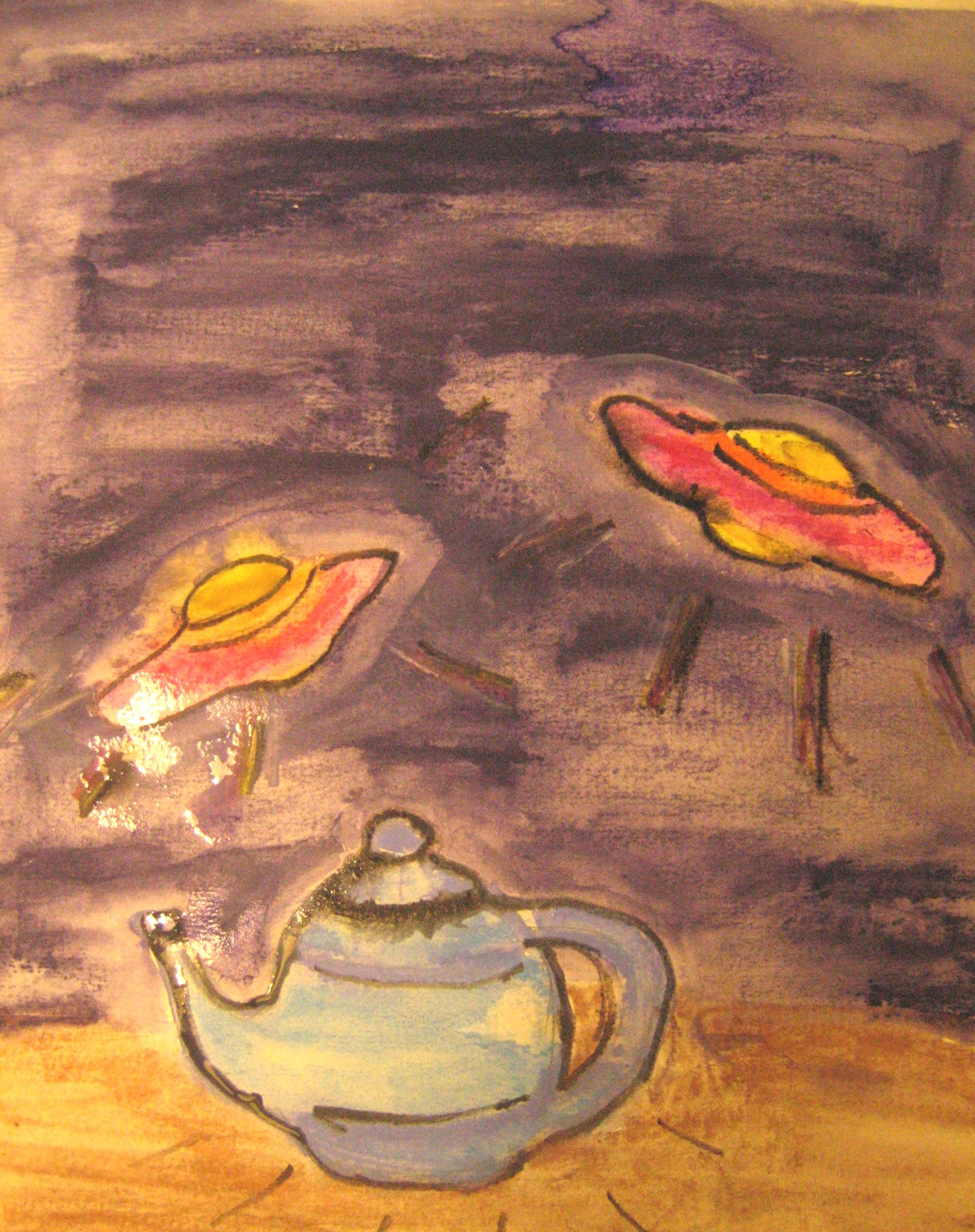
I especially cannot understand these people’s take on Obama.  (Some of them view him not only as  a non-U.S. citizen, but terrorist witch doctor).   The people who espouse such views  seem to me like the kind of people who believe in UFOs.  (Particularly UFOs sent into space by the Federal Government.)

But these people are not truly crazy;  they drive cars, hold jobs, pay taxes (reluctantly), raise children, take care of the elderly, work.    But they feel that they/we are in terrible trouble, and they act like people both steaming mad and desperately seeking a cure.  (They make me think of those books that advocate eating nothing but garlic or watermelon.)    The cure they want is to go back to a past that never actually was; to a simplicity that never was.

Making stupid jokes at their expense, sneering at them (and at Palin), is not a good way to quell fears,  ease resentments.

While Obama can be professorial, he is also extremely good at explaining complicated issues in simple, but not reductive, ways.    He needs to use that skill more to remind Americans of how the country arrived at this economic downturn, of why the banking system was saved, of how the Republicans in Congress (and in the White House) both contributed to the current crisis and are now blocking its repair.   He needs to keep it simple, make it direct.

And while hypocrisy may deserve satire, Obama (and his supporters) should avoid the side of the sneer.

The Twilight Zone – Lessons Obama Might Learn From Stephanie Meyer

February 10, 2010

I’m still reacting to the news that Stephenie Meyer has sold over 45 million Twilight Saga books.  To put this into a bit of perspective, Barack Obama only got about 69 million votes when he was elected President in 2008. 

Granted, 69 million is substantially more than 45 million, and, of course, that 69 million only consisted of U.S. citizens.  (I believe Stephanie’s tally is worldwide.)   But, on the other hand, Obama’s voters were not paying more than $10 per shot. 

These figures have led me to think that if Obama is looking to “up his numbers”, he might consider some lessons in popularity from Stephenie Meyer, and her prime male Twilight character, Edward Cullen.

 (Note: these are not my lessons.  But popularity is, unfortunately, not my strong point.)    

Here are some I’ve gleaned: 

1.  Make the trappings of wealth–big house, fast car, great clothes–seem easily attainable;  do not gloat after these trappings yourself, but do not poohpooh the pleasure they give others.  

2.  Abolish speed limits.

3.    Make it very clear (a la Edward)  that you are subject to murderous rages which you hold back through iron (but imperfect) self-control.

4.  Always tell the American voter (we’re your Bella) that we’re beautiful.   (Even if we’re fat.) 

5.   Make us feel (a la Stephanie here) that magical thinking really does work, i.e. that if we truly want something, we will get it.  Yes, there may be a bit of dramatic bustle along the way, but no significant trade-offs, sacrifices, or even analysis, will be required.   (Sarah Palin seems to have mastered this one.)

6.    Keep it sweet.  Simple.   No big words.  

7.  Think about change, sure.  But use paradigms that are familiar, instantly understood.  (Don’t worry about inconsistencies.)

8.  Don’t worry too much about those that can’t keep up or get caught in the cross-fire.  Think of them as the tourists who are the victims of the Voluturi while Edward saves  Bella.   Yes, it’s too bad.   But hey, Edward and Bella are back together again.  

9.  If all else fails, hire Robert Pattinson.

Deficit of Trust in Government – The Difference Between Coke and Pepsi

February 4, 2010

Continuing to think about the deficit of trust in government.    (See prior post.)

Part of the problem (aside from a pusillanimous, self-interested congress, the unfettered flood of special interest moneys, and periodic out-and-out scandals) is that many people’s day-to-day interactions with governmental institutions have an unpleasant aspect–taxes; speeding tickets; waiting at one of those blinking yellow lights for an endless road repair; the Post Office, which, if not exactly unpleasant, often involves lines, and a high background level of frustration.  (The phrase “going postal” did not arise out of a void.) 

Then too, there’s seeming arbitrariness of government — the perception that some people unfairly get benefits while others are denied. 

Which brings us to the judicial system.   I happen to be someone with faith in the U.S. court and justice system.  I believe that it is (more or less, fundamentally, at least in principal) sound (certainly compared to many other countries.)    But its high costs combined with its power and political underpinnings can make its verdicts both terrifying and burdensome.   When they are eventually delivered.  It tends to have a velocity equivalent to molasses in a snow storm.   (Extremely expensive molasses, a very long snow storm.)   A  friend of mine living in Queens has recently spent over eight months and thousands of dollars in legal bills evicting a tenant who never paid a single dollar’s rent.  

I’m not writing here about judicial reform, or nuisance suits, or even unscrupulous lawyers.  I understand that many landlords perpetrate horrible abuses on tenants.  (I’m a tenant.) 

The point is that these factors engender an instinctive distrust for all government, not simply the difficult parts.

Unlike corporate brands, which people readily differentiate, with clear preferences for either Coke or Pepsi, Burger King or MacDonalds, Toyota (oops!) or Ford, many seem to conflate different levels and types of government–federal and local government (where money has especially undue influence), the  executive, and judicial branches, the state trooper and the FEMA social worker, the random INS or TSA worker and Obama himself. 

It’s a problem that can only be solved by individual effort; all involved (both workers and citizens) genuinely trying to do better.  

I’m not holding my breath.