Archive for the ‘New York City’ category

NYC Sub(way) Sahara – Unlined Wool Pants

August 6, 2010

NYC Subway Platform Feeling Saharan

Subway platform today like a damp Sahara.  Made of concrete.

Which, I know, doesn’t sound Saharan at all.

But what I haven’t yet mentioned are the blasts of fevered air shooting through the tunnels as if from across miles and miles of sunbaked sand.

Those oven-y winds feel very Saharan.  As does the waiting.   For something, anything, to appear on the horizon.  A flash of light.  An oasis.  (An airconditioned car!)

Service cuts seem to be well in effect now  (My wait for the Number 4 or 5, probably the busiest line in Manhattan, was about 25 minutes this evening.)

Which brings me to unlined wool pants  I was thankfully NOT wearing those this evening, not even cropped ones, but I inadvertently ordered two pairs online.  (I intentionally ordered the pants; I didn’t expect them to be unlined.)  Wool pants which were on final sale, but still not THAT cheap.   I didn’t think to check the description because women’s wool pants are ALWAYS lined – especially from an upper end company.  (Hint, Michelle Obama wears their clothes.  Which makes me wonder–do they line the pairs sent out to her?)

How does this connect to Subway service cuts?  It’s one more sign, to me, of paying more – getting less, the persistence of hard times.

Yes, I know–unexpectedly unlined wool is the least of the problem. Especially if on the legs, rather than over the eyes.  Still, they are a symptom.  Like the nearly unbearable platforms that we wait upon, for a long long time.

Subway Blog – An Eye Out For Spiritual Texts on Train

July 9, 2010


Me , rather I, (in the seat there) on NYC Subway Car

On the subway this morning, I move quickly from the side of a guy reading the Bible, not so much because he is reading the Bible—well, a little because of that—but  mainly because I see an open solo seat further down the car.

I realize after I sit down, however, that I am now sitting directly opposite another guy who is swaying back and forth over a copy of the Torah (or at least some seemingly spiritual Hebrew text).  He moves his lips distinctly as he reads, and he reads very very fast.

I’ve already tried to be the Good Samaritan on the train this morning myself, holding the door open as long as I could for two elderly tourists who, having a hard time with their Metrocards, had just barreled through the barred iron gates onto the incredibly muggy platform as the train doors began to close.  But the train doors are programmed against Good Samaritanism and nearly took off my hand before the tourists could stumble in.

As a result, I feel like I’ve already brought too much attention to myself to move one more time.   Still, it’s a bit hard to focus with the Torah guy swaying and reading so—loudly is not the correct word–energetically.

His nose itches; he’s congested; it’s bothering him.  The hand motions dealing with his nostrils are out of sync with the rhythm of his sway, which goes on without interruption, as does his free hand, following of the characters of his text with a stiff, three-fingered point.

I don’t want to watch him so closely; I don’t want to know about his nasal issues.  To be fair, he’s dealing with them discretely enough (as discretely as a swaying, gesticulating, lip-moving, man can) but it is almost impossible not to be aware of him when he is shouting—okay, not shouting—gesticulating so much.

I make myself look up the car.  I see a guy, next to the guy with the Bible, looking at himself with a small hand mirror, and I began to really wonder about (a) the nature of this particular subway car and (b) narcissism when I realize that he truly holds a small rectangular magnifying glass which he is using to read a newspaper article about LeBron James.   (Okay, so just narcissism.)

But I find myself increasingly agitated by the Torah reader.  It has nothing to do with the Torah.  I realize, to my embarrassment, that if someone were reading the Koran opposite me with the same avidity, I would be considerably more concerned.

When the train pulls into the next station, the Torah reader bolts away, and I am amazed at my sudden relief.  How wonderful it is on a Friday morning to have the car taken over by silence, stillness, near emptiness.  I catch the eye of a woman on a far bench, who, for once, smiles back, and I feel so suddenly relaxed that I don’t realize, until the mechanized voice begins and those inexorable doors prepare to close once more, that this is my stop too.

I make the steaming platform just in time.

A long week.

Mixed Feelings About the City

June 25, 2010

Full Moon in City

It was a great relief, at first, to step into the warm summer evening.  Not only was it Friday evening—the air conditioning in my New York City office is cold enough to leave one, after a long day or week, chilled through.

In the embrace of the sultry air, I decided, on a lark, to walk all the way from mid-town on the East Side down to the West Village where I was meeting someone for dinner.  How wonderful, I thought, to live in a  city I could walk, a city with sidewalks, avoidable tunnels and throughways, a city that allowed for random exercise.

A few blocks later and I began to wonder  if the good effect of the exercise  was not counterbalanced by the negative effect of the pollution.  Plus my eyes were grainy with soot.

But I had told myself I was going to walk, and, as followers of this daily blog may sense, once I make a commitment, I am not readily shaken from it.

Soon, I was thinking of Horatio Hornblower, and how, in one of the novels, his feet become so blistered he can hardly hobble.

Still I kept a steady pace, even in places where the crowd was thick enough to warrant the regular dodge, and a hand clamped hard on my purse.   I kept it up through hoards of shoppers, cafe-gazers, people pushing into and out of subway entrances.  I kept it up even when my slightly rapid, attempting-a-light-heart pace, felt very out of place.  Although, truthfully, there is nothing like a walk in the streets of New York City to make almost anything odd about yourself  seem as run of the mill as an annual 5K at a Gold Medal Flour factory

“Characters” abound.  Some of them fill you with wonder; some pity; some dread.  Most you just don’t want to stare at too long.

Around mid-town, for example, there was the seemingly elegant woman wearing a fur-lined mad bomber hat.  Her walk stately walk was burdened by bags from such high-end stores that, at first, I wondered whether she was someone traveling from a Northern place, or, perhaps, in the midst of moving, someone, who, despite the 90 degree day, simply felt like wearing her mad bomber hat instead of packing it.  Then I saw her face.

Then there was the guy sitting on sidewalk, propped up against a mailbox, on an extremely crowded 34th Street.  It took me a moment to understand that a large black dog was lying (on its back) between his legs, its wandering muzzle seeking out the large slice of pizza he balanced on his chest.

After supper in the village, I felt so stuffed with Ethiopian food – there’s something about those spongey pancakes – I felt the need to walk some more.  It was cooler now that it was dark, less gritty though the wind had picked up.   A huge, beautiful, orangish, full moon hovered just above the shorter buildings, blocked by most others.  I pointed it out to one trio who waited with me at a stop light (they thanked me), did not point it out to the guy in the small park who, for no reason except perhaps to show off for his friends, called me a very nasty epithet (I figured that he wouldn’t thank me),  did not even think about it when I dashed across one street in Tribeca to avoid the darting dark shadow near my footsteps (yes, I know what it was and they terrify me!), and, finally, as the street corners became a little more open at the bottom of the Island, found it again.

Fell into a doze almost immediately when I finally got home, shoes off.  The cooling summer night that now wafted through my open windows felt somehow softer from the other side of a screen, from inside four walls, and I tried not to think too much about that man, that woman, that curse, that dog.

Summer Mornings Without Air Conditioning – A Certain Slant of Light, Gainsborough Hair,

June 6, 2010

Sir Thomas Gainsborough - Mrs. Thomas Hibbert

Emily Dickinson writes about a “certain slant of light,/Winter afternoons,” which I’ve been thinking of a lot as I wake up these days. There’s definitely a certain slant of light on summer mornings.  I feel (kind of) sorry for those who sleep in air conditioning and don’t get to fully experience it.

It’s only a trick of my ear that thinks of Dickinson, for this slant of light is not oppressive like the light in her poem.   It’s a low angled, almost curved, light, which accompanies a time of softness, space, invitation.  Movement is easy enough, though after the restlessness of a night of trying to find a cool place on the sheets, you may not want to move much.  Your body feels suddenly dry, almost powdered.  The air, because you are careful not to fully open blinds, is tinged by a slight blue-grey wispiness like the hair in a Gainsborough painting.

Sounds are distinct, but muted—footsteps below your window, water running upstairs—there is nothing like a Sunday morning after a sultry night in New York City for quiet.   Stereos stilled–if there is a music, it’s in the tradition of John Cage.

You can smell that it will be hot again soon; you can even see it after a while –just there, at the corner of your eye.  The promise seems not to come from the sky so much as from the sidewalk, which, with its cached memory of yesterday’s heat, early radiates an incipient over-brightness.

But, the heat’s not forced itself into your apartment yet;  for these minutes, Gainsborough lingers in the air, and the breeze whispers at just the right pitch.

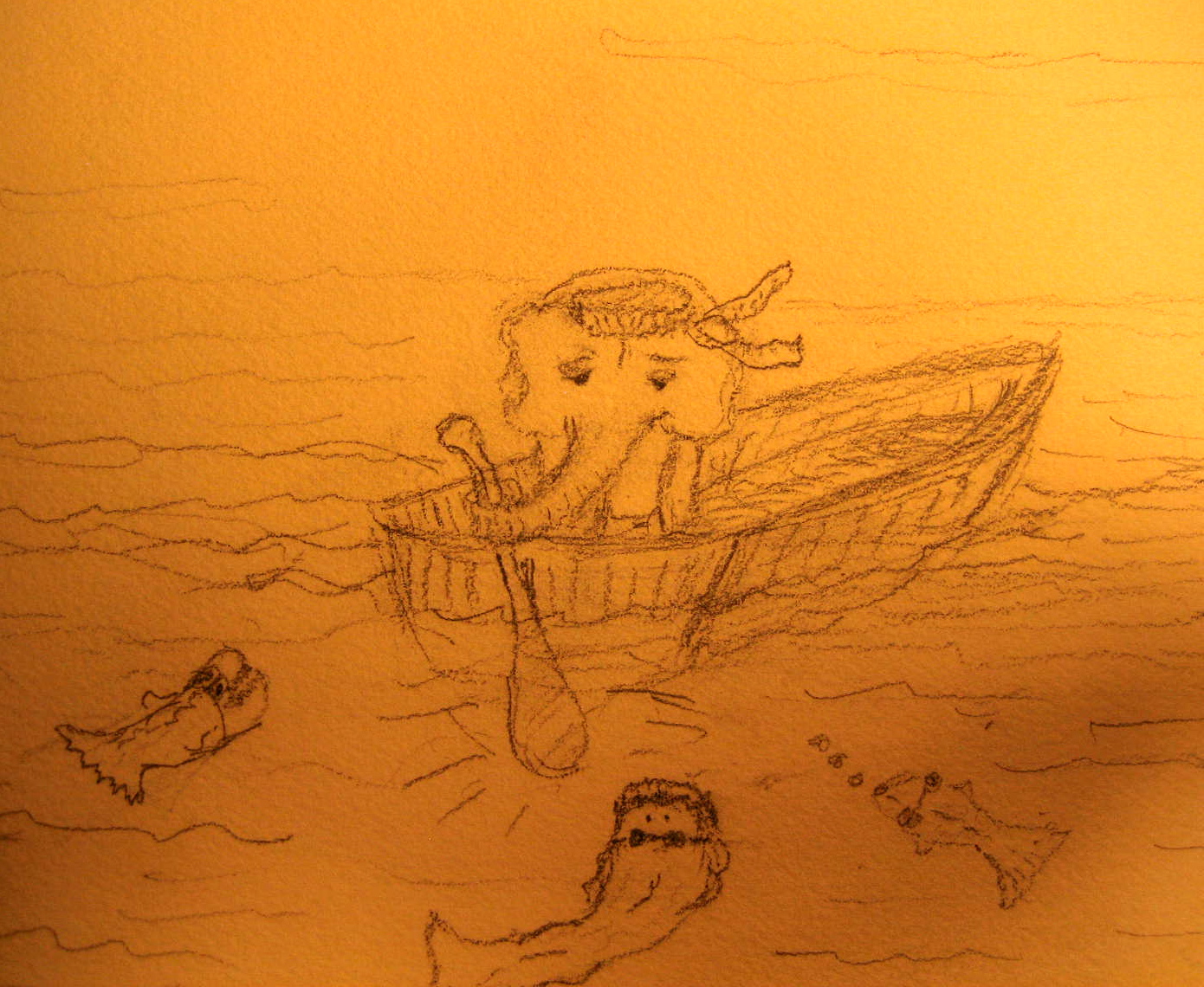
(If you like summer and sultry, but are more into elephants than Gainsborough, check out 1 Mississippi by Karin Gustafson, on Amazon.)

(And, for a complete change of pace, check out yesterday’s post, why people hate banks.)

Fleet Week – Where are you, Horatio?

May 26, 2010

Fleet Week in New York (See Statue of Liberty in background!)

It’s Fleet Week in New York!   It corresponds, oddly, with my current personal absorption with Horatio Hornblower, the mythical hero of C.S. Forester, who through a series of eleven books makes his way through the ranks and at least some of the depredations of the British Navy during the Napoleonic Wars.

It’s an interesting testament to the power of narrative that I had a very hard time tearing myself from the printed page of Forester’s Ship of the Line this morning to watch actual battle ships course down the Hudson, right next to my apartment building.   (So much for living in the moment.)

I just wanted to stick with Hornblower, even though the ships were hugely impressive, and lined with living, breathing human beings.

Much has changed since Hornblower’s time.  The U.S. Navy ships seem inordinately plain compared to Hornblower’s schooners, frigates, ships of the line, with their top gallants, topsails, reefed topsails, mainmasts, mizzen masts, jury masts, rigging,  netting, and long nines.  There are a few small towers of gizmos, presumably related to radar, but for the most part, these new ships are large slightly curved trapezoids of painted grey.

It’s hard  to imagine these huge wedges of steel as the descendants of the beautiful, if gnarly, sailing ships of the British Navy.  Though there they were–men (presumably women too) lined up in rows of white (the sailors) and dark blue (the marines), roughly in the same divisions of rank and service as on Hornblower’s ships.

Other similiarities: decks!  Portholes!  (Wait–are there portholes now?) Starboard, port, stern, bow, lee, tack–vocabulary.

Space constrictions–though I expect modern seamen have more than 18 inches per hammock.

Some monotony of food?  But, hopefully, today’s soldiers  do not have to tap their sea biscuits to scare out weevils.  (They only need to be concerned about trans fat and high fructose corn syrup.)

What else do Forester’s sailors and today’s share?  The sea!  The sky!  The horizon!  Occasional seasickness!

Reading C.S. Forester makes one very conscious that conditions of the British navy during the Napoleonic Wars were almost unimaginably severe, especially with so many sailors press-ganged to begin with.  (Hardly a volunteer force.)

Scurvy, disease, amputation, the requirement of absolute obedience at the threat of flogging, court martial, hanging.  Though, actually, the biggest danger seems to arise from the incompetence and/or greed of supervising officers. (Hornblower, of course, excluded.)  And too, less-than-reliable allies.

Hmmm….

Of course, what ultimately makes the books compelling is not the politics, the tacking and heaving of sails, or even the discussions of sea biscuit, but the character of Hornblower himself — outwardly indomitable, inwardly hyper-sensitive, noble (in spirit if not rank), brave, and amazingly quick-witted even when in a near stupor of fatigue and stress.

Did one of his spiritual descendants sail by this morning?

Maybe.   (I, for one, was too busy reading to notice.)
Even Stouter than Hornblower?
Vegetarian Along the Hudson

May 17, 2010

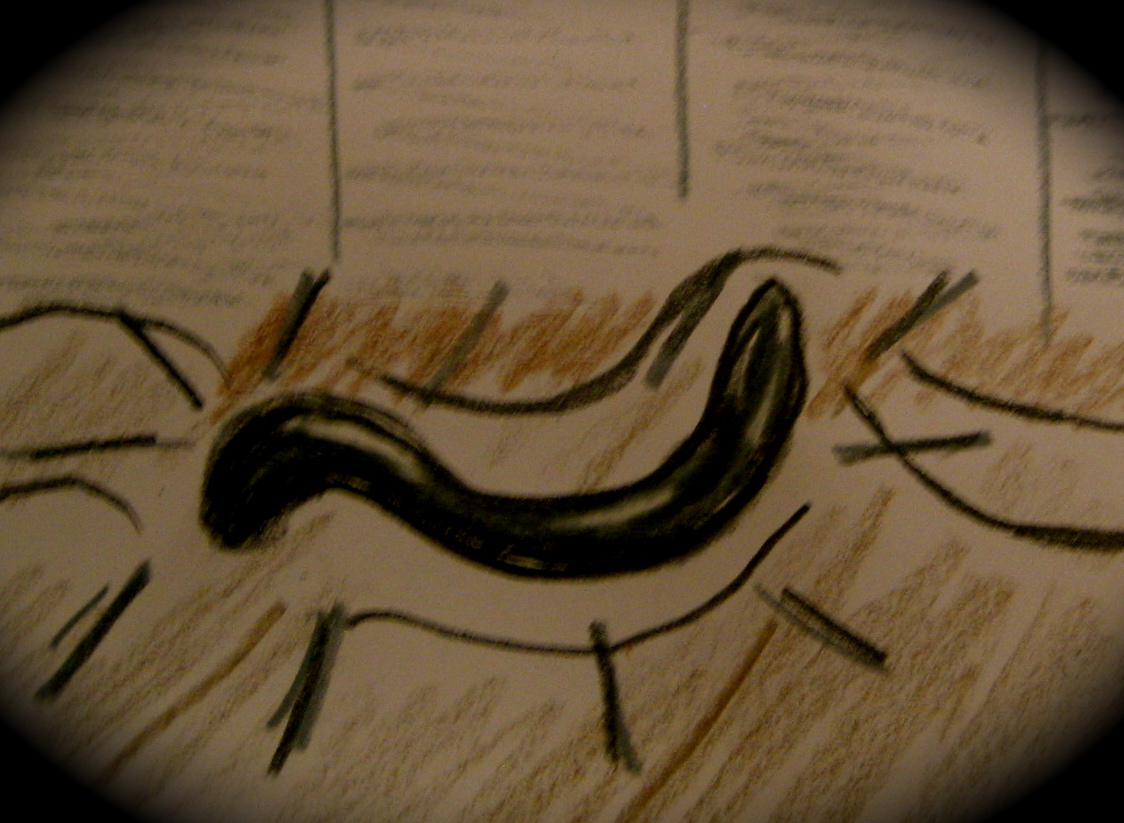
Eel on the Esplanade

The late part of the evening started with me semi-bragging about, semi-bemoaning, an adult lifetime of limited ice cream consumption.  I won’t go into all the reasons for this, but will simply say that I really haven’t eaten much true ice cream (as opposed to some weird kind of frozen diet delite) since about age 17.

Actually, there’s a distinction here between ice cream eaten (that is, other people’s ice cream tried, and spoonfuls taken straight from a quart), and ice cream purchased for one’s own consumption.    What I’ve done little of, as an adult, is buy myself ice cream.  (I estimated less than ten cones’ worth.)

My husband, a person raised with a high esteem for dairy fat, told me that was the saddest thing he’d ever heard.

Somehow this led to the idea of his feeding me huge amounts of ice cream if I ever developed full-blown Alzheimers.  This then transmuted into a joke about feeding the projected non compose mentis me large amounts of meat, despite my many years of vegetarianism.

“You wouldn’t do that.  Promise me you wouldn’t do that,” I said, surprised with the sudden depth of my feeling.

A sweet guy, he quickly promised repeatedly that, of course, he would not.

Later tonight, walking my dog along the Hudson on the esplanade in Lower Manhattan, I saw a man dart across the sidewalk.  He darted with the urgency of traffic-avoidance though there are no cars on the esplanade (other than the little truncated electric trucks in which the Park Police whiz around.)

He was darting to retrieve one of three fishing poles propped against one of the more solid walls that line the river bank.  With swift jerky movements, he pulled something that was totally black, but marked with a mirror-like shine, over the wall, then let it drop and flop onto the sidewalk.

Passers-by stopped, stared.  I pulled my very reluctant old dog (she was sure her obligatory walk should be already done) down from the upper walkway to get a better view.

The length of dark shine swiveled and flipped.  The man bent down to it with what looked a knife—it seemed like he was cutting, jabbing—but it must have been the line, because when he straightened, the fish still whirled and twisted.

I am always a bit suspicious of fisherman along this fairly polluted part of the Hudson.  Because they are out here late, and in very cold, damp weather (although tonight was neither), they do not look like mere “sportsmen.” That may be part of why I couldn’t stop staring at the dark satiny creature and thinking (1) toxins; (2) suffering;  (3) eel.

Eel?

Too long and uniformly narrow to be a fish.

I pictured (unwillingly) unagi.  Some kind of brown sauce.  And thought again, toxins, gills, suffering. More suffering. I wished the fisherman would just pick the darn thing up and bonk it hard on the head.

But he was attending to his other poles and paid little attention to the persistent, if slowing, squirm of the eel, except to look down now and again, more carefully after it wriggled into the shadows in the lee of the wall.

I sometimes think of vegetarianism as a bit precious, elitist, even PC, though I’ve been vegetarian for a very long time.   But for the second time in one night, it felt suddenly genuine, meaningful.

Still I didn’t say anything.  (Meaningful?)  Took the dog inside.

Running Late – Exercise On the Go

May 15, 2010


Running Late (and Slightly Elongated)

Followers of this blog know of my earnest, if multi-tasking, devotion to Astanga Yoga and the elliptical machine, but I’ve yet to discuss my most efficient method of getting regular exercise.  This is to leave a bit late for nearly everywhere I go.

I am not sure that this exercise method would be effective in more car-friendly environments (where you might only accumulate speeding tickets), but if you are running late in New York City, you usually are also trotting, jogging, speed walking, scooting, maneuvering, and dashing, late.

There’s nothing like that “whiled-away fifteen minutes” after your pre-set time of departure –you know, that time spent not departing when you are hopelessly trying to find something to wear that feels “right”, sweeping your kitchen, taking your vitamins, circling back to your apartment to turn off your iron—to get the old legs moving, and that regretful heart pumping.

In addition to the physical benefits of running as quickly as possible, for as long as possible, along a crowded street, there are also certain psychological benefits to a chronic lack of punctuality.  If, for example, you are trotting alongside your husband, who is also perennially late, you will find every single unresolved issue between you coming to the fore and absolutely ripe for frank discussion.

Even if you are chasing along on your own, you will happen onto epiphanies.  Chief among these is a clear understanding, usually (eventually) reached while waiting for a subway train (which, because you need to make time, is delayed) of the impotence of your individual decisions; your relative puniness in the universe; the fact that you are subject to great forces—fate, the MTA, your own inability to leave on time–forces that are determined to always make you late, forces that you must simply accept.

Hopefully, around the time you reach this understanding, you will find yourself in a place with cell reception.

Tchaikovsky And Raccoon

May 7, 2010

Prima Raccoon

May 7, 2010—Tchaikovsky’s 170th birthday.  Noted all over the world today because it inspired Google to put up an icon depicting Swan Lake.

(In my mind’s ear, I hear a young voice saying in a few weeks—Tchaikovsky?—isn’t he that guy Google did the ballet picture about?  If the young voice remembers at all.)

I hope it does, as Tchaikovsky is a composer who is particularly appealing to the young.   At least, I always loved him as a child.  (Since I seem fixed in perpetual childishness, that also means now.)  His mix of soar and sentimentality, the accessible and the exotic, really excited  me.  I had an LP (a big black record!) of his “greatest hits” that I used to play repeatedly in our basement—this was a particularly good place to dance around as there were no mirrors, and few visitors.

I loved dancing to Tchaikovsky’s ballet music—it seemed to call up grace (or, at least, imagined grace).  It is music that extends and curves one’s arms, that supports an uplifted spine, that points the toes, twirls the body, makes one feel correspondingly light and beautiful.

One does not usually group Tchaikovsky with those composers that died at a crazily young age–Mozart and Chopin—but Tchaikovsky was only 53 at the time of his death.  He came to his own as a professional musician relatively late (at least compared to Mozart, ha!  Who didn’t? ), spending his school years at the Imperial School of Jurisprudence in Saint Petersburg (poor guy!)   Though his musical genius was well recognized after he began composing,  his life was tinged with melancholy and crisis, many suspecting that his sudden death resulted from suicide.   This is hard to believe based on the music alone.  Tthough it does have a minor or somber quality, it is also often embued with a sweet and enthusiastic cheer.

Changing the subject—abruptly—I saw a raccoon in Central Park this evening.  Seriously!   With mask and ringed tail, scratching its way up the bark of a Central Park Tree.   Stopping to stare down at us with typical New Yorker attitude  (meaning we felt that we shouldn’t stare back too long)

It was my husband who truly sighted the raccoon—telling me that he’d been watching it for a while but hadn’t wanted to say anything till he was sure of exactly what it was.  (I have a phobia of r–s.  Hint–another animal that begins with  “R”  more common in Central Park.)

I thanked him for his restraint.

When we listened to Tchaikovsky later, he mentioned that I must have had a really hard time with the Nutcracker Ballet.

It took me a while to understand what he was getting at.  (I’ve blocked all those big grey saggy dancers out.  Especially their tails.)

Suddenly, Tchaikovsky did not seem quite so cheerful.

Trying to Think About Pie and Not Faisal Shahzad, Though Perhaps Not Hard Enough

May 4, 2010

Smoking Pie

I wanted to write about pie today—the fact that my mother (now nearly 87) sprinkles sugar on top of the slice she will serve herself, while, if I eat a slice of pie at all, I spoon on plain, unsweetened yogurt; while my daughters will take the time to whip up heavy cream.   All evening, I’ve been wondering, in snatches, whether this is the natural progression of life.

But I live in New York City, and even though I really would rather think about pie toppings, I find my mind taken up by the 53 hour saga that began with the smoking car in Times’ Square, and has led to the arrest of Faisal Shazad, the alleged car owner and bombsetter.

I have to start by saying (and I’m mainly addressing this to you, Mom, if you ever happen to read this blog) that the attempted car bomb has had virtually no effect on my particular New York life.

It seems actually not to have affected many New Yorkers very much.  I noticed the absolute ordinariness of my evening rush hour train:  in the bank of seats I leaned over, the three people front and center of me either had eyes shut below furrowed brows, or eyes shut below a hand shielding said eyes (from the delightful train lighting or, perhaps, my stare).  The next guy was playing solitaire on a electronic game player; the next two were smiling and talking with great animation.

New Yorkers’ natural tendency to put their personal fatigue, or personal conversations, over hyper-vigilence has probably been accentuated by the fact that the Times’ Square bomb does not appear to have been a really well-constructed device.  A sense of security has also been created by the fact that the authorities, amazingly, have already taken the guy into custody.  (Even though it seems that they almost lost him as he boarded a plane to Dubai.)

I congratulate the New York City police force, the New York City bomb squad, the Times Square vendors (!), the FBI, the TSA, Homeland Security, all those authorities who coordinated efforts so quickly.

Still, one very frightening question comes to mind–what would have happened if the bomber had stayed inside the car?   Had, in other words, been a suicide bomber?  Committed enough to his mission (due to political or religious zealotry, bitterness, brainwashing, craziness, drugs, duress, whatever,) to physically see it through?   Would a smoking car with a driver have seemed that extraordinary?   Would vendors have been as likely to question it, even if it did seem strange?

Hollywood tends to depict New Yorkers as “in your face”, but, in fact, New Yorkers are pretty good are minding their own business, the art of non-confrontation rather important when you are all squished together.

So what would have happened?  I, for one, would rather think about pie, but there’s smoke in the background.

16th Day of National Poetry Month – Vacationing Away From New York Limericks

April 16, 2010

New Yorker In a Car (Outside of New York)

Unfortunately, this 16th day of National Poetry Month was so busy I had little time to focus on much poetic.  A good day, in short, for draft limericks!

I’m sorry to say that the limericks I did  (which connect as one longer poem draft) have a fairly limited subject matter;  they describe that feeling of “going to seed” which may descend on vacation, particularly a family vacation, in which normal exercise and eating routines are put to the side; this feeling may be particularly pronounced in the case of the peripatetic New Yorker.

The limerick form is five lines, with a rhyme scheme that is typically: A, A, b, b, A; with the first, second and fifth rhyming lines longer than the truncated couplet of the third and fourth lines.

Traveling New Yorker

There was an old gal from New York
who watched what she put on her fork;
still, outside the confines
of the Four and Five lines,
she felt herself turning to pork.

The thing is that life in the City
made her walk through the nit and the gritty,
while, whenever afar,
she traveled by car,
quite bad for the hips, more’s the pity.

So she worried, this gal from Manhattan,
as she felt herself fatten and fatten–
too many fast treats–
too many cheap eats–
and just about all came au gratin.

Oh, for her home—twenty blocks to a mile;
twenty steps too, till the average turnstile.
Sure, there was soot,
but she’d breathe it on foot.
Once back, she’d stay put for a while.