Archive for the ‘India’ category

Drawing The Veil

April 7, 2013

20130407-111855.jpg

We wait for Gopal to bring chai.

He is taking a long time and we begin to suspect that although he came up to the office to take the order, he has now in fact left for the day. (This turns out to be right.)

I am in the meantime feeling down about faces. I like to draw faces. I do not do it terribly well.

I’m okay with little children. With children, it’s usually good enough to just draw sweetness–simple lines.

Adults are more difficult. The lines are creased.

I had thought I might be able to do teens–no wrinkles–which is why I started up on the Muslim girls in the car. Here’s what happened:

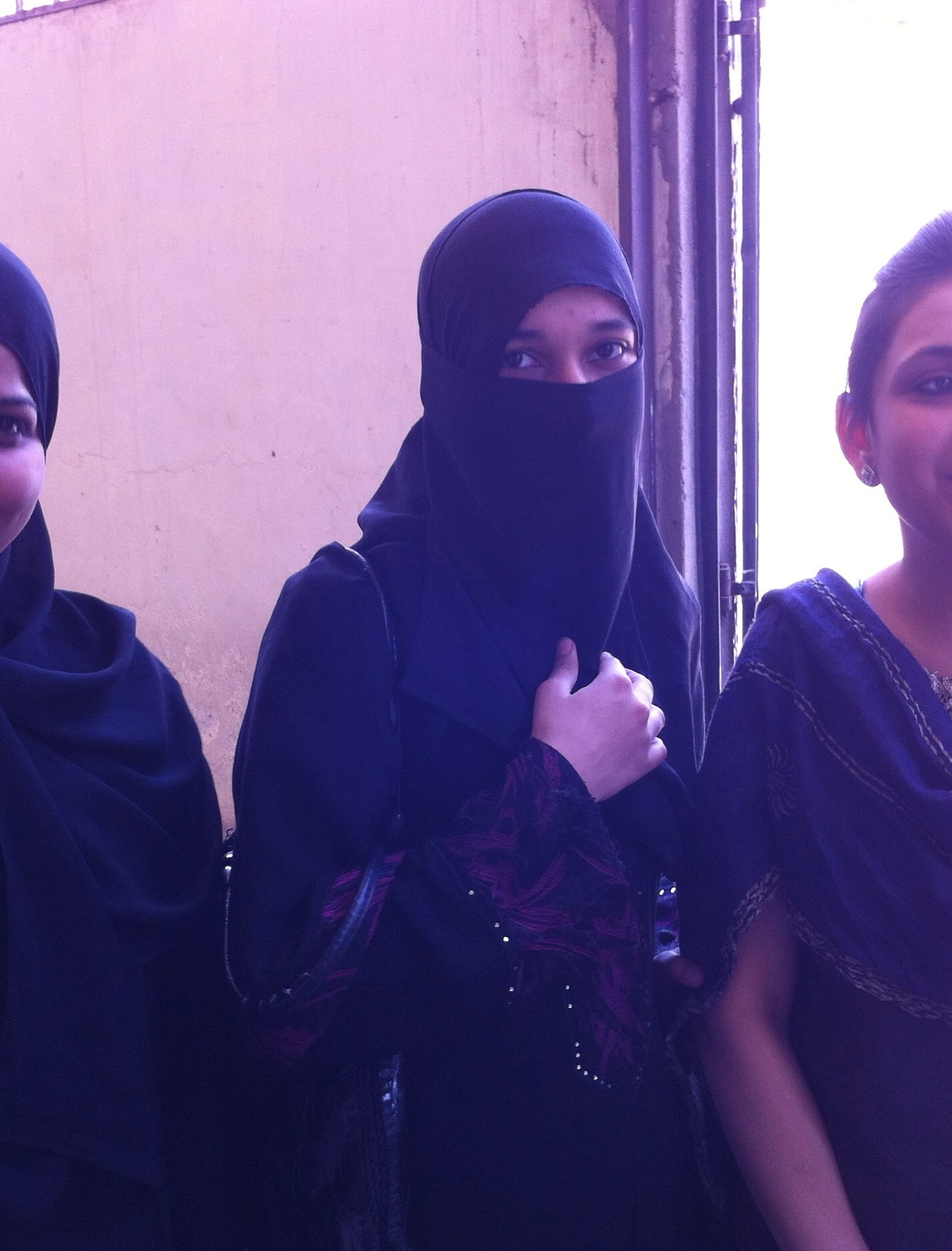
There is traffic and the one squeezed a seat away has taken my picture – for some reason, Indians like to have photos of Westerners– and so I take out my notebook and start to draw her. She is the girl in the burkha, a very pretty sweet girl. (It is not a classic burkha, but a cloak with a tight black head covering and a veil over her face.) I figure that will be simple, if a bit strange,

It is not so simple though. I haven’t drawn anything but cartoons (i.e. elephants) for a while, and when you are actually drawing a person, you want to show at least some aspect of them, something that they will recognize as themselves. Which, in the case of this girl meant it almost all had to be captured with the eyes.

Well, she has slight circles showing under the eyes, so I get them too. And the individualized hairs of brows and lashes.

But it is so difficult. My vision is not good (so many excuses!)–I cannot see the page well. Finally, I take off my glasses, which seems to help–the shape of the veil covering her head is also surprisingly hard. Hair can be drawn quite gesturally, but this has to be more accurate- she has a very slender scalp I check the closure – the way the veil that covers her nose and mouth laps over the head veil.

She is pleased. I tear off the page and give it to her and she is very pleased. She does not seem to think that the idea of a portrait in veil was odd, and now her friend, who sits just beside me, wears blue and not the hot black, and is not veiled, looks expectantly, and traffic still sluggish, so I begin again, making all kinds of excuses that they do not understand about how bad my drawing is, especially in the jerking car.

I make these in part because I can tell from the start that she will be more difficult. To me, the most important part of amateur portraiture aside from capturing some aspect of the face, is that you make the person look pretty. (Honestly, I think prettiness is probably even more important.) This girl is pretty, but she has bigger features (well, features), and it is hard for an amateur like me to capture the idiosyncrasies but maintain the strong prettiness.

I erase as much as I draw–it is surprisingly hard to do her nose stud in a way that does not look like some weird extra nostril or pimple.

But I get something down and she too is pleased, and now we have arrived, and I turn to the third girl, in black burkha but with her veil down (face showing), and I imagine that she looks disappointed–we are on a rough dirt street, sandy, brick and trash strewn, and we say goodbye, and I offer to do hers, I would be happy to try standing here in the street, but I know they cannot understand my English, and my portraits are so bad, I hate to make a big deal of it –so we say goodbye, walk on around the corner, go up to the office – they are on their way home.

To get to the office, we have to go through another building, onto a dirt alley, and then up an external stairwell. On one side of the stairs is a a view over a Hindu Temple; it is jammed into very narrow space beside some poor shanty-type shacks, charpoys (crude cots) on the dirt alley, where extremely poor people, naked babies, sit or lie down at the end of this hot day. Just next to this alley is the overpass of a large bridge that goes over an expanse of river, mainly dried up right now, the strands of remaining water deep green, the dried silt bed littered with garbage that people seem to pick through or pick their way through.

As we get upstairs to the office (where now we wait for tea), I look down the stairwell – it is open to the world – the alley, the bridge, the jam of temple, and there see the three muslim girls just across, on the concrete overpass of the bridge, beside the whizz and honk of traffic. They are standing there, on a part of the overpass opposite our stairs, clearly waiting for us to look down to them; they all three wear their black veils now, head and face coverings —even the girl who does not wear black, whose face I drew in full, and the girl I missed, the one I still regret, who wore the tight head veil but not the face covering.

I wave at them. They wave back. I imagine that they smile. Their eyes smile.

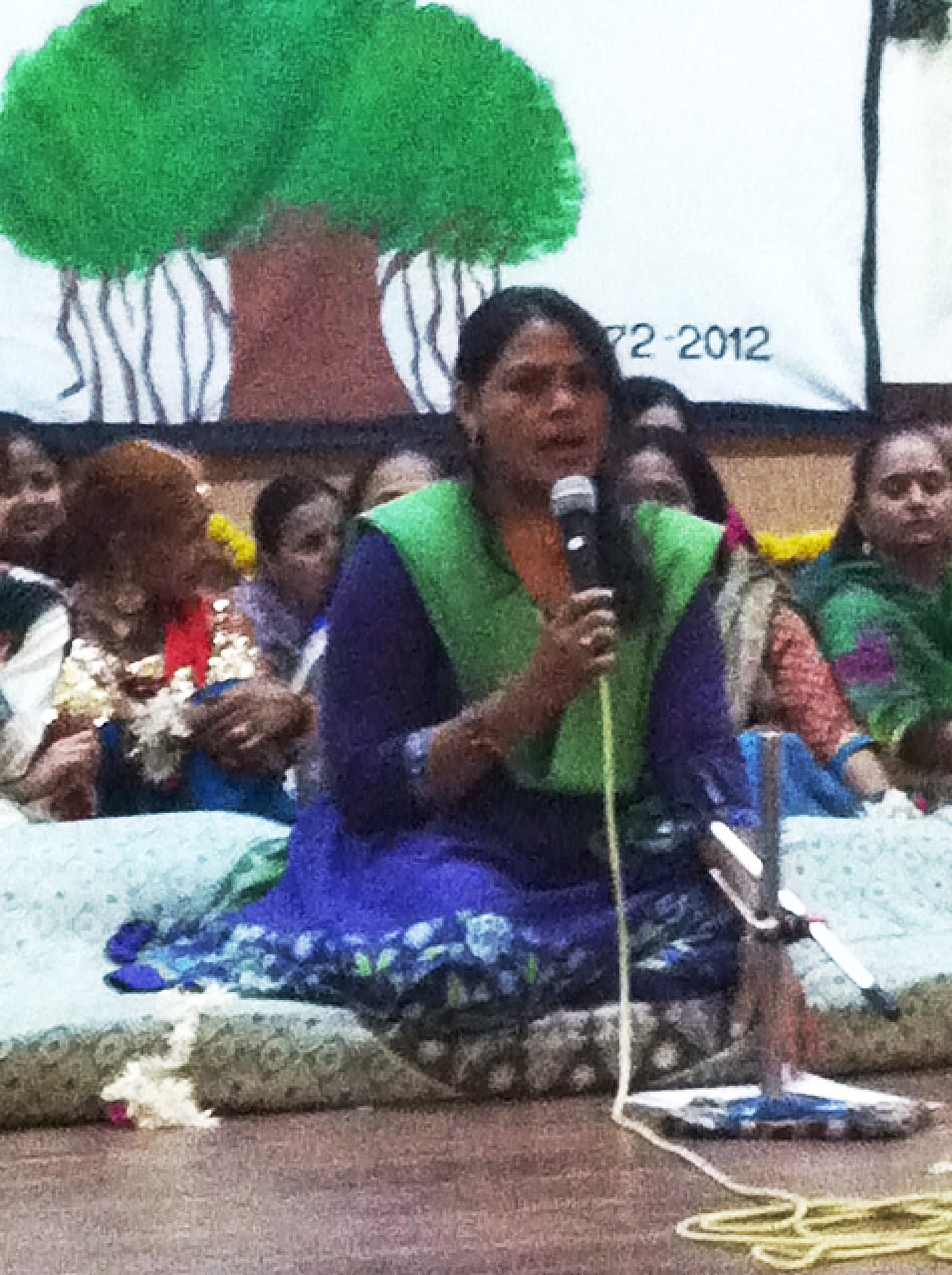
(I took a photo of the three girls, but two of them did not have their faces covered and although my daughter does not think that their photos would ever been seen, I feel worried to show their faces online, so have cropped the picture only to show the one girl who always kept on her veil. These girls are among the group studying computer at SEWA, the Self-Employed Women’s Association. I rode in a car with them from the SEWA poetry reading, which they also attended.)

PS — thanks so much to you all who read these posts. I’m sorry that I don’t have much time to edit – i.e. shorten, and haven’t written poetry, and tried working on novel. I really appreciate your stopping by though. It means a great deal to me to have someone to write to. K.
SEWA Slam, Women’s Poetry Reading, Ahmedabad

April 6, 2013

20130406-220632.jpg

20130406-220727.jpg

20130406-220707.jpg

20130406-220830.jpg

20130406-220845.jpg

20130406-220859.jpg

20130406-220936.jpg

20130406-221432.jpg

I cannot understand more than a word or so of Gujarati but it turns out that there is a certain style to empowerment poetry–strong rhythms, impassioned spirit, use of repetition and refrain, and sardonic humor–that is universal.

But before getting on to poetry — and you can see it being read in all of the photos above –I should say that the reason that I am in Ahmedabad right now is that my daughter has been working with the Self-Employed Women’s Association, a women’s organization that was started by the extraordinary Ela Bhatt in 1972, first as a women’s wing of the Textile Labour Association, which in turn is India’s oldest and largest union of textile workers, founded by Anasuya Sarabai, the philanthropic daughter of an Indian industrialist family in 1920 (after being inspired by Mahatma Gandhi’s successfully led strike of textile workers in 1917.)

SEWA split off from the TLA in 1981, as a separate woman’s collective, made up of “self-employed women,” that is, women from the informal labor sector – headloaders, rag pickers, vegetable sellers, piece workers (usually working at home), bidi cigarette rollers (also often working in the home), women who tend to be extremely poor, with few sources of capital and little bargaining power against their bosses, landlords, the law, family members, anyone.

After its split from the TLA, SEWA spread out a number of limbs and roots –its symbol is a Banyan Tree–including (in addition to the labor collective), the organization of a women’s bank, social security system, insurance program, health clinics, child care, rural workers associations, training programs in various trades (everything from henna decoration to computers), literacy programs, life skills programs, a girls’ club (largely for the daughters’ of SEWA members), a SEWA academy, video SEWA, radio SEWA.

So, I come here to visit one of the offices for the afternoon as my daughter finishes her work, and guess what they happen to have set up for that day — a large poetry reading! (Not, I admit, in any connection to me.) Except that I got to go.

About thirty women read. All were beautifully dressed. (A few in my daughter’s office were busily applying eye liner to each other before they left.) Many spangles and bangles. (Some people think of women as dressing up for men, but when women dress up for other women, they can really go to the max.)

There were young girls reading, and also women who had been members for thirty years. This means that these women most likely started out as manual laborers–headloaders or vegetable hawkers, women who first learned to read and write in SEWA literacy classes.

The poetry was serious and impassioned–some, you’ll see in the videos below, read with great gestural emphasis. There were also, of course, many jokes. Although I had a strong sense that “the Man” was mocked somewhere, I really do wish I could have gotten the particulars.

SEWA is multi-religious, multi-caste. Hellos were said by poets with traditional muslim or hindu greetings and sometimes both. The hoots and whistling following some refrains would occasionally have an Inch’Allah thrown in, if the poet was Muslim. (I also think that some poets read in Urdu, but I cannot be sure as it is also a language I do not understand.)

Was it different from a Western slam? Sure, aside from the beautiful dress, each reader sat cross-legged, was barefoot, and afterwards took, as a reward, a wrapped-up wad of pan (betel nut leaf with flavorings folded into a little triangular “football”) from a small brass pot in the middle of the stage.

But even my unschooled ear could pick up the rhymes, the repeated phrases (each one growing and growing into a further, longer, more resonate repition), the rhythms and echoed refrains.

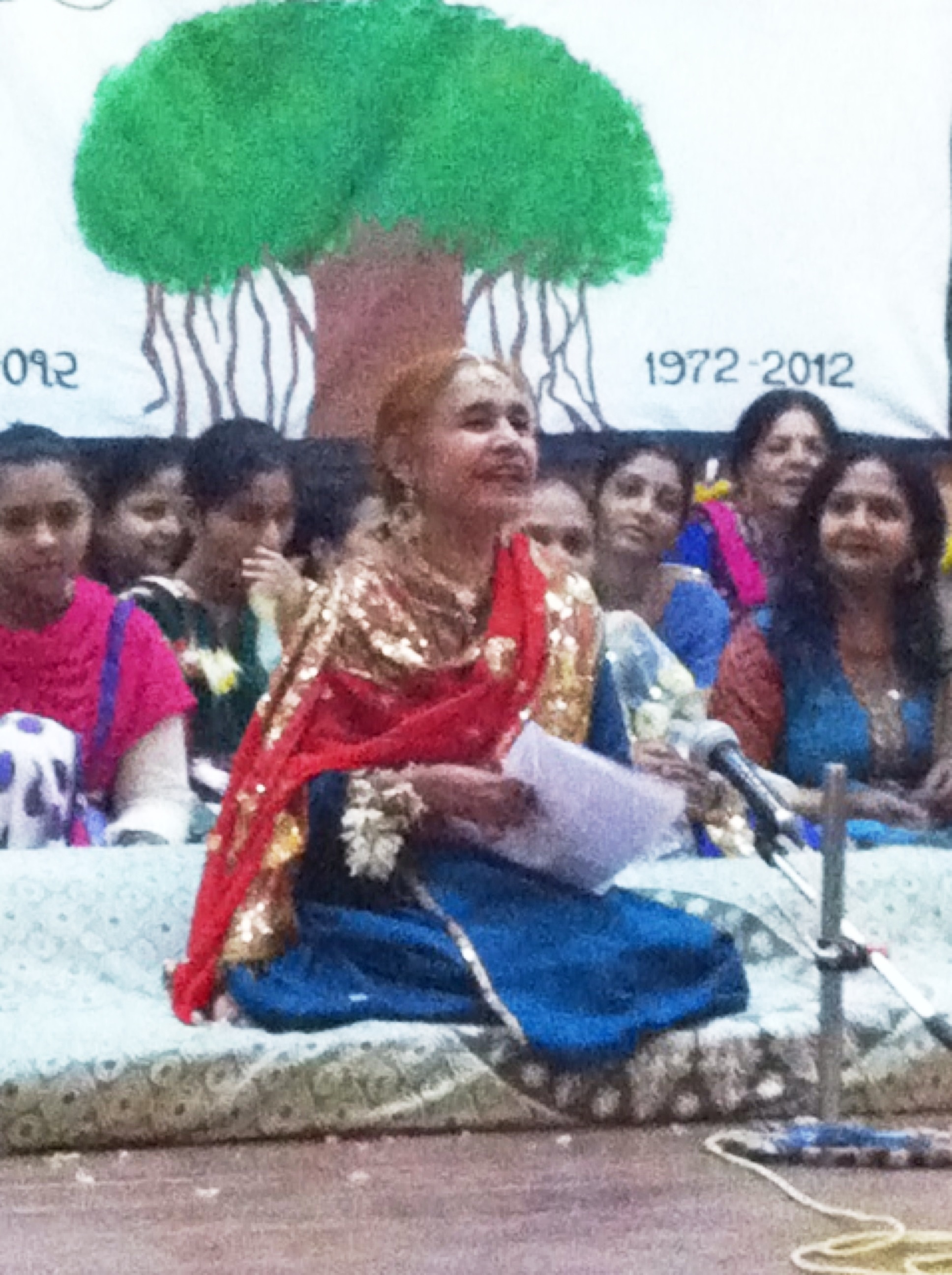
Ela Bhatt, now fairly elderly but unbelievably sweet and dignified, spoke (and even sang briefly). The women adore her, often using her name in their verse. It is clear that they feel that she (and SEWA) have given them a chance in life.

The closing, which my daughter tells me is typical of all large SEWA gatherings, involved the singing, with rhythmic clapping, of “We Shall Overcome.” In Gujarati. With multiple verses. All known by heart.

Pure poetry.

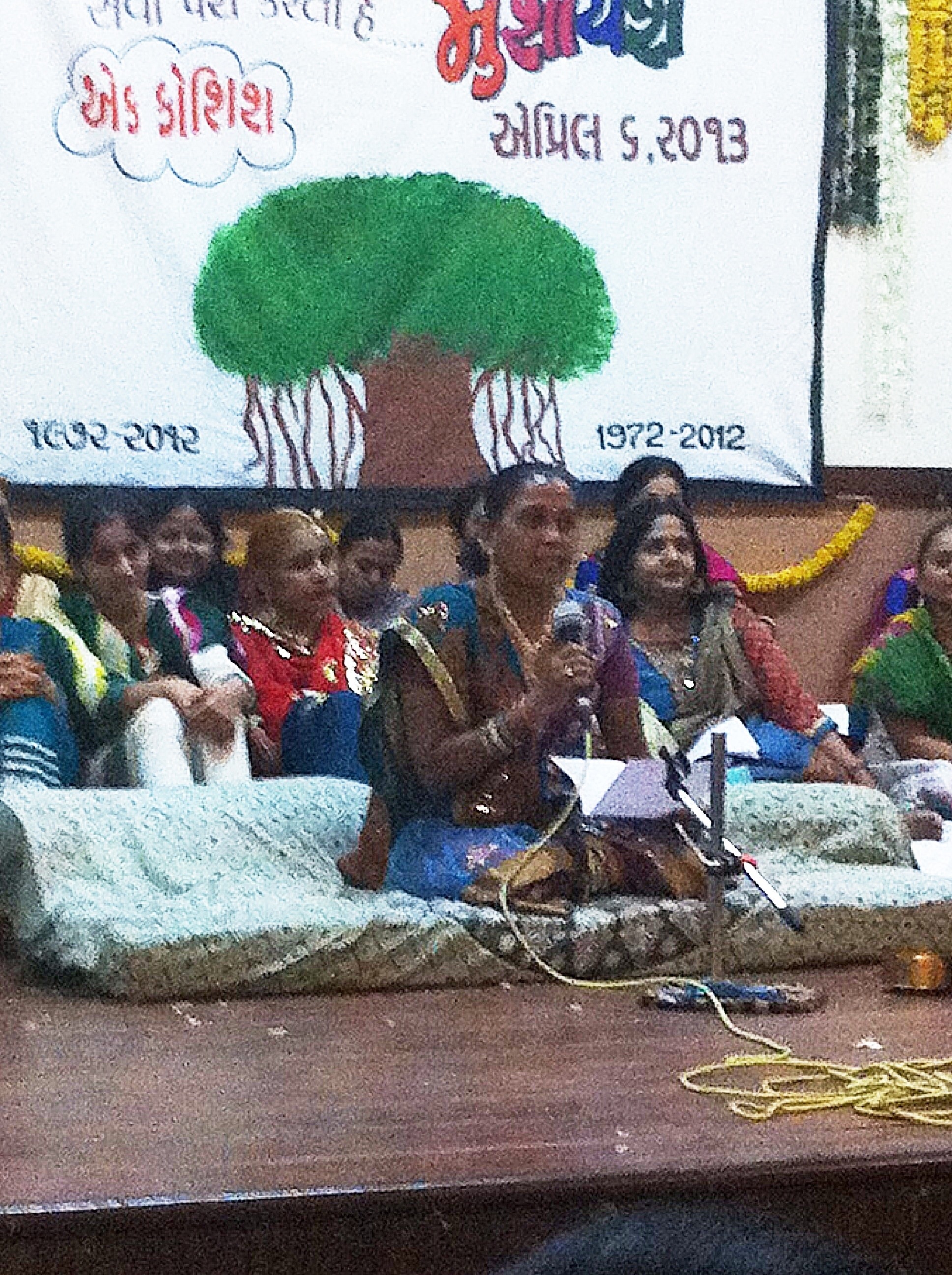
(I have included very blurred photos of some readers above, and of Ela Bhatt. Sorry that my light and camera were poor. I was only able to upload one video and I’m not sure it’s really there. She was one of many spirited readers. )

Ahmedabad (Forecast–Heat and Smoke)

April 5, 2013

20130406-074909.jpg

Yesterday, the online weather forecast for Ahmedabad, a large city in Gujarat (Western India) where I am staying, said simply “smoke.”

The smoke one is conscious of is not the smoke of a stream or clouds or billow, and it is not particularly dark. It’s smoke that is like a form of humidity, meaning pervasive, felt ever presently on the skin and in the nose, prickling more than particulate.

There was often a smell of smoke in the older India I visited many years ago–one could scent it even when the plane landed–but that smoke smelled rather sweet – of cow dung with, if one was lucky, a touch of cardamom This smoke is edged with plastic, the burn of bottle and bag.

My daughter suspects that there’s probably also fair amount of motor exhaust–she has been here few months, and crossing a street, or worse a roundabout, has been one of her major and very understandable fears–but frankly, she can no longer smell the smoke at all, so I’ll call myself the immediate family authority. While I’m sure there’s also exhaust, it’s the plastic that feels pre-eminent.

I do not mean to make the City seem unpleasant! The smell is certainly not overpowering, and I’m sure is strengthened by the heat–the hot season has already descended already — over 100 each day–which tends to keep any kind of weighted air close to the ground. It’s just that this burned plastic smell is something that really worries me. I suspect that it pervades many many cities in Asia (and probably in the entire third world).

What is especially odd here is that fairly substantial efforts are made to collect and recycle plastic – in part because it is something that poor people can do. At the same time, the concept of “virgin plastic” has become a popular feature of trendy products; that is, products tout the fact that they are not made of recycled plastic. Agh!

(My sense is that this may come from a long history, stemming from the caste system, that is concerned with notions of personal “pollution” – that is, the “pollution” that historically was deemed to come from sharing wells, taps, food, even sunshine, with untouchables and low caste persons. Again, I think India has made great strides in that area – so this is completely a guess on my part.)

(Also, again, by raising things like this, I do not mean to make the City seem unpleasant – Ahmedabad is an older industiral City, the center of Gandhi’s labor movement, and still a big center for Gandhism. People here have been extraordinarily generous and kind to my daughter, and are very friendly on the tourist level too to me, although it is not it is not a tourist center.)

In the meantime, the above is a view of Ahmedabad, this morning, from our hotel window (ironically a Holiday Inn Express).

Below is a very blurred picture of traffic. If you look closely, you can see man, wife on motorcycle just behind and ahead of the bike.

PS- I haven’t decided how to handle blogging here yet, or writing. I am trying to write a fair amount, but don’t know whether people would prefer immediate sorts of posts or more thoughtful; more personal or more touristic. Oh well. I’m sure I’ll figure something out.

On the personal front, my feet hurt terribly – didn’t have time to sandals (even the very old ones I have packed up in some box), and some new online shoes that are not sandals have not worn in -I always have to have some clothing travel glitch, (ii) I should have brought a sleeping sack – a cloth bag–like I always make my daughters bring, and (iii) the food in Gujarat is delicious — very vegetarian and slightly sweet. (Yes spicy.) It is ten and half hours ahead of E.S.T. here. Don’t ask me about the half hour – I think something to do with keeping India on a single time zone.

20130406-074533.jpg

Delhi Airport (Now/Then)

April 5, 2013

20130405-155249.jpg

20130405-155316.jpg

20130405-155511.jpg

20130405-155536.jpg

I have a few minutes of free wifi time at the Delhi Airport after the information lady very kindly registered me with Aircel. She said I needed a number — any number–which she could then call in on my behalf. (Ideally, it would be some kind of phone number, whether or not it was mine.)

There is a kind of bureaucracy that seems to thrive in India. I’m not going to talk about crossing security at this moment. Needless to say, carrying all one’s things on carry-on was not convenient, nor is having super short hair, which caused me to be directed to the line-free men’s only area, and after a certain amount of compressed giggling, re-directed when my sex was realized. (Needless to say I do not have the grace and dignity of many women my age who are Indian; this was compounded by zero sleep.)

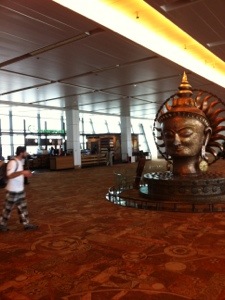
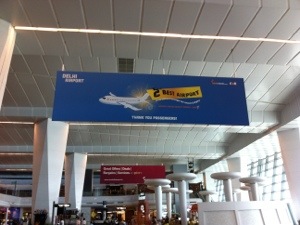
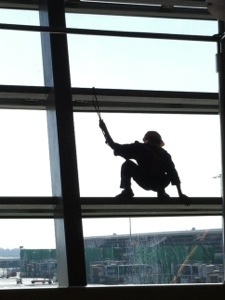
At any rate, Delhi airport is now all chrome and glass and starbucks and Italian clothing, and duty-free shop.

This is very different from my first visit here when it was small and dark and India was in an era of self-sufficiency with little foreign investment, and the whole airport seemed lit by a couple of huge buzzing buglamps. To be fair, my memory waws also from a time in which I’d had no sleep.

I set forth below a sketch that i wrote about my first arrival in India. Needless to say, it is very much a draft, written on the fly and with only a few minutes late, can’t correct, but here goes.

PS — Sorry for the length and any kind of un-p.c. aspect. Take care.

**************************************

The first time I went to India I arrived in the middle of the night. It was completely black out with a sense of heavy overhang. Unseen tree branches. No street lights or traffic lights.

The airport, Delhi, was fluorescence painted yellow–everyone’s seemed to be lit by camera flash. The man who picked me up, Vijay, from the South had a huge toothed bright smile. Even the custom’s agents in their olive drab seemed only lit up in swatches. Vijay led me to a cream colored Ambassador, it’s rounded hubs like the Art Deco of another age.

This was the early 1980’s, a time during which the Indian government was promoting self-sufficiency as well as reacting against Kissinger’s past “tilt” towards Pakistan during the Nixon presidency. As a result, and as I was soon to discover, you could find practically nothing in the country that was not made in India – except for a few very minor imports from the USSR.

That included cars. We drove the round-hubbed Ambassador through that heavy overhang of darkness. It was not hot–October, not cool – I don’t remember much of the weather actually –only that it was incredibly dark–from the back seat I could not even see the road– and I had a feeling we were driving forever, and my host Vijay kept turning around and smiling and asking me how my flight was.

We stopped at a gate, opened, by a guy in a pale khaki uniform – I soon learned that it was common fin Delhi for even employees of the most minor hotels to wear uniforms and came to a stop before the letters YWCA. My guesthouse.

Vijay took me to the door where everything became fluourescently blue, instead of the yellow of the airport, and after ringing the bell repeatedly, one of the darkest men I’ve ever seen came out in a uniform pants, yawn and sleeveless t-shirt, looking blue black beneath the buzzing tube light–wings of moth fluttering unseen around him, and looked at us questioningly. Vijay rapped off sharp words–the man nodded, had me sign a detailed register, which asked everything from my address to my mother’s maiden name–wanted to take my passport which there was no way I was giving up. I had it tethered to my neck in a pouch. Vijay barked some more, and then turned that same fullsome smile back to me – he was a rounded man–, namasted and told me he’d see me tomorrow, or he laughed later that same day for it must have been about 2 a.m. by that time.

Then he was gone – the one person in the country who seemed to know my name, and English–I thought that they would all speak English in India, and the porter, with an open uniform khaki shirt now over his slender torso, wifebeater, hoisted my backpack upon one shoulder — not on one shoulder through the strap, but at the top of his shoulder balancing it it by his head and began to climb up the robin’s egg pale stairs, in and out of the fluorescent light tracts.

I followed him and the moths, noticing suddenly on an interior wall, a lizard climbing vertically up – a gecko I guess– gasped loudly enough that the porter turned down to me. I nodded towards the lizard who kept up its same translucent cimb–in that light–you really seemed able to see through the toe webbing.

His face was shadowed even darker–at that time most Indians were ver slender –I think that they still are, and have the dramatic bone structure that goes with leanness – and the whites of his eyes against that darkness looked almost mottled – as if the contrast with his skin made one see all the variations in the whites more clearly – the tiny little veins – the blue and red tinges – the actually cornea (brown black) — those corneas stared now blankly, not comprehending that the lizard could have incited my gasp.

And waited for me. I nodded quickly–the pack looked so heavy by the side of his head like that – he wore flip flops as pale and transluscent as the lizard’s webbing – and so we trudged on again, on to about the fourth floor.

The actual floors, had landings that were open to the world–too dark to see anything, just night hair – cooler than I expected, or I shivered anyway, ands he opened the door with what looked like a skeleton key – one of those old ones in British movies, and I felt an embarrassed, ridiculous but real fear to be going into the room with him – taller than me, seemingly made of teak, mottled eyed, the world utterly dark and quiet except for the buzz of the fluorescents he’d switch on.

He did that now – the room buzzed softly – he brought my pack in, put it down on a table covered made of a kind of cheap wooden board, gingerly stretched his neck. Stared at me.

I finally got it. But Vijay had not waited for me to change money at the airport as my guide book had suggested, and I realized now that I had no rupees.

The porter nodded towards each bed, then went to the bathroom and turned the light on and off meaningfully. Then, waited,stared.

No rupees, I said, and tomorrow, and he switched the lights in the bathroom on and on again. There was one on the mirror over the sink. He switched that one on and off now too.

Swung open the closet door. Swung it shut. Waited. Stared.

Tomorrow, I said, and no rupees. And cursed silently the smiling Vijay, and all I had were five twenties that my boyfriend had given me before I left – there at the door of his apartment, and five pink packages of sweet and low – saccharine being something not readily available in India, and me an addict and thick pad of traveeler’s check, still I dug around my stuff wondering if I could bring him a post card of New York –and found in the side of my purse a five dollar bill.

Now five dollars at that time in India was a great deal of money. there were then 13 or 14 rupes to a dollar (now about 50) and my sense was that a dollar – 14 rupees went a long way –

I’ve got this, I said.

He stared at it blankly, his skin seeming to me more blue-back, his cheekbones more sculpted than ever. He did not reach out to take it.

“Dollars,’ I said, “Five Dollars.” I tried to do the math into Rupees – like 75,” I said.

He stared. Then went back to the bathroom, turned on the switch one more time, turned it off again, all the time keeping his dark eyes on me.

“It’s all I have,” I said.

I think that now a porter in Delhi would not react this way.

But this was thirty years ago, and my sense then and now was that probably someone who was a porter had very little contact with dollar bills.

“It’s all I have, ” I insisted, holding it out, and he took it at last, reproachfully, and scuffed out of the room, me following closely so I could quickly lock the door behind him.

(Though, of course, he had the key.)

But I did not worry about my safety exactly. More, I think, about my sanity. I was alone. In New Delhi. With no rupees. But at least I knew how to work the lights.