Archive for the ‘Blogging’ category

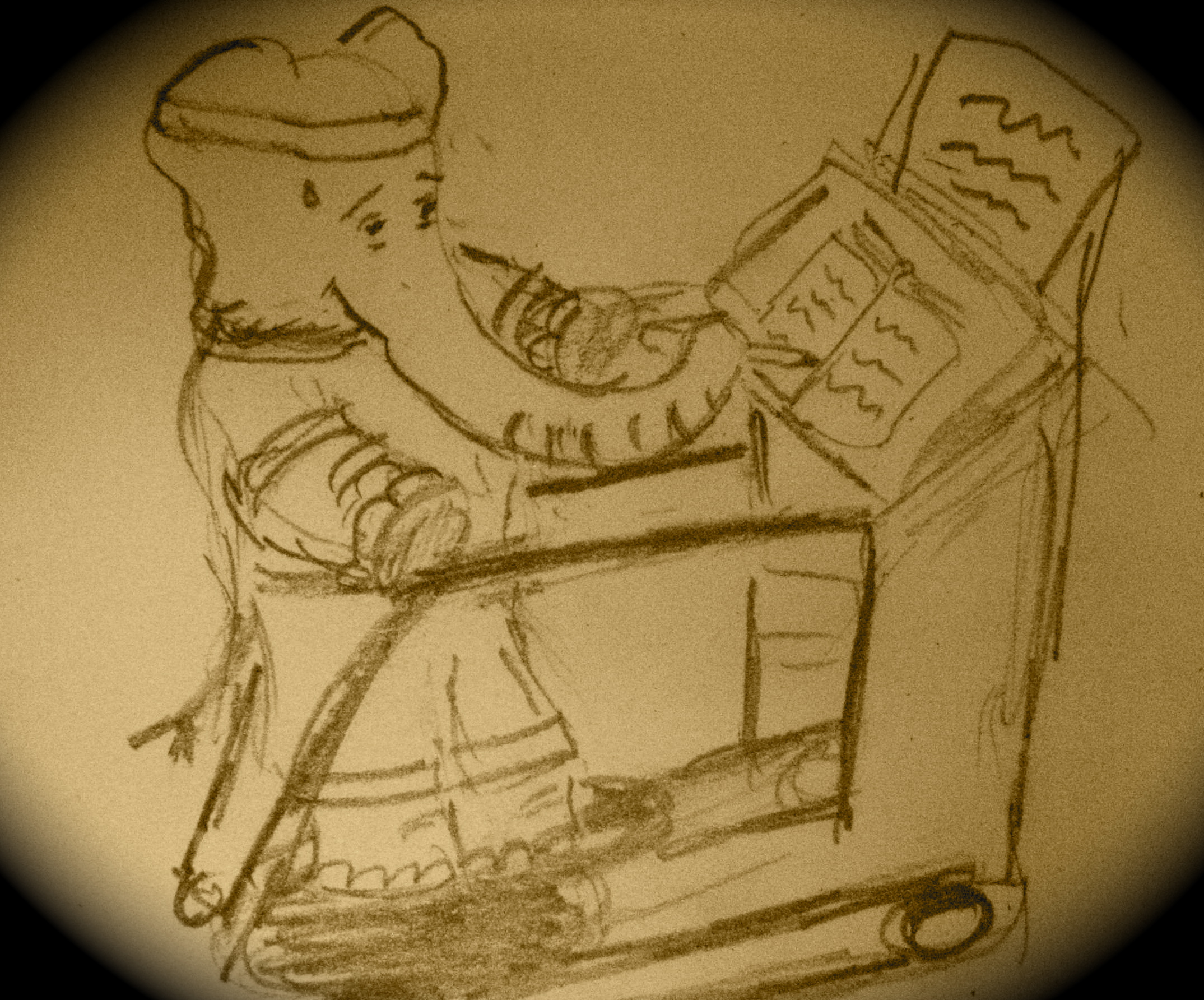
Blogging, With Elephants?

May 28, 2010

More Elephants

I am bemoaning today the lack of subject matter of this blog.   Actually, it’s not completely fair to say that there is no subject matter.  The subject matter is whatever comes into my ManicDdaily head.

I am bemoaning today the lack of consistent subject matter.

People like subject matters, just as they like a certain predictability.  It’s bred into the species, I think, maybe into living itself.  Babies with clear naptimes tend to nap  more easily and more cheerfully; dogs want to stick to their routines, marking the same old spots on their same old walks; horses find their way back into their stalls; and adults (human adults) like to get the same kind of bagel with the same kind of cream cheese, with the same kind of coffee, with the same amount of sugar and milk in it, every single morning.

As part of this preference for the routine, I am pretty sure that people tend to prefer a blog that has a theme.   Something they might even learn from, or at least, feel uplifted by.

But I don’t really know anything well enough to teach it.  Further,  anyone labeling their blog ManicDDaily may not in fact be so uplifting, so….

Hmmm…..

What can I write about?  Consistently? (Or draw?!)

Elephants?

(But shouldn’t it be meaningful?)

More elephants?

Hmmm….

Any and all suggestions are welcome .

Elliptical Thinking ….errr….Writing

May 12, 2010

Gym Blogger

The other day I blogged about learning to write wherever–not, in other words, using one’s lack of a writer’s cabin as an excuse to put off work.

Today, I’m putting that admonition to the test by blogging at the gym.  Right now, I’m writing as I walk down the stairs to my gym, now I’m writing as I swipe my gym pass, now as I walk past the yoga class (writing there might be considered anti-Om). The place I’m heading is the elliptical machine, a machine which is dull, repetitive, and has a good ledge for my notebook.

And now I’m on the elliptical machine, and, in fact, I am already experiencing a slightly uncomfortable burn in my upper thighs and a definite twist in my lower back.  (One problem with writing on the elliptical, or perhaps any exercise, machine is that it’s hard to keep your body symmetrical.  I should note here that I’m writing in an old-fashioned composition notebook and not in an iPad or other electronic device which would perhaps allow one to jog and blog in perfect two-handed symmetry.)

Ah.  (It’s working… I mean, I’m working,  sort of.)

Though there are a few caveats to writing on an elliptical machine:

1.  Take care not to press your notebook into the electronic display or you will completely lose track of your time, strides per minute, calories, distance and heart rate.  Actually, forget about heart rate.  You are not holding to the hand bars and those heart rate measuring strips never truly work in any case.

2.  Do not expect to reach your maximum speed.  Maybe, in fact, it’s best not to even try for your maximum speed.

3.  Do not expect to write the great American novel.  At least not on the elliptical machine.   Frankly, if you wish to avoid disa—

Oops!  Just pressed the display  and the whole machine is rearing up, meaning that I’ve not only lost my time and calories, but all my resistance settings have plummeted and I’m suddenly going about a mile a minute.  No, only 141 strides per minute, but that’s still a bit fast for good sentence structure, and it also feels–

As I was saying (I’ve reset the settings now), if you want to avoid disappointment, you may be wise to let go of expectations of writing the Great American Novel, whether on or off the elliptical machine.

But seriously, the points of all this are:

1.  You can write anywhere.  Granted, the writing may not be always that great, but it can help you keep your writing muscles toned.

2.  We (I) seem to have this need to both multi-task and communicate.  Yes, it might be better to quell these needs, but sometimes there can be real comfort in just accepting your predilections–your fullest, most manic self (if you are not actually hurting that self or others).

Sure, people may view your truest self as being a bit strange–for example, the people around me right now may think I am a pretty poor excuse for a gym rat.  But, who cares?   There are plenty of empty machines to my sides.  In fact, my whole little section of this fairly crowded gym is completely unoccupied….

Hmmm……

Pattinson and Poetry

May 2, 2010

Comparative Hair - Billy Collins/Robert Pattinson

After a month of posting draft poems in honor of National Poetry Month, I have to say that there’s a certain payback to blogging about Robert Pattinson (the 23-or-4 year old star of the Twilight Saga movies).

The fact is that not that many people are interested in poetry, particularly the draft poems of an unknown blogger, while many many people are interested in Pattinson (as in gaga over, or contemptuous of). Sure, there are also a lot of people who are disinterested in Pattinson, but often disinterested in a way that borders on the self-righteously dismissive (e.g., a teeny teeny bit interested).

Lately, an important percentage of the fascination does not seem to be with Pattinson himself, as with the very interest he elicits (all those screaming girls.) He was recently named, for instance, one of Time Magazine’s 100 most influential people in the world.

Curiously, the commentator justifying this designation did not cite any particular example Rob sets, or influence he levers, so much as the fact that any information about Pattinson–public sighting or comment–is the immediate subject of a zillion tweets and retweets.

And why are people so interested in Rob? Okay, the looks—Nureyev cheekbones, tortured eyes, hair—this blog has already discussed those at length. More importantly, however, Pattinson is identified with a character (Twilight’s Edward Cullen) who is an escapist ideal—the perfect…oops! nearly perfect…oops! not quite man. Here Pattinson plays into a double fantasy of male perfection and vampirism, with each element vying for the most incredible. (Sorry, guys!)

Poetry is tremendously down to earth in comparison. A good poem tends to bring the reader more fully into the moment, or, at least, some moment, rather than out of it.   Even fantastical poems, such as those by Yeats or Keats or Robert Bly, deal in the real and human and very imperfect.

But people like perfect escapes. Which may be why poets, even those super popular poets, like Billy Collins, tend to earn much less than movie stars. That and the hair.

Multitasking in An Elliptical Age (Filling In The Blanks.)

March 2, 2010

Blogging on Elliptical Machine

I’m at the gym right now, trying to write this blog post on the elliptical machine.  One good thing about blogging on an elliptical machine is that it is far safer than blogging while actually jogging, especially at night.

We live in a multitasking world, especially those with Blackberries or iPhones.   (Such devices are a bit like young children at the beach—you feel a strong need to keep at least one eye on them at all times.)

Human life has nearly always required an ability to juggle.  Women in particular multi-tasked long before it was a word— carrying a baby while doing almost anything, watching toddlers while doing almost anything, soothing male egos while doing almost anything.  (Okay, I’m sure traditional men multi-tasked too—trying to keep women subservient while doing almost anything.)

(Sorry.  I guess I’m not in a great mood tonight.  After all, I’m blogging on the elliptical machine.)

Certain types of multi-tasking feel quite natural:  talking with your mouth full;  thinking while scratching your head (or, if male,  your…..) ; gorging while going on a diet.    Some combinations are difficult–cleaning up while you cook, for example–but others  can be achieved by just about everyone.  (Gerald Ford really could walk while chewing gum, no matter what some historians say.)

Typically, tasks which combine well are performed in different quadrants of one’s being, such as the physical body and the mind, or two separate parts of the physical body (mouth and feet.)

But today’s multi-tasking often seems to involve doubling up in the same corporeal or mental space:  talking on the phone while reading one’s email,  constantly updating Facebook status while also doing homework,  driving while texting.

In performing these new multi-tasks, people don’t use different quadrants of themselves, but different quadrants of reality—both the “right here now” reality and the virtual reality of the screen, satellite, busy distracted mind.

For many, virtual reality is more mentally compelling than “right here now”.  Our physical bodies, however, are stuck in “right here now.”

And now I suddenly notice that I’ve been stopping my elliptical gait for whole sentences at a time.  Which makes me think that, when the mind is trying to double-up in one quadrant of activity, it is often not true multi-tasking, but instead switching rapidly between tasks, turning off to one thing as it turns to the other.  In other words, it’s a series of changing gears, each of which brings with it a kind of ellipsis.  A  blank of inattention to at least one of the tasks, and maybe to all of them.

On the road, in the street, in the real world, that can, of course, be very dangerous.  But in the world of the gym, which is kind of a mechanized limbo between “right here now” and the virtual world, it’s actually seeming to work.  I notice suddenly that the elliptical machine is really quite relaxing if you are only doing it in short bits.  And this blog post, amazingly, is just about… done.


Further To….

February 20, 2010

One of the good and bad features of a daily blog (especially for a blogger with a daily job) is that it requires the blogger to get posts out quickly, sometimes before an issue is very well understood.  (Sorry!)  In such cases. the post is really a reaction (perhaps premature) to an issue, rather than any kind of cogent analysis.  Sometimes the post doesn’t even reflect the blogger’s longer-term, or considered, reaction to an issue,  but, at best, is simply a snapshot of the moments in which it was written.

Here is further information about the topics of two recent posting:   the first relates to The Line Between Satire and Sneer (illustrated by the teapot surrounded by UFOs), which expressed my wish that the TV show Family Guy hadn’t joked about  the mother of a character with Down’s Syndrome being the former governor of Alaska.    Palin and her daughter Bristol interpreted the program as a cruel jab at Palin’s son Trig (with Down’s Syndrome).  An article in today’s New York Times describes the reaction to Palin’s outrage of the actress,  Andrea Fay Friedman, who did the voice-over for the Down’s Syndrome character and who herself has Down’s Syndrome.  Ms. Friedman accuses Sarah Palin of not having a sense of humor, and of misunderstanding the episode, which presents the Down’s Syndrome character as an obnoxious but strong figure:   “I’m like ‘I’m not Trig. This is my life, ” Ms. Friedman said in a telephone interview with the Times, “I was making fun of Sarah Palin, but not her son.”

I still don’t like Family Guy.  (It’s the crassness.)  And I still wish that the show had not given Palin further “mileage”.  But the article, which gives more information about both the episode and Ms. Friedman,  certainly clarifies another perspective.

The second story which is subject to increasing illumination as the days go by is about Joe Stack, the man who ran a plane into the Austin, Texas IRS building (and whose disgruntlement with the IRS apparently began when the IRS refused to give him a tax exemption as a church.)   Gail Collins has a great article today, The Wages of Rages, about Stack, but also various lame-brained attempts of Republican politicians to expropriate Tea Party rage for political capital.   Yes, she manages to include a reference to Mitt Romney tying his dog to the roof of his car.

Blocking Writer’s Disorganization

January 26, 2010

As some of you know, I’ve written several posts on blocking writer’s block.  (Check out that category!)  But in the last couple of hours/days, I’ve been dealing with a different problem.  Writer’s disorganization.

Mine centers on one of the least-cited negative qualities of working on a computer – the  ability to save multiple, vaguely distinguished, drafts.

It sounds wonderful in principal.  The ability to “save as,” repeatedly, means that you never have to throw anything away.  You can experiment with all kinds of revisions.   Unlike a visual artist working on a single canvas, you rarely have to irrevocably choose what works best.

But combining (i) revision with (ii) indecisiveness can be disastrous over time.  Especially if you are cursed with (iii) an aging memory, and (iv) an ability to reel off pages.

Which is the best draft?  The final draft?  The one you want to send out?

The dates should provide a clue (if you save them by date!);  however, indecisive, moody, and interrupted, rewriting may mean that your very last draft is far from your best.   (If you started changes that you didn’t carry through, your last draft may not even be fully coherent!)

If you confine the drafts to your hard drive, some trees may at least be spared.   But some of us (whose names will not be mentioned here) have developed the concept of “print only” drafts (as opposed to “read only” files), meaning that certain drafts may be  printed,  even copied, but never actually perused.  (Why is it that once one gets used to reading on a screen, the printed page seems so naked, painful, exposed?)

I certainly have yet to solve this problem.  But here are a few suggestions which, like multiple drafts, sound good at least in principal:

1.  Slow down.  When you revise, read changes carefully, maybe even aloud.

2.  Take yourself seriously.   Put your bunches of drafts in separate computer files.   If you are working with a longer piece, you might even take the time to type some little commentary at the top of the draft.  (I’ll never do this, but it sounds good.)

3.  Consider actually destroying redundant drafts.

4.  When you do print, put little footers on the pages so you know which version it is.  Put the printed copies in a little notebook, rather than a plastic bag in the back of a closet.   Label them, show them, look at them.

5.  If this is all too difficult, maybe you should just blog.  If you do it daily, you won’t have time for multiple drafts.   (Aahhh.)

Waxing Philosophical – The Framework of Now

January 19, 2010

One of the negative side effects of being a writer and blogger is difficulty being a “liver”.  (I do not mean here an organ that filters blood, but a person who does not filter experience.)

When you focus a great deal on ongoing narratives and commentary, it can be very hard to just be (as they say) in the moment.  The ongoing mental monologue (or dialogue if, like me, you are a Gemini) unfortunately leads to a lack of attention, also a lack of wonder.  This is terribly self-defeating as both attention and wonder are important tools in coming up with something real/good/unique to write about.

Of course, it’s not just writing and blogging that make for difficulties in being present in the actual ongoing physical world.  Modern life cultivates customs of pre-occupation.  Cell phones, blackberries, make avoidance of the direct physical moment seductively easy; a screen on which one can project one’s own narrative and constant commentary (whether texting, emailing, or simply identifying) is compellingly addictive.

There’s also the fear factor.   Turning your attention to the moment, to the right now physical world, can be scary simply because you are typically such a small part of that moment, such a teeny, transient, corner in that world.

Here’s a short poem about it, written while trying to take a walk.  (In short, it’s a poem written about being in the moment while avoiding actually being there.)

The Framework of Now

How hard it is
for the mind to fit
into the framework of now;
the reason may be
that ‘now’ is not ‘me’;
how the mind hates to see
how much goes on,
and will go on,
when it is gone.
Can’t rationalize the lack
of its active participation,
a bulwark
unto itself.

All rights reserved.  Karin Gustafson

P.S.  – the above poem is really a draft.  These are always especially hard for me if no formal verse structure, i.e. sonnet, villanelle, pantoum, is involved.  If anyone has any ideas, let me know.

Plan for the New Year! Less Martyrdom! (I’m Realistic.)

December 31, 2009

St. Lucie (Francesco Beda) (1521)

It’s terrible to be a martyr.  I’m not referring to someone like Saint Lucie depicted above with her eyeballs on a platter, or Saint Agatha, shown below, with the lopped-off breasts on a platter.  (Renaissance painters of saints seemed to really like platters.   And breasts.)

No, what I’m talking about is a self-professed and not completely willing martyr of a modern woman or man who, like me, bites off more than she or he can chew with the expectation/hope/desperate wish that someone will swoop to the rescue, and, for example, unasked, grab the six bags of groceries dangling from the martyr’s wrists,  carry said groceries home, and, while unpacking them, clean out the fridge.  (But quietly.  Any cleaning out of the fridge must be done in a manner that expresses no criticism of any stale, moldy, or long-expired food neglected by said self-professed martyr on said refrigerator shelves for the last twelve to eighteen months.)

I should note that I am discussing martyrs here in preemptive self-defense.  My original plan for this blog was to list several things I wish I’d said less often in 2009, and several  things I wish I’d said more often;  what I then scrawled down were some incredibly whiney and selfish-sounding phrases.  This process led me to come up with a resolution for 2010, which is simply to be less of a martyr; that is, to stop agreeing to things, or at least quite so many things, that are not really so agreeable, and to stop waiting for outside rescue; to stop being so squeezed in other words.  (News alert to ManicDDaily:  it is extremely unlikely that your boss will ever tell you to go home early so that you can write a better blog!)

While this resolution sounds a bit solipsistic, my hope is that it will actually lead to more  robust generosity. (You’ll notice that both Saint Lucy and Saint Agatha are not painted as squeezed, wizened, or anguished, but as fulsome, buxom, peaceful.   I take this as meaning that it is better to make a direct, clear and intentional sacrifice, than to feel endlessly chipped away.)

So, keeping the big anti-martyrdom resolution in mind, here are the whiny lists:

Six Things I Wish I’d said Less Often in 2009

1.  “I’ll get that to you tomorrow at the latest.”

2.  “Don’t bother.  I can handle it myself.”

3.  “Let me pay.”  (Again!)

4.  “I don’t really eat sweets.”

5.  “You take it.”

6.  “I’m sorry.”

Six Things I Wish I’d said More Often in 2009

1.  “I won’t be able to get that to you till the end of the week at the earliest.”

2.   “I’d love some help.”

3.  “If you insist.”

4.  “Yum.”

5.  “Why don’t we split it?”

6.    “I’m sorry.”

I’m not going to be able to do without No. 6, the apology.  However, while the apologies of the martyr sometimes seem ubiquitous,  they are, in fact, conspicuously tardy, or even absent when the martyr is truly at fault.  (It is really hard for martyrs to ever acknowledge being truly at fault.)    So, I guess what I’m aiming for is a shift in the depth of the apology.  (Maybe a better word is self-awareness.  Hmm….)

At any rate, have a very happy new year!   Thanks so much for reading!  And keep your eyes on/off the platter!

Saint Agatha (Orazio Riminaldi) (1625)

(P.S.) Note that I say “less martyrdom” and not “no more martyrdom.”  Ha!

Newspeople, Bloggers, Blocking Writer’s Block

November 30, 2009

Yesterday, I wrote a kind of odd post about “Celebrity News” which focused on the addictive quest for celebrity in our culture.  I also discussed the intense craving of some newspeople, particularly TV newspeople, to be people “in the news” as well as people discussing it.

I felt a little guilty writing so dismissively about newspeople’s quest for attention.   It did not escape me that bloggers could be said to suffer from similar cravings.

I can’t speak for all bloggers—I only really know one.   Still, I think the average blogger’s pursuit of attention is somewhat different from that of the average TV newsperson.  First, the newsperson often seems to be embued by grandiosity;  a (perhaps inherent) narcissism has already been gorged by all the staff persons hovering– brushing their hair, checking their noses, patting their tummies—(wait a second, that’s spaniels–)

A blogger, in contrast, tends to be alone when working, either by choice or happenstance.  (The blogger’s family, losing all hope of a dinner at home, has gone out.)   The blogger, unlike the TV newsperson, or any TV persona, receves little coddling; their “stats” are a pretty good ego-toughener.   Moreover, the blogger knows that even the few that do “view” the blog may look for a second at most—the time it takes to realize that a mouthwatering tag like “Robsten” has led to no new gossip and questionable adulation.

As a result, the blogger must garner sustenance from the age-old wisdom of Gandhi, as quoted by that newly-minted sage, Robert Pattinson, in the trailer of his upcoming movie, Remember Me: “Gandhi said that whatever you do in life is insignificant, but it’s very important that you do it.”  (Sorry, but in the downswing from the manic side, I find myself studying this trailer.)

Which brings up what may be the most important difference between the TV newsperson’s motivations and the blogger’s.  The blogger (or at least the only blogger I know) does not crave attention so much as expression.  Yes, the blogger is thrilled when the number of hits rises, but his (her)  most engaging and happy moments, are those spent actually writing, typing, and cursorily editing, each post.  And then, of course, the pressing of the little button that says “Publish,” and the watching of that little button spin.

This is something for those with writer’s block to remember.   Try to get hooked on the process, and not to think too much of the impression that you, as the person engaging in the process, are making.  Of course, you need to keep your audience in mind.  You are trying to communicate.  You want your readers both (i) to be able to follow your work and (ii) to want to follow your work.   But try to keep the focus on the the writing, the message, and not on yourself as its deliverer.  Writing is not about getting your nose powdered, head (or tummy) patted, but about putting the words on the page.

Friday!

November 20, 2009

It's Friday! (Elephant From 1 Mississippi)

It’s Friday!  Finally!  And sunny!

For those of you who are not Robert Pattinson fans – and  I understand in a tangible way lately that the word “manic” comes from “mania”, and “fan,” “fanatic”–apologies for the last few posts.  Note that I tend to alternate, almost simultaneously, Pattinson posts with more serious posts, so if you run into one of the Pattinson ones and Pattinson really is not your interest in any way, just keep scrolling down.  Or check out the categories on the side of the home page.  (This is a wonderful tool WordPress has.)  There’s a lot on poetry, of poetry, advice about writer’s block, parenting, and other non-Pattinsonian  subject matter.

Thanks for reading!  Have a great, hopefully-sunny-where-you-are weekend!

(And, if you get a chance, check out 1 Mississippi by Karin Gustafson on Amazon.)

Thanks again.