
Archive for 2011
Apple Picking! (With Elephant)
September 25, 2011Repetition Raises A Villanelle (“Shattering”)
September 24, 2011
This is another post inspired by dVerse Poets Pub, a really supportive website for online poets. The prompt this time concerned poems that deal in repetition. As followers of this blog know, I’m devoted to the villanelle, a poetic form that is based on repeating line sequences. This villanelle is part of a pair–its companion piece, “Burned Soldier” may be found here, as well as a discussion of how to write a villanelle. Both poems were inspired by the ongoing wars in Afghanistan and Iraq. Any thoughts or suggestions most welcome.
Shattering
The shattering of lives should take some time.
It shouldn’t come in flashes, clods of dirt,
no moment for altered course, for change of mind.
The actual choice ahead should be well-signed–
pre-emptive smoke, perhaps a blood-soaked shirt–
the shattering of lives should take some time.
He knew that road was risky, heard a whine,
but in the end those warnings were too curt,
no moment for altered course, for change of mind.
Hard to foresee your own true body lined
with metal plates and plastic tubes of hurt;
the shattering of lives should take some time.
So many hours after to refine
what happened in that second’s blinding lurch,
no moment for altered course or change of mind.
Or was it fate? A studied path, not whim?
His heart tried hard to measure out the worth
of shattering lives. It would take some time,
with no moment for altering course or mind.
(All rights reserved.)
P.S. – I’ve posted a lot of villanelles, which is a favorite form for many years. I love the music- and yet, the repetition. They can be found by checking out that category from home page.
Another Sestina (Sigh….) “Vacuum”
September 23, 2011
(Supposed to be cigarette smoke)
This is a poem, a sestina, that I’ve posted before, but I’m linking it tonight to the liv2write2day blog of Victoria Ceretto-Slotto, in which she asks for poems writtenabout the dark, or shadowed, self. I’ve written a lot of dark poems lately, so could not quite bear a new one, but this poem deals with these issues, at least for its characters.
The sestina is a fairly complex form which uses six six-line stanzas, each line ending one of six repeating words, closing with a three-line “envoie” that uses all six repeating words. (More about the form in yesterday’s post.) It’s a challenging form; the goal is to make the repeated words hypnotic, ironic, thought-provoking, meaningful rather than formulaic or forced.
Hah!
I’ve posted another sestina called “Pink” which is really a better poem then the one below. This one was my first attempt and, although it uses the form, it does so by using fairly generic repeating words. So, it’s a bit of a cheat. (See, I’m already going to dark places!)
The poem tells a story, but keep in mind that it’s a creative work, which, in my case, at least, means it has large elements of fiction, dramatization, exaggeration.
Vacuum
When my aunt came to visit, they talked
of old times, my aunt hunching over
her cigarette, her heavy breasts held up
by an arm across her middle, my mother
smoking as well, her cheeks like a vacuum
cleaner, puffing out. She only smoked when
her sister came, then turned into a teen when
the folks are out. Gestures sullen, she talked
the rebel, as if to fill the vacuum
of her youth, when she never thought she’d get over
all the obstacles they’d set, her own mother
not understanding, no wonder she got fed up.
She loved them, yes, but everything was up
from there–farm life. Especially then, when
owning land was something, not, like her mother
thought, everything. You were still talked
about, looked down on, passed over,
a farm not bringing cash to fill the vacuum
of nice clothes, furniture, rugs to vacuum.
Though what they remembered–that night they stayed up–
was when the government took their land, building over
their farm a munitions plant for the war, and when
their father went north to rawer land, and they talked
of joining him when their own grandmother
was “stronger.” (So they said.) Loved by my mother,
the grandma favored her in turn, filling a vacuum
in the heart of the middle child, the child who talked
of appearances, sticking her nose up
the others thought, the grandma protecting her when
they mocked, but sick now, her life nearly over.
They worked shifts at the plant, then each took over
the grandma’s care–aunt, their mom, my mother.
‘But who was with her,” my aunt asked, eyes round, “when
she died?” My mother thought: “I had out the vacuum,
I remember that. Pulled it out after ringing up
the doctor,” my mother smoking hard now as she talked.
“So it was you,” my aunt said, “when—” “I tried to vacuum
fast.” But slowly my mother spoke, smoke rising up
like traces of what could not be done over, slowly she talked.
P.S. I am also linking this piece to Imperfect Prose for Thursdays. 
Sestina – “Pink” – and Little “How-To”
September 22, 2011
This is an old poem that I am reposting as part of dVerse Poets Pub formal poetry exercises and also for Jingle’s prompt re color. It is a sestina, one of my favorite forms (though I don’t do them enough.)
I’ve included a little information about my take on the form below.
Pink
Trees full of blossom, the night smells pink
though it’s black, a thick summer darkness
barely held back by window screen.
I hear dishes in the sink, a familiar clatter,
and think of the summer kitchen
of my youth (my grandma’s), where the women wiped
the dishes, too many for the rack, wiped
the oilclothed table too; the men, skin pink
from glossy food, escaped the kitchen
glare, slinking into the darkness
of the den, the chatty t.v. clatter
a sound fluorescence against the dim screen.
There too, we were protected by a screen
from bites, buzz, wing, and the wind that wiped
that stretched-flat land, a soft clatter
of night and grass and damp that blew towards the pink
edge of dawn, an engine of chill darkness
that was only truly blocked by the glow of kitchen
yellow. I watched one aunt in the kitchen,
amazed that she never even tried to screen
her keen sense of life’s darkness.
When she looked at my grandmother, she often wiped
her eyes, and sniffing, face too pink,
cleaned with a banging clatter.
Though she was always a center of clatter,
that aunt. She had a kind of two-walled kitchen
in her own house, open; and wore hot pink,
played jokes, charades, a half-hearted screen
of despondency, still, the good housewife, she wiped
the smallest speck from her counters. Her own darkness
seeming inevitable, it was a darkness
she hurried towards, smoking, drinking hard, the clatter
of uncertainty (as to timing) wiped
her out. In the meantime, she cleaned-—my grandma’s kitchen
after her death, and, at the Funeral Home, made a quick screen
of the corpse. “That lipstick’s way too pink,”
she hissed, then wiped my grandma’s lips like a kitchen
stain. Despite the clatter in my brain, I served as screen,
a guard in the blossomed darkness, as she rubbed off pink.
(All rights reserved. Karin Gustafson – from Going On Somewhere, available on Amazon.)
The sestina is an extremely “ordered” form of poem with a strict line structure that focuses on six repeating “end words,” (that is, the last word in each line.) Thankfully, these end words do not have to rhyme.
There are six six-line stanzas, and six repeating end words. At the end of the six six-line stanzas, there is a three-line stanza (the “envoie”), in which the six repeating words are used again, two per line.
The hard part is not just repeating the six words, but repeating them in the right order; each stanza turns itself partly inside out for the next one. The music of the poem comes from the shifting, and sometimes surprising, echo of the repeating words. If the meaning and tone of the words can also shift through the poem, a kind of irony can be found.
Here’s how the form works:
For notation purposes, I’ll assign each end word a number – 123456. That is the order of the first stanza.
The second is 615243. The third is 364125, the fourth 532614, fifth 451362, and finally 246531. You’ll notice that the last line of each stanza becomes the first of the next, the second- to-last line, the third, etc. It helps to think of the stanzas as interlocking or clasped hands, with the clasp between the fingers moving up the hands with each stanza. (I guess they’d have to be Anne Boleyn-style hands – six fingers.)
There are different forms for the order of the words in the last three-line stanza; my favorite puts the words in reverse of their original order, meaning 65,43,21.
The form is hard, yes. A tip: once you’ve decided on your repeating words, write them down in the prescribed order for the entire poem. (This means that you’ll have a nearly blank page or so, with just a column of numbers and words on one side.) This list will not only help you keep your focus; it will also avoid the frustration of having a nearly finished poem that, you suddenly realize, did not quite follow the rules. (If it’s a great poem as is, terrific. But if you wanted to write a great sestina, this can be upsetting.)
It is useful to pick end words with flexible meanings and usage (meaning words that can be either nouns or verbs, even homonyms). Commonplace words are easier, but less interesting.
In Georgia
September 21, 2011
No flippancy is intended here; it’s really all I know how to draw. Crazy world/country. Feel sorry for all, sorrow for all.
Hard time focusing (i.e. focusing in hard time)
September 20, 2011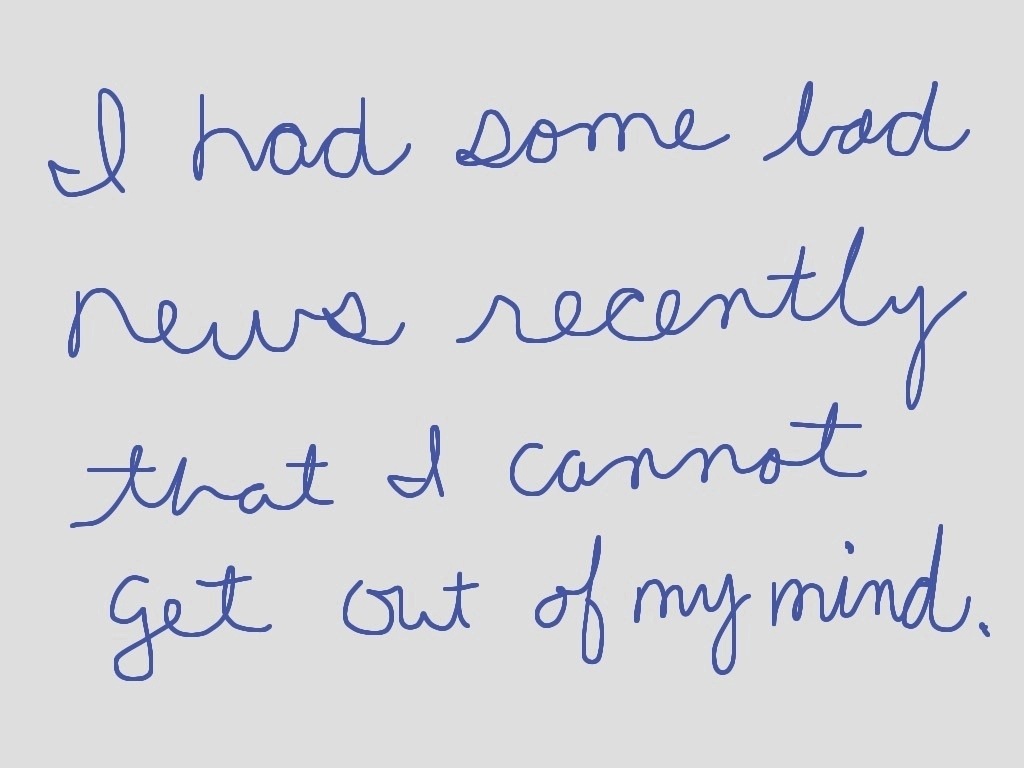




Poem To Mariano Rivera, on his 602nd Save
September 19, 2011
To Mariano Rivera, from a New Yorker
Mariano, you’re our man,
you pitch as well as any can.
When you step out upon the field,
the batters know they soon must yield.
Your cutters cut them down to size
as fans, in awe, dissolve in sighs!
Good old Mo, you are our man,
the greatest closer in the land.
(PS – Dear Mariano, sorry for the portrait. It doesn’t infringe on anyone else’s copyright, but it also doesn’t do you justice!)
(PPS – Thanks for all your years of inspiring and cheering New York.)
Ray’s Pizza Closing Or Moving – Really the original Ray’s (no trademark infringement intended.)
September 18, 2011
(Not actually like the appetizing wonderful pizza at Ray's.)
I was very sorry to read this morning that Ray’s Pizza on 27 Prince Street, the certifiably first Ray’s Pizza, the Ray’s Pizza that was so ahead of the pack that it didn’t have to assert its pre-eminence in its name, and more importantly (on a personal basis), the only Ray’s Pizza I ever regularly frequented, is closing.
There’s still the possibility of a move, but, after 52 years, Ray’s will no longer be open at 27 Prince Street, which sits between Mott and Elizabeth, one block below Houston (for non-New Yorkers, pronounced House-ton).
I have to confess to not having been to Ray’s for some time, but when I first moved to New York, I lived at Mott and Houston, about a block away, and Ray’s was a source of salvation.
At that time–late 70’s – early 80’s–Mott and Houston (now mainly yuppie and traffic-clogged ) was kind of menacing. There was a large juvenile detention center across the street, which, because it was a squat building with a concrete playground/basketball court, allowed for a lot of sunlight, but also cast a kind of shadow over the area. Of course, the streets were already shadowy–the Bowery a block away, legions of “squeegee-men” on the street corners. (They were the guys who were usually paid NOT to clean the windshields of cars waiting for stoplights.) Roosters crowed from boarded buildings/vacant lots; crack vials littered the sidewalks.
To the south, there was Little Italy. Safe enough–if you watched yourself (it probably also helped to be a certain racial type)–but shadowy. That part of Mott Street was still lined with Italian social clubs, little hole-in-the-wall places with one curtained window upon whose ledge stood a plastic Virgin Mary. Inside and out was a shifting (if rarely physically moving) group of heavily-jowled men wearing black coats and fedoras.
Picturesque, though also a bit sinister–Umberto’s Clam House where Joey Gallo was killed execution style was several blocks down as was the Luna Restaurant (where supposedly the hit men were eating before going after Joey). A bit closer to home, a Chinese Laundry torched. (I remember the face of the Chinese proprietor after the fire, like a sheet badly folded–lengthened, flattened, lined.)
And then there was Rays.
The pizza was delicious. Fresh, crusty,saucy, cheesy, not too much of anything to overpower, just enough of everything to savor. (The crust was so good that I remember a girl visiting from Long Island asking everyone else in the place if we wanted ours. She couldn’t justify another slice, but was desperate for more crust.)
The place was comfortable too, pleasant. There were exposed brick walls, which for someone from suburban Maryland, seemed incredibly exotic. In the summer, some of the chairs and tables were shifted out to the sidewalk.
Ray (Ralph Cuomo) was a big guy at that point. (I think I mean in all senses, i.e. large, expansive, later dying in prison.)
The black-hatted, black=coated guys came in to Ray’s too, not for pizza so much as endless cups of espresso.
Still, the place had kind of a family atmosphere. I won’t say that I didn’t ever see anything that didn’t make me gasp, and my husband kick my leg to shut me up. But Ray was friendly, polite; no one was ever rushed. A lot of artist types sat there endlessly arguing about Ross Bleckner.
There was the regular slice, the white slice, the pesto with olives slice, and for a while, weirdly, the white slice with pineapple and ham.
All so good. (Well, I don’t know about the pineapple and ham.) I left Mott Street to travel a year in India and spent a fair amount of that year trying to decide which slice–the regular or the white–would be the first thing I’d have when I got off the plane back in New York. On the clackety Indian trains, waking up to swat a mosquito at my ear, sometimes even when suffering from some traveler’s stomach bug, I would contemplate this question. It was an incredibly difficult decision, even though I knew, of course,that either option would be absolutely great.
I wish the current manager of Ray’s, Helen Mistretta, the very best of luck.
(PS – this post does not mean to imply any connection between Ray’s Pizza and any of the activities described in Little Italy–I’m just thinking back to a time generally. All I know about Rays–great great pizza.)
Unable to Change or Fix Life Poem–Yellow Glads–Grasping At Straws (And Contentment)
September 17, 2011
The political scene seems too grim to even contemplate these days, so turning back to poetry. Poetry! And iPad Art! Although this poem is fairly serious too– Any suggestions, comments, are most welcome, particularly with respect to title.
There
There is so much in life
we cannot change or fix:
your dear friend stacked
with flowers, yellow glads
and lilies white, the green baize
cloth that masks the upturned
earth; the tumor that
takes over a torso, the still
familiar face that can’t digest
the body’s betrayal;
time spent more carelessly
than cash (loose minutes
rarely found in turned-out pockets);
all those difficult years
when contentment was there–
there–there within our grasp if we had just
grasped less; the
flotsam jetsam straws we clung to,
drowning rafts, that
sparkle now in the current of all that’s past,
catching against far shoals, banks, shores–
there–there–there–
(As always, all rights reserved. Karin Gustafson)
(If you are a reader from the wonderful dVerse Poets Pub, the link to the train poem which I should have written and posted today to participate in the Pub is here.)
AND NOW! I am posting this one to the dVerse Poets Pub Open Link night and also to the ver supportive Promising Poets Parking lot (blogspot). Thanks for the opportunity.
Grapes Picture, poem
September 16, 2011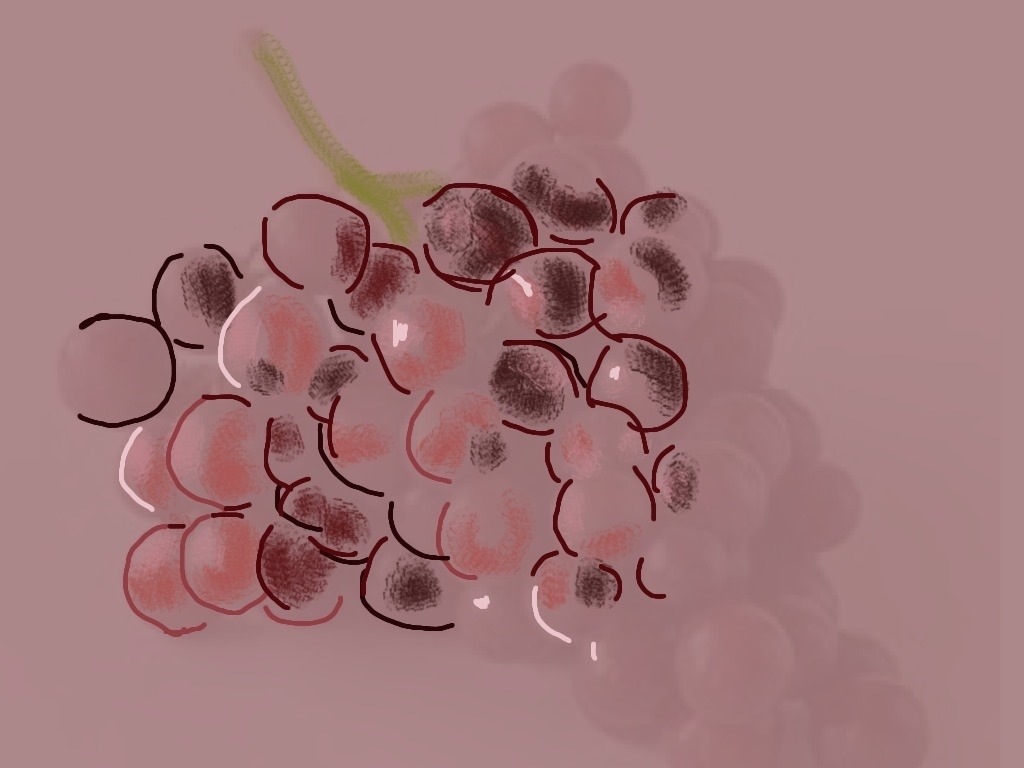
I generally like to be a little upbeat at the beginning of the weekend, but I’ve been reading a lot of kind of dark poetry lately. Many people have a penchant for rather dark poetry, which has led me to write this one.
Grim Poem
There is that
in some of us
that only wants to eat standing
at a kitchen counter.
There is that
that simply cannot
set a table for one,
that sneaks grace
through sidelong dances,
arms stretched around
the ulterior–other’s needs,
moral purpose,
the justification
of simple difficulty: (no pain, no
gain).
The effacement hardly springs
from nobility–our hearts
swell with schadenfreude
well enough, sour
grapes our table wine–but from
what we do not know: how
to be different, how
to be ourselves.
 ManicDDaily
Recent Comments