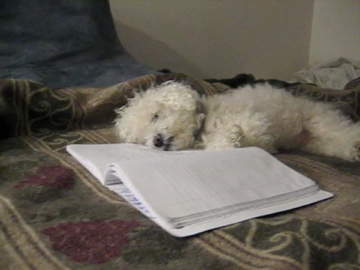
Pearl is really really tired of editing.
I am still working on finishing the manuscript of a novel that I thought was just about finished ages ago.
By finishing, I mean editing, and re-editing. Cutting and cutting more, adding teeny bits.
I am not changing the plot at this point, even though it’s a bit silly. I am just honing. This needn’t be such a long process, except that, unfortunately, I am not somewhat who carves, but rather, someone who whittles. Meaning that I have to go over the same surface again and again and again, smoothing and chipping rather than making decisive definitive cuts.
The big problem with whittling is that it feels endless. (If every time you go through the manuscript, you find more to change, it’s hard to ever feel “finished.”)
Though I am quite sure that at a certain point, I’ll feel pretty certain that I am finished. This will undoubtedly be before I truly am finished. It will still feel good.
I am not there yet.
My next step is to read the whole thing aloud. I shudder at the thought, but reading aloud is truly a great way to edit, especially when you are sick and tired of editing. When you read a manuscript aloud, all of the habitual acceptance disappears, and you immediately understand that that part you always liked is simply boring, or redundant, or run-on, or (if you are lucky), pretty good.
You can see why I shudder!
Pearl just wants me to get on with it.
(For more on writer’s block, see multiple other posts in this category.)


 ManicDDaily
Recent Comments