Archive for the ‘writer’s block’ category

A Pearl For the Blocked Writer: Let Go of The Bad News; the Grandiosity; Just Do What You Do.

October 9, 2010

I woke up today feeling terribly depressed.  Yes, it’s probably my chemistry (the down side of the m-word), but, as I browsed through the online New York Times, I also felt that I had every right to blame my hopelessness on the world in general.

Everything seemed to bring up Reagan’s old (deficit-producing) supply-side economics;  they seemed not just to have been swallowed by the American people but to have become an integral part of the body politic–its eaten-out heart (as in “eat your heart out’);  the idea that compassion is bad while greed is good (for society as well as the greedy), almost a moral imperative.

There was the article about the refusal of politicians to support improvements in infrastructure despite the terrible need both for the improvements and the jobs the improvements would provide.  Then the negativity towards healthcare (in one, a Florida politician whose company was indicted for massive medicare fraud.)

Then there were the  little children bullying other little children, seemingly egged on by parents who are happy, primarily, that their kids are at the top of the popularity heap.

I don’t want to detail the stories of truly horrific brutality, stories where even the words “lack of compassion” can’t be squeezed in.

Normally, I try to spend Saturday re-writing one of my old children or teen novels.  (I have a few that for years have seemed sort of finished, and yet still aren’t quite “done.”)  But, suddenly, my little fictional tales seemed ridiculously trivial.   Sure, they all promote compassion; but they are also, due to my lack of talent and vision, not particularly life-changing, society-changing.  Not even, perhaps, life or society-nudging.

Of course, one would like to write life-changing books!  But what if you just don’t/can’t.

Feeling grandiosely whiney, I looked over at my very conveniently located muse–that is, my good old dog Pearl, snoozing at the bottom of my bed.

Talk about a lack of grandiosity!  Talk about forging ahead!

Pearl might very well like to be a noble dog, a celebrated dog (a Balto!) even just a big, strong dog. But she was born cute and fluffy and a little bit clownish.

Pearl might even like to be young again, with fully functioning limbs.

Nonetheless, Pearl presses doggedly through life each day, doing what she does as best as she can.   And not doggedly just in the sense of persistently and dutifully–but with a joy us non-canines (and blocked writers) can only wonder at.

More on Writer’s Block, Yoga, Pearl–Weaning Yourself From the Dependence on Acknowledgement i.e. Pats

October 6, 2010


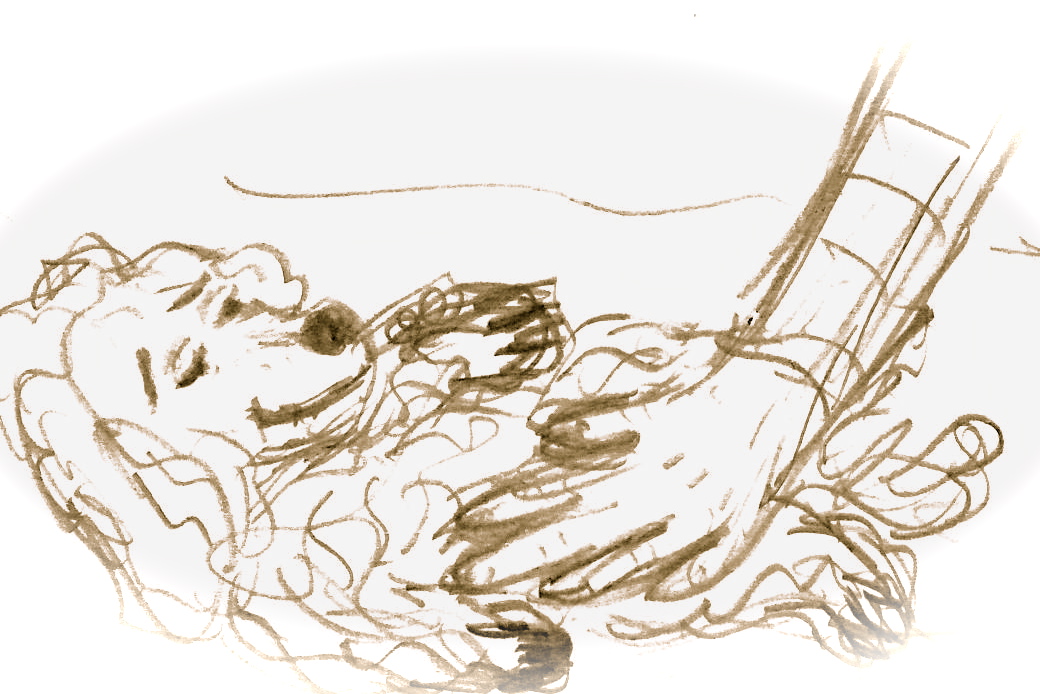
Writing Beside Pearl (Only She Usually Maintains A Slightly Bigger Private Space.) (Also, sorry for Apple plug...)


Yesterday, thinking about yoga and my dog Pearl, I wrote about blocking writer’s block through finding a seat in your blank page.  Mulling over these issues further made me think about the time, some years ago, when I stopped going to yoga classes.

I practice Astanga yoga and had gone to six or seven classes a week for some years.  Then suddenly, it all got too expensive, and more importantly, too stressful.

It is very easy in a Guru-oriented practice like yoga to fixate on your teacher–to obsess over whether you are pleasing him or her, to (on the inside) constantly beg for approval.  It is easy to fixate on your fellow students too.  (Why are they getting all the assists?  Does my teacher even like me?  Is it the sweat?)

These types of thought patterns can turn one literally into a downward dog, sniffing constantly for a simulated treat.  (Think “spaniel”.)

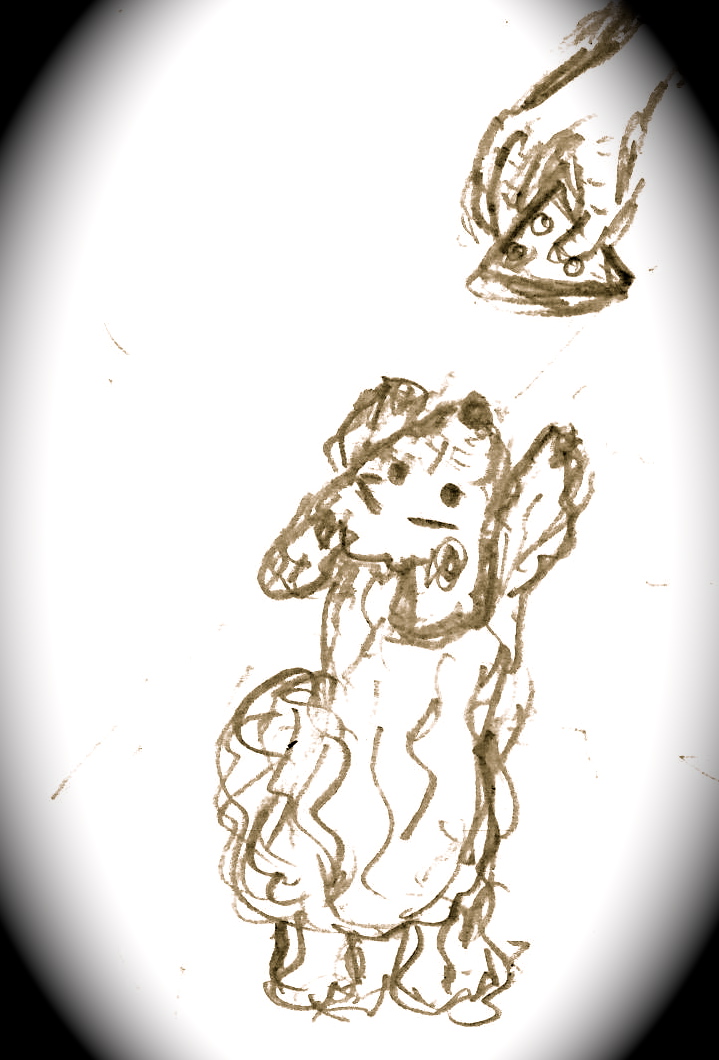
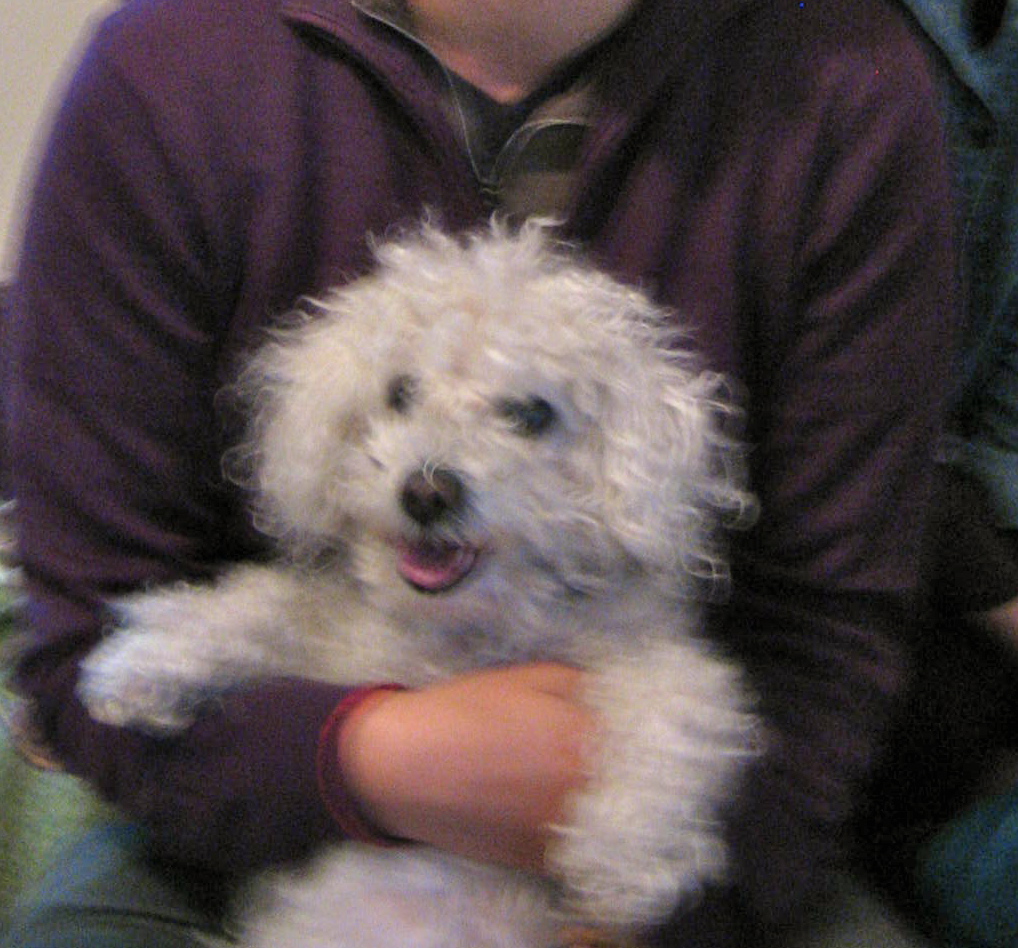
Now, Pearl, my fifteen-year old dog, is a very different kettle of canine.  She is not averse to pats, but she won’t perform for them.   (It’s cheese or nothing.)   She likes to be quietly near her human; but she doesn’t grovel.  (Except, that is, if there’s cheese, and, perhaps–if you start it–the occasional belly rub.)


Perhaps A Belly Rub


Doing yoga to score points with a cool teachery type (at least two earrings in one of his ears, one nose stud for the female nostril)  is clearly unyogic, but doing yoga in isolation is also pretty difficult.   Often I feel sluggish and apathetic.  Even so, I generally can make myself go through the motions because of three basic reasons: (i) it is what I do;  (ii) it makes me feel good, and (iii) it is one of my few clear channels to a greater Self.

Writing is very much like that (if you leave out the sweat.)  It is fun to take a writing class; it is fun to write with a buddy–but how do you keep going without the pats of your colleagues; without acknowledgement, and no certainty of an audience.

First, you have to tell yourself that writing is simply what you do.

Secondly, you have to focus on the physical pleasure of writing–the flow of energy through your arms, the dance of your fingertips.  You have to let yourself understand that even writing “tada tada tada” can be a sensual experience.  (Much less the word “sensual.”)  And what about the elation of scribbling off that last sentence?   (Tada!)

Three–you have to let yourself enjoy your greater Self–the mind’s eye that reads what you write before you even get it down.

Finally, find your inner Pearl–that part of you which will not shy from a pat, but won’t perform a trick for it.  This is hard, but recognize that when you just let your self write–the physical pleasure, the verbal company, and the sheer satisfaction of doing what you do–will be enough to carry you forward.

(And, probably, to maintain integrity, you should maintain a safe distance from…cheese.)


Cheese!


For more on blocking writer’s block, click here or check out the category from the ManicDDaily homepage.

Blocking Writer’s Block – Find Your Asana (Like Pearl)

October 5, 2010

Pearl Precarious.

I’m back to blocking writer’s block today, inspired by two main muses–yoga (my practice) and Pearl (my dog).

The Sanskrit term for a yoga posture is “asana,” meaning seat.  As many yoga teachers will tell you, to get into a posture–even a standing pose–you need to find your seat.  This does not mean to find the spot where you are at ease, but a spot where, over time, you may find ease–that is,  a posture that you steadily maintain for that time.

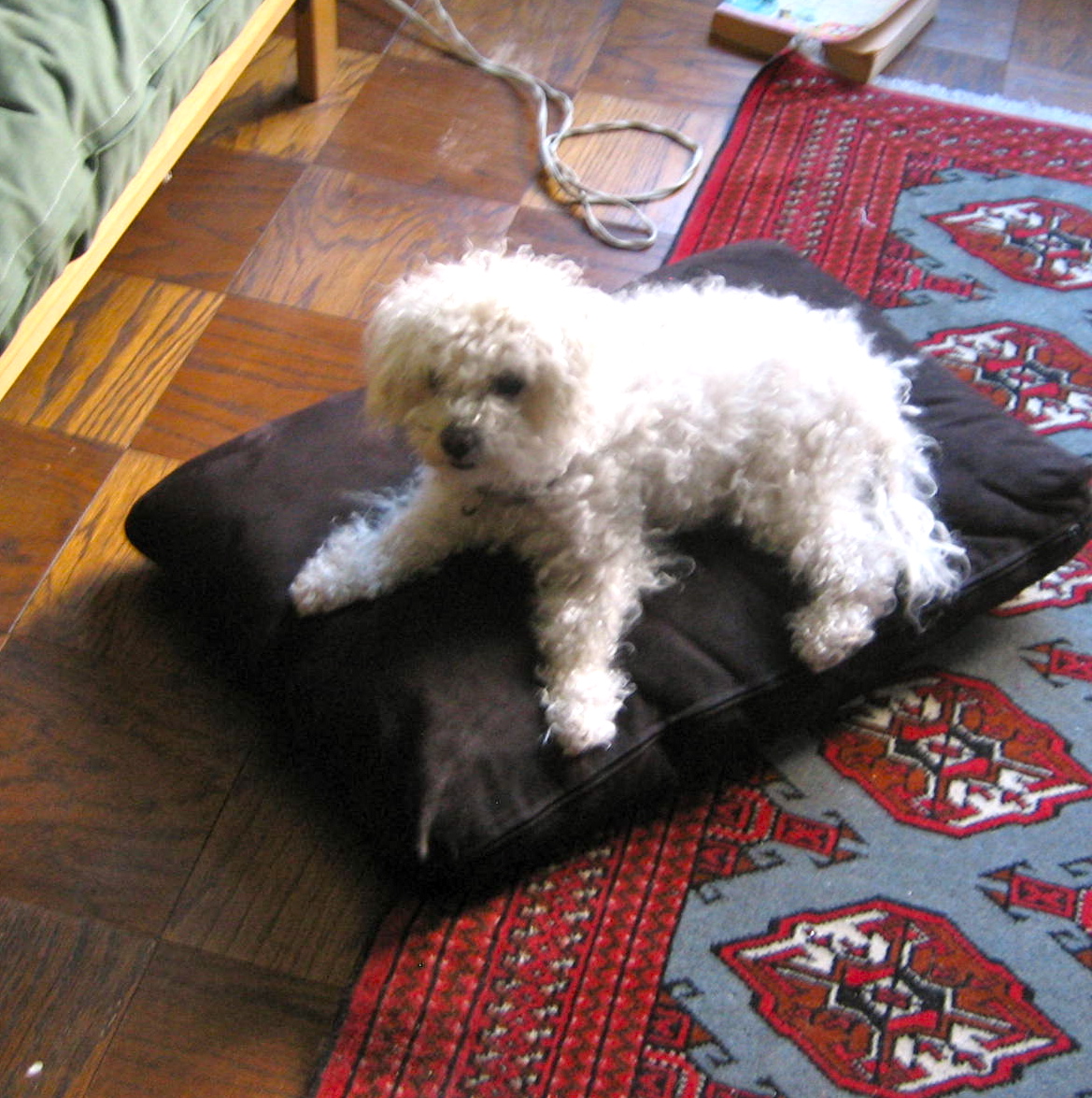
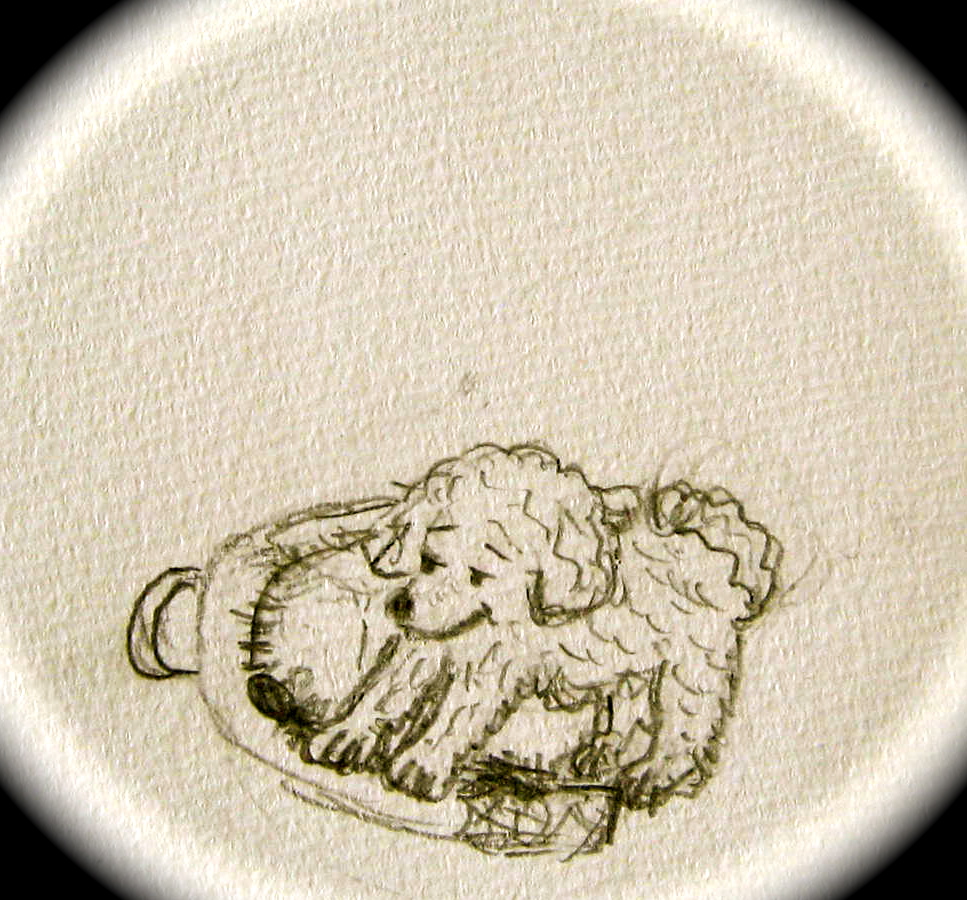
Pearl, my fifteen-year old dog, is a master of finding such ease even in the most precarious of positions–the edge of a bed, the center of a stack of clothes folded into a suitcase, the bag that we jam her into when we are trying to sneak her into some dog-free zone.

Despite her adaptability, however, Pearl can be quite particular about her chosen “seat.”  If left to her own devices, she will almost always seek out the softest spot–the one place on the bed where she can get down to some high thread-count sheets, the piece of paper or pillow that has  inadvertently dropped onto the floor.

Pearl Left To Her Own Devices

Neither Pearl nor many great yogis suffer much from writer’s block.  Their presence alone tends to be their message, their written words immaterial.   Nonetheless, they offer valuable lessons to the struggling writer: learn to make yourself comfortable wherever and whenever you are.  Your seat is your page.  Settle into it without too much regard to external circumstances–in a subway car, for example, or train;  while waiting in line or for a doctor’s appointment;  whenever you have a moment–even when you are not sure whether you have an idea.

In the midst of your openesss to circumstance, however, be choosey!  Like Pearl, exercise a certain discrimination as to where you and your page physically plant yourself within the parameter of anywhere.  On the subway, for example, if one seat feels better than another–for me, it’s the ones at the ends of the cars–sit in that seat.  If one side of a cafe isn’t working, change to the other.

Up to a point, that is!  The yogi takes his asana slowly, careful of alignment and placement, and then, when all that’s as good as it will get,  the yogi makes, through his breath, space.   (BTW, by his, I mean, her.)

Use your writing as a kind of breath to open up your physical and mental space, as a breath to make your page a place where you can survive.

(If you feel like someone is looking over your shoulder, congratulate yourself on finding a reader.)

In Her Preferred Position

Blocking Writer’s Block – Terry Pratchett- Parallel Parking?

October 1, 2010

Parallel Parking?

Sometimes you feel like you need a change.  You want to do a whole U-turn, but that feels as dangerous and illegal in the real i.e. metaphorical sense, as it does on the street.  But you don’t feel you have the time or patience to turn the slow way, the way that, well, parallels parallel parking–that is, the type of turn that involves a lot of backing and twisting and backing and twisting.

I just finished the new novel, I Shall Wear Midnight, by the incomparable Terry Pratchett.  It is not one of Pratchett’s best books;  it has a very complex plot with a great many characters  (long-time denizens of Discworld) who may not resonate with a non-Pratchett afficionado.   But like all of Pratchett’s books, it has wonderful moments of ingenuity, wackiness, and above all, generosity.  Also a lesson:  find out who you are and be it.  Find out what you like to do and do it.

Pratchett, who has now written over 40 books, is someone who found out what he liked to do at a relatively early age and who has done it a lot, even continuing now through early onset Alzheimer’s.

Which brings me to one of my perennially favorite topics–blocking writer’s block.  We can’t all have Pratchett’s prolific elan.  But we can like him, work with what we have.

Easily said, I told myself.  So what about all the projects you want to do?   I thought of, for example, a book on writer’s block, for example?  I’ve already written a fair amount about the topic, but it immediately felt unmanageable.   My mind even filled with illustrations–yet, they too felt impossible.  (For one thing, they didn’t have elephants.)

And then, I got a phone call from a college-age daughter.   She wanted to talk; to get some advice.  So lovely to be sought in that way.  After a while, still listening, I began to draw.

The drawing, below, was not exactly what was in my head.  Still, it was a start.

First "Blocking Writer's Block" Drawing

My lesson:  give yourself the gift of trying.  Make yourself make a start.   Better yet, let yourself make a start.  Even if you have to twist and back into it, slowly working yourself into your chosen spot or direction.

Then, after a while, start again.

Second "Blocking Writer's Block" Drawing

Draft Poem Process – Blocking Writer’s Block

September 15, 2010

Okay (to the regular readers of this blog), I admit that the draft poem posted at about 1 a.m. this morning is blank verse in the truest (and possibly, worst) sense of the word.  I’d like to dignify it with some epithet like Creelyesque, but I’d hate to do that to the wonderful Robert Creeley.

Instead, I’ll explain away the poem by giving it as an example of an effort to block writer’s block.  If you want to write, you have to write.  It really is as simple as that.   You have to do it without being too precious about every single result.  That’s probably an elemental rule for getting yourself to do anything creative.

Waiting for the right conditions, the right mindset, even a modicum of brain power, may put you in a queue of one forever;  if you wait for inspiration, there you might be–in the abandoned mind bakery–holding a ticket that is never called.  (Even if it is called, all those wonderful half-baked goods may have gone completely stale by the time you actually get to the counter!)

Sure, an inner voice may tell you urgently that you are  a writer, an artist, but it’s unlikely to tell you in the hurly-burly of every single day exactly what to set down.

That’s where doggedness comes in (and not necessarily the doggedness of the wiggly happy dog that greets you at the door every evening.)  It’s more like the dog that is pawing pawing pawing at the zipper of your backpack because it is sure that somewhere inside nestles a treat.   Sometimes that treat is the old remains of a bagel; sometimes it’s chocolate!

Which, I know, yes, is terrible for dogs.  (More for us.)

Writer’s Fatigue – Watch Out For The Burn.

September 8, 2010

Washcloth washcloth burning bright!

I’ve written a lot about blocking writer’s block; usually I’ve talked about blocks caused by insecurity or fear of failure, indecision, just plain stuckness.   I’ve advocated various exercises to limber up pen-holding or keyboard-typing fingers.

What about writer’s block caused simply by fatigue?

Sinking eyelids, molasses mind, slurring fingers.

I inadvertently set a washcloth on fire a few minutes ago.  In two places.  That kind of fatigue.

It’s not all that easy to set a washcloth on fire.  It wasn’t even on fire until I took the symmetrically charred fabric out into the night air and lay it down on some stiff, humid Florida grass–really called  Bermuda grass–grass that my crabbed mind thought would dampen all embers.

But something about that combination of night air/grass/stretching and glowing washcloth out set off actual flames.

That kind of fatigue.

That kind of block.

Avoid, during such moments, writing while operating heavy machinery.

Blocking Writer’s Block – Love Your Elephant

July 11, 2010

Love Your Elephant!

Readers of this blog may not realize it but I love Virginia Woolf, Walt Whitman, Dostoyevsky, the plays and poetry of Shakespeare (who doesn’t?), Rilke, Wallace Stevens, John Donne, Sharon Olds.

But what comes out half the time when I sit down to write this blog is…Robert Pattinson….

And when I write my non-blog work (aside from legal memos and poems), I often end up with children’s novels about talking dogs, teen novels about oversized noses, young adult fantasies about Royal beauty and magical gifts.  (Yes, I’ve written grown-up types of things too, but the number of pages devoted to the talking dogs and magical gifts is undoubtedly higher.)

I love Goya, Velasquez.  Matisse and Giotto.  Fra Angelico, Francesco Clemente, Kandinsky, Anselm Kiefer, Alfred Jensen;  I have a great deal of respect for Tintoretto. (The Scuolo di San Rocco is not exactly my style but absolutely amazing.)

But what (more than half the time) comes out when I put my own pencil to the page?  Elephants.

The curves of trunk, humped back, toe nails, seem to just form.  I long ago stopped fighting against it.

I’m not saying that it’s not good to rail against one’s natural tendencies;  to stretch one’s self.  But it also can be both skillful and liberating to just accept where your energies take you; especially if you are suffering, or have a tendency to suffer, from writer’s or artist’s blocks.

I would be the first to admit that it can be very embarrassing to hieroglyph in pachyderm.  If you have any pretense of sophistication, you may hate that all your cuneiforms are cutieforms.

You may feel disdainful of your talking dog.  (His name is Seemore by the way; as in see—more, since he’s so very observant.  He has taught himself to read and is an amazing speller.)

You may give up re-writing your novel about the beautiful princesses with magical gifts, not because it’s derivative (it really isn’t), but because it’s feels just sort of… silly.

Don’t.  At least don’t give up on these things because of embarrassment.

If your voice or vision tends towards another direction—science fiction, prose poetry–camels!—check it out!    (I don’t mean here to try a lot of different things—I mean if you happen not to be interested in children’s book or elephants, but in something equally unhip—check it out!)

What you are ultimately looking for is authenticity, a channel for energy, a bunson burner to create energy (which really is difficult to sustain if you are not genuinely caught by your material. )  Don’t be put off if what is authentic to you takes an odd, or unexpected, form.  The fact is that your own voice is by its nature somewhat unique (and, if you are anything like me, it may also be kind of odd.)

For more on writer’s block, check out the category from the ManicDDaily home page, and for more on elephants, check out 1 Mississippi by Karin Gustafson on Amazon.

More on Blocking Writer’s Block – Maintaining Bad Habits (Advice from the Dalai Lama?)

May 25, 2010

Rotating Storm

At the Dalai Lama’s lectures in New York City over the last weekend, he advised (naturally) meditation as a means to slowly effect change in one’s life.  “One lecture not enough,” he chuckled.

He encouraged the audience to start a practice even if their beginning steps felt very small.  He advised just “five minutes” every morning, particularly if the five minutes were “quality time;” that is, five minutes spent with some attempt at genuine focus.  A small period of quality time seemed better to him than a longer, more wandering attempt, simply because it helped one avoid bad habits.  In His Holiness’s view, a bad habit was harder to break than a new habit to instill.

All of that sounds right.   And I hesitate to argue with His Holiness the Dalai Lama.  Particularly about matters related to meditation.

So I won’t.  Still, I was thinking this morning as I did my slightly desultory, bad-habit-infected, yet daily, yoga practice that I’m not in complete agreement with these principles, at least not when they are applied in areas other than meditation, such as a practice of daily writing.

Here’s my problem:  of course, quality time writing is better than going-through-the-motions time.  But what if you are faced with a choice between going-through-the-motions-time vs. zero time?  Is a bad habit really worse than no habit? (That is, not writing at all?)

I am concerned that many people when starting any kind of discipline make a good and earnest beginning–then, things bog down, especially as the glow of initial results fades, and the hard slog begins in earnest.

I don’t know what His Holiness would advise for a bogged-down meditator—I’m guessing that it would be a combination of continued effort, and a little less fretting.

I would co-opt that same (surmised) advice for a writing practice.  At times, it is likely that some bad, escapist, habits may creep in;  they may in fact be all that keeps you going–the background distraction of a book on tape; the muddled support of three cups of tea and a glass of wine;  writing on the elliptical machine;  relaxing with vampire novels so as to avoid the schaden freude of more challenging works.   Perhaps it does make sense to scale down during such a period–when you are having a hard time finishing anything, you may be better off working on a short story (or  blog) than the great American novel.   Still, it’s important to keep putting in your five minutes, even a fitful five.

The most important caveat here is not to get smug about your fitful efforts.  Stay honest.  Sometimes you may not feel capable of more than a thread of creativity; but don’t assume either (i) that it’s all you will ever be capable of; or (ii) that it’s enough.

One other suggestion (taken from a yoga teacher, David Life, who was trying to help me with backbends)–if you need to cheat a little to do your work (or pose, in the case of yoga), try alternating your form of cheating.   Rotate your bad habits to avoid letting any single one become the norm.  In the case of backbending, that meant sometimes turning out my feet too much, other times, bending knees.  In the case of a writing practice, that may mean sometimes just writing a very boring journal entry; other times, a very boring prose poem!

Blocking Writer’s Block: Don’t Worry About the Where

May 11, 2010

Writing IN Your Notebook

I am returning to my series of posts on blocking writer’s block this morning at one of my favorite secret places for writing—the New York County Supreme Court building at  111 Centre Street.

Yes, the downstairs lobby is a bit tacky.  From the outside, the place looks dark, shut down; you feel almost certain from the sidewalk, that the main exterior doors will not open when you push.  (In fact, they do not open–much.   They squeak, scrape, and stick; with a lot of force, you can just wedge yourself through.)

But when you do get inside the building, past the metal detectors, beyond the dingy elevators, up to a highish floor, a sea change occurs—the main corridors here are lovely, with granite floors, marble (or faux marble) walls, and tall windows edging the South, West and East exposures, looking out over lower Manhattan.

I’m not saying that these corridors are particularly posh—there’s a definite utilitarian cast to the white plaster-board of the dropped ceilings.  Even the granite and marble look as if the colors were chosen not to show dirt.  (These are public buildings, after all.)

But the wooden benches that line the windowed walls are smooth and comfortable,  sunny and light, and, if you are not on a floor of bored and disgruntled jurors, the corridor carries such a serene hush that when, in the midst of muted steps, you hear a murmur about “what street informants want,” you are definitely taken aback.

I have to say upfront that I’ve never gone to New York Supreme just to write—I’ve always had some official purpose, and had to sit there waiting to fulfill it.   But it is nonetheless a very good place for writing.  (If you haven’t been sub poenaed, virtually no one bothers you.) Important caveat:  I think that coming in here just for a quiet place to work might actually constitute some kind of crime; it’s probably best not engage in it in a place filled with cops.  (They tend to be big cops, their hips bulging with handguns and, well, hip.)

So now, I’m on the subway writing.  It’s also not bad.  Yes, an unseasonably cold day makes the seasonal air conditioning drafty; the mechanized voices jabber nonstop, and there is the constant loud whir, bing, squeal of the engine, wheels, track.  Still, I have a seat.   (It’s not a rush hour train.)

More importantly,  I’m not just writing on the train right now—I’m mainly writing in my notebook. Which is about as quiet and uncluttered and spacious as lined white paper can be.

The point of all this:  don’t worry about where you are doing your work.  Don’t put it off because you don’t have the right space (a writer’s room, cabin, desk, even computer).  Don’t put it off even to wait for  the right moment.   I know it sounds clichéd, but the fact is that the only place you ever have to write is the place you are right now;  the only moment you ever have is this one.

To some degree, the same reasoning can be applied to drawing and painting. Again, of course, it’s wonderful to have a lovely studio, easel, table, but your drawing is not made only in your studio.  The place it truly inhabits is the page (or napkin or envelope.)

Of course, some places are genuinely more inconvenient or conducive than others;  if you have access to a convenient, conducive place, take it!  But the factor that most quickly makes a space workable is simply working in it.  Engagement is a great architect/decorator.

I don’t write this to be annoying, or to tout my own powers of concentration.  (They are not very good–when I write in a public space, I sometimes just follow my mind’s meanderings.)  I write to help counteract the many forces that lull one into procrastination.

If you want to work, then get to work!  Wherever!

(P.S. For more on blocking writer’s block, check out the writer’s block category on the ManicDDaily home page.)

(P.P.S. Computer problems delayed the posting of this post beyond my daily deadline, drat!  Sorry!)

The 14th Day of National Poetry Month – Writer’s Block Sonnet (and White Sock)

April 14, 2010

Blank Page and Sock

The 14th day of National Poetry Month, sigh.  The draft sonnet I wrote today is intended to illustrate the principle that a poem can be written with no inspiration whatsoever!  In other words,  don’t wait for the muse.

The draft below follows the rhyme scheme of a Shakespearean sonnet; although I do keep to certain syllabic limits (approximately 10 or 11 syllables per line), I’m not sure that these exactly correspond to iambic pentameter.   For more on sonnet structures, check here, (or check out the poetry category form the home page of this blog).  For more on writer’s block, check out the writer’s block category.

Writer’s Block Sonnet

A blank page is not like a plain white sock.
It will do nothing for a cold foot at night,
and fits poorly into a shoe; you can’t tuck
your pants into it as part of a fight
against Lyme’s Disease; it won’t put you at ease
in any way; won’t cushion the impact
of concrete; won’t even give you release
from the itch of sand or pine needle, the tact
of the blank page so much less than the sock,
though also white and cheap and omnipresent.
The page won’t be worn quietly, it will talk
to you, it will talk at you; it will resent
any effort to shush its voice, cap its sound.
You won’t listen?  Then, it will stare you down.