Archive for the ‘Vicissitudes of Life’ category

Feeling Loss in Bright Green of Early July – Giotto Blue

July 2, 2010

Giotto Blue

I am right now in a beautiful country place.  My eyes are bathed in a bright light green.  I’m even wearing a light green sweater so I am literally surrounded by the color.

Though I’m also sitting beneath bright blue—not sky, but a screened-in porch, which I like to think of as a Giotto blue.  The paint does not shimmer like the green (or true Giotto blue, for that matter) but it’s still quite lovely.

All this loveliness.  It’s an odd time to think about death, but it’s amazing to me how the thought crops up.  “Crops” seems an anachronistic term till I think suddenly of the “Grim Reaper,” and then it all makes sense.  The fact is that just about anything that grows, dies.  (See how I manage to hedge that—“just about anything.”  How about “anything” plain and simple?)

Now you see it, now you don’t.

I’m not quite sure why I am thinking about this on a 4th of July weekend.  Maybe it’s because when you return to a place that you have long returned to, especially a country place, where you see people you have long seen, but only periodically—you become very conscious of time’s passage.

So here I am in all this bright green, nearly the same bright green as in every single July I’ve spent in the last twenty to thirty years, but the people walking around the green are, well—balder, shakier, heavier, thinner, frailer, greyer, and, in the case of those who were very young in past years, perhaps even more beautiful, and also now able to cook.

Not quite so many day lilies by the garage, more down by the pond.

In my manicddaily way, I focus intensely on these kinds of changes, and can get very sad about them.  Manicddaily kinds of people tend to be extremely good at calling up past losses and imagining prospective ones.   I can become quite mournful even in the midst of what should be joyful moments at the absolute inevitability of loss, disappearance, death.

Some say that the best response to these types of feelings is “to be more in the moment”.  I’m not so sure.  For me, that poignant sense of loss is part of the moment (even if just the moment as experienced by my head or hormones.)

Okay, so maybe a better answer is to be more in the physical moment;  to focus on the coolness of the breeze against your skin, the green before your eyes, the gently warm sun lighting parts of both that green and skin.

But, sometimes the understanding of loss is part of  your physical experience of the moment as well as your mental experience, part of your very chemistry.

For me, one effective (though perhaps obvious) way to deal with this chemistry of loss is to try to summon up some kind of appreciation.  Gratitude  Even just relief.  Any one of these can work as a neutralizer, a base to the acid.

After all, I’m still right here, thinking these things through.  (Hurrah!)   And that mix of green and sun and breeze and Giotto blue is really quite wonderful, and also amazingly enduring.  At least, for now.

Summer Mornings Without Air Conditioning – A Certain Slant of Light, Gainsborough Hair,

June 6, 2010

Sir Thomas Gainsborough - Mrs. Thomas Hibbert

Emily Dickinson writes about a “certain slant of light,/Winter afternoons,” which I’ve been thinking of a lot as I wake up these days. There’s definitely a certain slant of light on summer mornings.  I feel (kind of) sorry for those who sleep in air conditioning and don’t get to fully experience it.

It’s only a trick of my ear that thinks of Dickinson, for this slant of light is not oppressive like the light in her poem.   It’s a low angled, almost curved, light, which accompanies a time of softness, space, invitation.  Movement is easy enough, though after the restlessness of a night of trying to find a cool place on the sheets, you may not want to move much.  Your body feels suddenly dry, almost powdered.  The air, because you are careful not to fully open blinds, is tinged by a slight blue-grey wispiness like the hair in a Gainsborough painting.

Sounds are distinct, but muted—footsteps below your window, water running upstairs—there is nothing like a Sunday morning after a sultry night in New York City for quiet.   Stereos stilled–if there is a music, it’s in the tradition of John Cage.

You can smell that it will be hot again soon; you can even see it after a while –just there, at the corner of your eye.  The promise seems not to come from the sky so much as from the sidewalk, which, with its cached memory of yesterday’s heat, early radiates an incipient over-brightness.

But, the heat’s not forced itself into your apartment yet;  for these minutes, Gainsborough lingers in the air, and the breeze whispers at just the right pitch.

(If you like summer and sultry, but are more into elephants than Gainsborough, check out 1 Mississippi by Karin Gustafson, on Amazon.)

(And, for a complete change of pace, check out yesterday’s post, why people hate banks.)

Memorial Day Weekend- Liquified Whitman

May 30, 2010

Memorial Day Weekend

Here is a draft poem for Memorial Day weekend.  Did you know that Vitamin B is recommended to ward off bug bites?  Apparently, mosquitoes hate the smell.

On the Grass By the Pond

My Vitamin B-infused pee
blends with the blades of yellow-green
below my thighs, like
liquefied Whitman.
Memorial Day Weekend.
First outdoor pee of the season.

Memories of Memorial Day

May 29, 2010


Memorial Day Weekend

Memorial Day Weekend.

When I was a child growing up in suburban Maryland, the weekend was glorious. It meant the opening of swimming pools for summer; it meant the opening of summer for summer.   It meant that any school days we had left would count for nothing but a countdown, in which the sweat accumulating at the backs of our knees would smell faintly of graphite and the white vinegar used to sponge down the school cafeteria.

The pool was where we spent almost every daylight moment in our summers.  We had no air conditioning,  managed the heat through damp bathing suits, that were kept on even after we came home, darting around the slow darkening of summer yards, kept on even in the blue glare of night TV.

Later, as an adult, Memorial Day Weekend meant a chance to drag my two children to upstate New York, leaving the very momentary green of May city for some real, deep, comprehensive, green.  We seemed to be collecting coolness up there too.   (Air conditioning has not been an easy accomplishment in my life and there is nothing like most New York City apartments for jumping into summer fast, each room its own little microcosm of global warming.)

It was only on these trips up to the country that I glimpsed the true meaning of Memorial Day.  There is one cemetery our route passes; actually the road bifurcates it; drives smack down the middle.

Of course, the cemetery is green in May;  it’s green all summer long, the grass lush, fenced in, mown, lined with small brown and grey headstones that look almost like the class of kids in my old schoolroom, half-asleep.

There were always a few little bouquets, some too brilliant against the rectangular stones to be completely real.  But on Memorial Day weekend, there were more, and, with the flowers, small American flags, prongs stuck into the earth or on small stands

Sometimes, driving by, we’d see a few small groups, women with pale hair scalloped around their faces, the curves made by curlers, or permanents, old-fashioned hair.  Women with pastel pants, sometimes worn under dark windbreakers; upstate New York’s weather changeable in May.

Even watching them, with their curled hair and small American flags, it took me a while to catch on.

(For a villanelle about swimming in summer at the pool, check here.)

Responsibility/Independence…Independence/Carefreedom–Horatio Hornblower Longs For His Wife’s Hand

May 27, 2010

Scale - Responsibility/Independence

My latest hero, C.S. Forester’s Horatio Hornblower, makes an interesting observation in the 9th book, (the one I am reading tonight), Commodore Hornblower.

Facing difficult decisions in the Baltic in the period immediately before and after hostilities open between Sweden, Russia and France (led by England’s arch nemesis, Napoleon Bonaparte), Hornblower is suddenly, deeply, homesick.  He finds his command and the many duties and expectations heaped upon his slighting stooping shoulders suddenly overwhelming (those who spend the life in the cramped quarters of ships almost always slouch a bit); he misses his wife, child, and the trivial chores of the land-based life in England that he found almost stultifying at the beginning of the book.

Then he calls himself back to the realities both of who he is and of human nature generally:  “And here he was complaining to himself about the burden of responsibility, when responsibility was the inevitable price one had to pay for independence: irresponsibility was something which, in the very nature of things, could not co-exist with independence.”

Responsibility/independence.  I’ve never heard the words rigged quite so cleverly.

What a wonderful thing it is to call one’s own shots.  Yes, it’s nice to get help; it’s very nice to feel taken care of; to have some prop holding up the idea of self-reliance.  But to be able to say “screw you”has a special satisfaction, which, of course, comes with a price.   If you say, “screw you”, to someone, it’s helpful to be able to live without that person’s financial or emotional support.

Perhaps this is all very obvious.  Perhaps I’m just blinded by my current affection for all things Hornblower.   (He really is a very charming character.)   But I find his direct correlation between responsibility and independence remarkably thoughtful.  The odd thing is that when one is burdened with responsibility, it is hard to actually feel independent;  often, especially in today’s society, independence is equated with freedom–freedom from ties, freedom from responsibilities.  But that freedom, or carefreedom, is different from the strength, the possibility for discretion, that Hornblower sees as independence.  (Hornblower catches this irony too as he describes the envy he feels for the able-bodied seamen, who have the carefree nonchalance of those whose only job is to competently carry out orders.)

Hornblower’s understanding all this doesn’t negate his sharp longing for his wife’s hand, son’s smile.  But, ever the stoic Brit, the Naval officer, he (silently) goes down to his cabin to study the chart of Riga Bay.

(That Hornblower.)

Monks At Radio City

May 22, 2010

Monks at Radio City

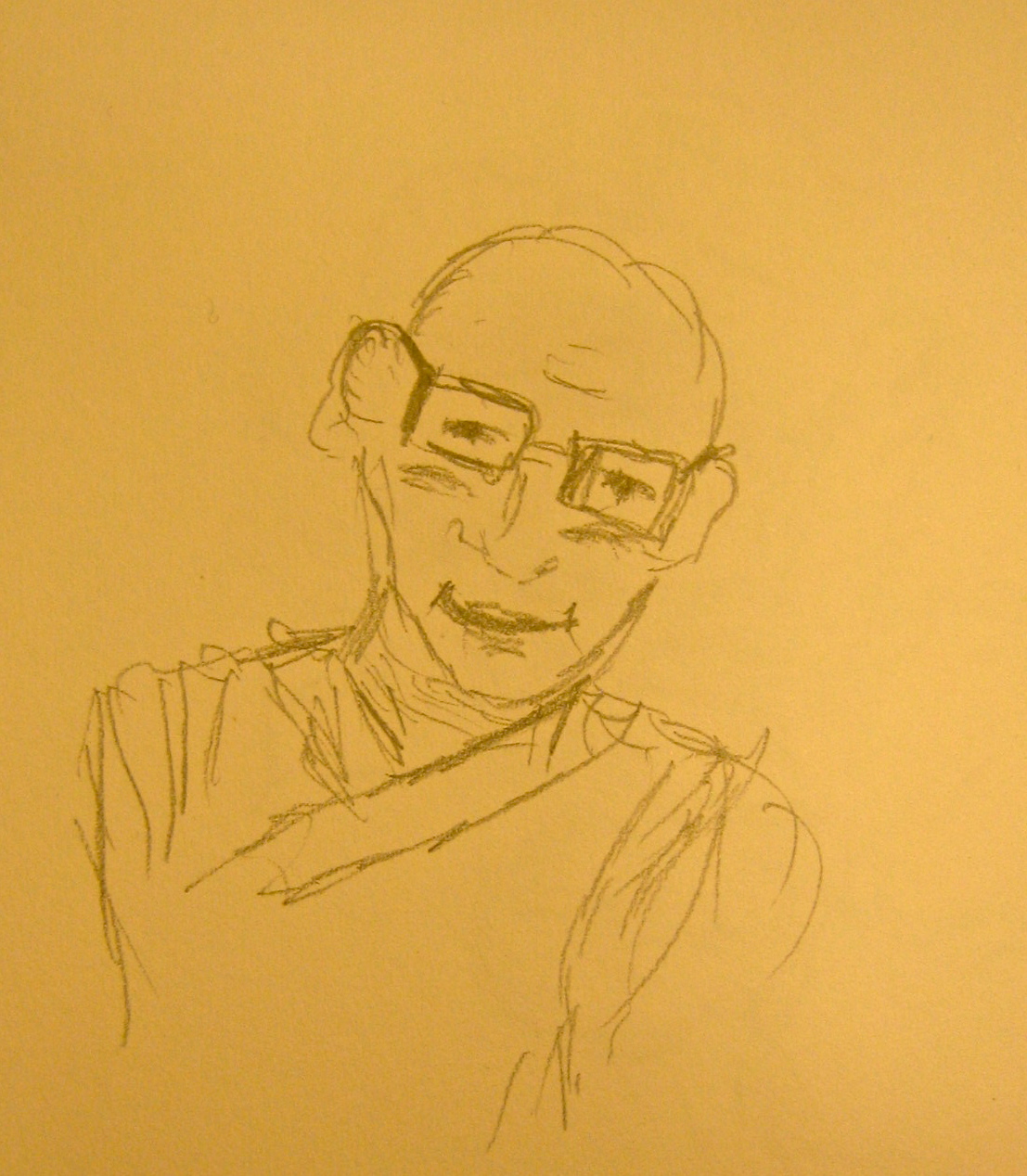
I was lucky enough to get to see the His Holiness the Dalai Lama again today for two of his final lectures in a series at Radio City Music Hall discussing Buddhist commentary on the Bodhicitta Bodhisattva’s way of life.  The Dalai Lama and Richard Gere both!   One whose bald head was (shockingly) partly covered by a thick maroon visor, the other whose head was (shockingly) totally covered by a thick shock of extremely white hair.

“What a good guy,” someone said as we walked up the aisle at the end of the last lecture.   (Meaning, I believe, the Dalai Lama, and not Richard Gere.)

Yes, a very good guy.   But what struck me as much as his goodness was his simple common sense; for all his idealism, for all of his adeptness at finding great benefit in the arduous and difficult, the Dalai Lama is a realist.  (“Hope for the best, prepare for the worst.” )

I had not, before this, focused on the pragmatic aspects of Buddhism–the fact that it doesn’t seem to push truths, so much as accept them..  Okay, I’m not so sure how well karma and reincarnation fit with that last sentence, but certainly the understanding of universal suffering and death, the illusory quality of perception, and the advocacy of altruism as a skillful means to happiness, are pretty clear-cut.  And the emphasis on investigation and acceptance leads to a great openness.  (At one point, His Holiness laughed at some of the astronomic views of Buddhist science, for example, and called them a “disgrace”, a “disaster”–no pushing fundamentalism on that front.)

Neither my eye sight nor my seat were good enough to sketch the Dalai Lama without reference to the camera screen, and the images moved quickly.  (Plus, I actively tried to watch him.)   So I include sketches above and below of various monks and nuns on the stage (all those shaved heads) , particularly those behind His Holiness’s translator.

(Note that the elephants in the very first sketch above are not intended to represent the infiltration of Hindu favorites so much as the infiltration of ManicDDaily favorites.

Have a nice night.

Have a nice night.