Archive for the ‘poetry’ category

Onomatopoeia on the MTA (Subway Song)

January 7, 2012

Opening of "Somewhere", Music by Leonard Bernstein, Lyrics by Stephen Sondheim

Sheila Moore working with dVerse Poets Pub has a wonderful poetics prompt on onomotopoeia today.  Boom!  A great excuse to escape from the heaviness that has characterized my recent posts.  (I am also linking this to Victoria C. Slotto’s poetry blog, liv2write2day, which has a prompt about music and words.)

The following is an old sonnet, posted before (sorry!), but somewhat revised.  I’m not sure that it quite qualifies as onomotopoeic poetry, but it does focus on sound, in this case an eerie music made by track and train car at certain subway stations on the IRT Lexington Avenue line.

“Somewhere” on the MTA

The subway sings its broken refrain:
the opening bars of “Theeeere’s aaa Plaaaace
For Us” from West Side Story.  The train
croons the first three notes as it leaves the dais
of the platform, the tune subsiding
then to squeak and wind and roar as we race
to a-harmonic levels, soon riding
at a speed without space for Bernstein’s trace
of tragic lovers defiant of fate
and family.  Yet…at every station…
there’s a plaace—again.  Who of those who wait
hear the song of that longed-for destination,
harmonic haven–beyond how, beyond where–
amazed that the Six Train nearly takes them there?


I am also linking this post to Gooseberry Garden’s Poetry Picnic.  (The prompt relates to NYTimes headlines–the subway? Hmmm…)

Sad Day

January 5, 2012

My beloved father died this afternoon.  He was conscious and loving and consciously loving until his last breath.  I feel lucky to have known him, much less to be his daughter.

I will probably write about both his life and death more in the future.  For today, I’ll settle for an older poem, a sonnet of sorts.  It doesn’t really describe that much about him, just a habitual moment in our lives.

My Father

My father knelt beside my bed; his round head
reflecting the bedside lamp with the look
of lighting within.  “And the genie,” he said,
“came out of a big blue jar.”  Not from a book
were the stories he told me at night.
Always of genies who were big-blue-jarred
and did fairly little, only the slight
magic of minor wishes, often ill-starred.
But the stories were just a warm up to
our prayers.  “Our Father,” those would start,
the words heading for hallowed, trespass too.
Interlocking like a spell he knew by heart,
they croakingly invoked a wished-for will
that the blue genied jar could never fulfill.

dVerse Poets Open Link Night “After It’s Fallen”

January 3, 2012

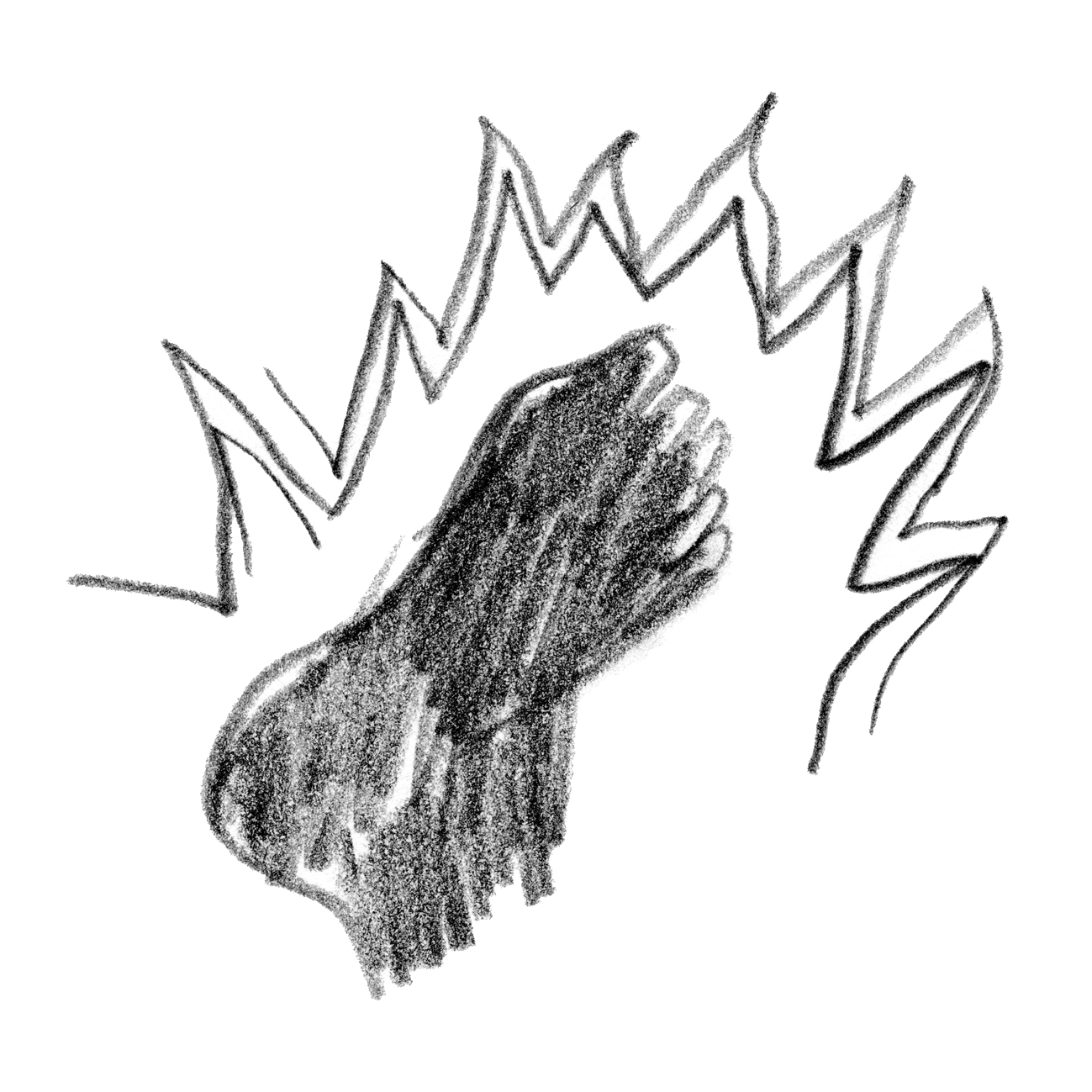
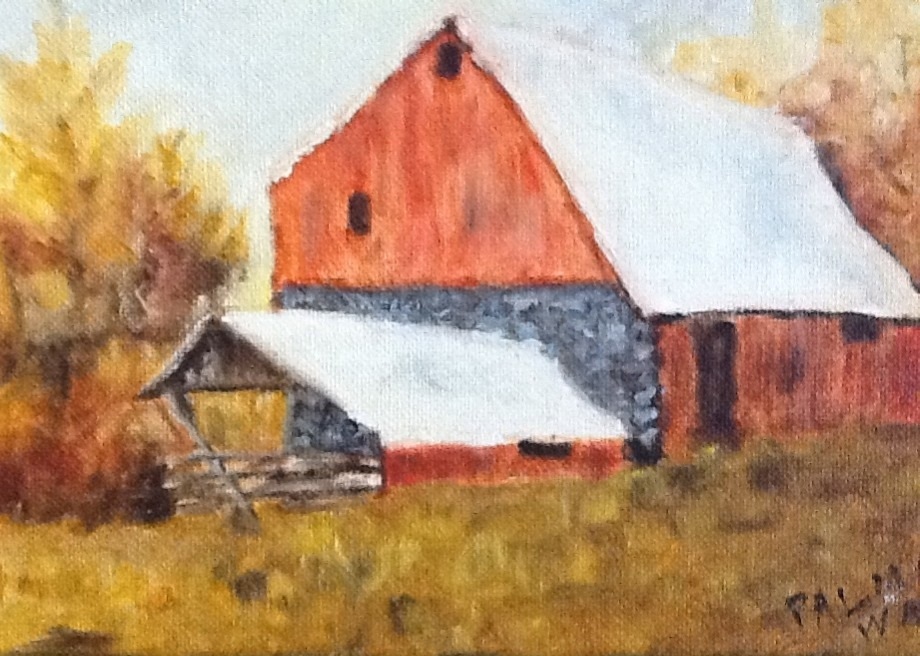
This is an older poem about the burning ghat in Varanasi (Benares), India.   The picture above is by Diana Barco, from a book of my poetry called Going on Somewhere.    I am posting it for dVerse Poets Pub open link night as well as the Poetry Palace Poets Rally and for Victoria C. Slotto’s blog, liv2write2day (for a prompt about memory.)  All are great resources for poets and those who love poetry.

After it’s fallen

In Benares, the tenders rake the fallen feet back into the flames.
The first time we watched them, I was horrified.
How you would know that foot, I kept thinking,
your father’s soft purply big-veined foot.
My father’s feet have always seemed too small to me.
When he walks he seems to go on edge, as if they
can hardly carry him.
The toes of his shoes turn up strangely,
even after he’s had them just one week,
Something from the war, he’s always said.

In Benares, the feet are the last parts to be burned.
They overhang the pyre and simply
wait there, smoking slowly
until the shins are completely charred.
Their full flesh too heavy for the burned legs,
they fall, eventually, to the ground.
They never fall together, but one first, pointing randomly,
the other still flexed in the air.

When one of the tenders notices, he
pushes the fallen foot back into the flames.
He uses two long poles, the
green bamboos of the bier.
Sometimes he has to lever the foot
to reach the flames again, crossing the poles
like huge chopsticks.

They have dark feet in Benares,
darker than my father’s would be,
smooth and brown.
I couldn’t stop looking at them, thinking how you would know
that foot on the ground there, that foot.

Goodbye to Old Year – “Taking Leaves”

December 31, 2011

20111231-034503.jpg

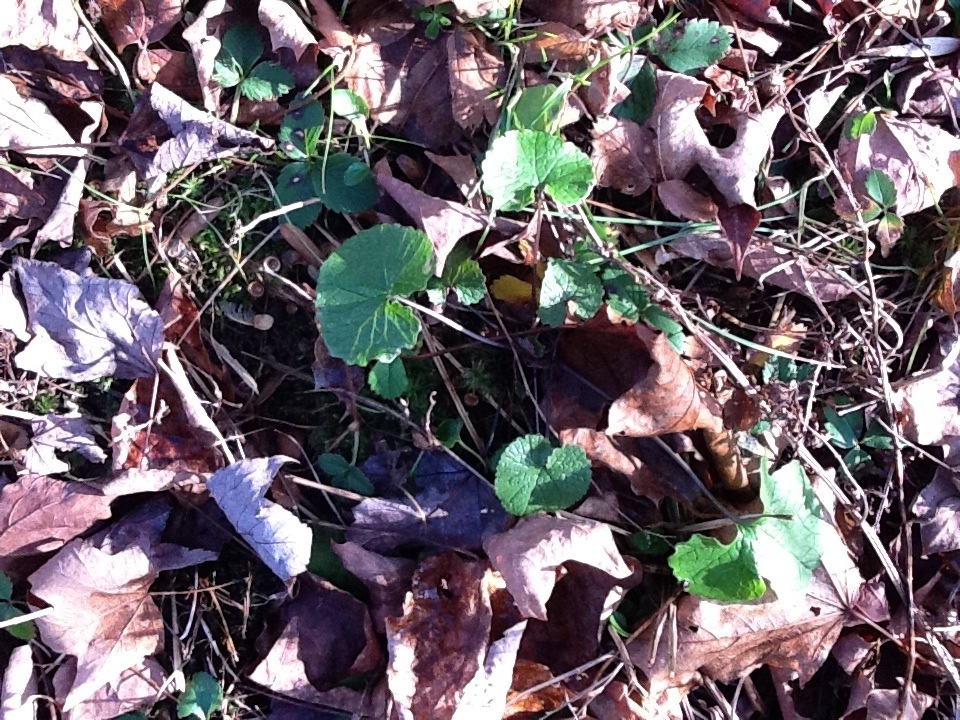
Happy New Year all!  I am posting this for dVerse Poets Pub “poetics” prompt about the reflection that comes at the end and beginning of a year.  Ironically, Mark Kerstetter, the wonderful host of today’s prompt used a photograph of a leaf in his article.  My poem, below, a sonnet of sorts (on I guess accepting the way things are), was also inspired by leaf shapes.

Taking Leaves

The lily pad is formed like a spoon of heart,
holly a pronged sleigh.  Look out for three points–
my leg itches at the thought–there is no part
of me–not organ, not digits, not joints,
not susceptible to mind’s suggestion
(like a house plant that blossoms to Mozart
and cringes at a din).  No. My question
is how to put the horse before the cart,
how to let the soul’s true shape unfold
outside the mold of to think and then to be;  
that is, not to ask why, or wait to be told,
but to just accept pi (what rounds), gravity
(what makes for fall), and Death’s shade (from Day One),
while we earthgrown still will–must–seek out the sun. 

Have a wonderful, thoughtful, safe, healthy, happy, New Year.

I myself realize that what I am hoping for most is kindness–to receive it, of course, but more, to give it–to overcome all those obstacles that sometimes come in the way of being as kind as I would like to be.  (Agh.)

Not-So-Crystalline Couplets (with Pearl in Chandelier) !

December 29, 2011

20111229-031601.jpg

At dVerse Poets, Gay Reiser Cannon has posted a wonderful “form for all” article on different types of couplets.  I confess my preference is for the “heroic” (an iambic pentameter couplet, which feels most traditional to me).  But Gay is more wide-ranging, and brings up a new form called a “Crystalline:”  a modified haiku (17 syllables) compressed into two crisp lines. 

Ideally, it seems that the form requires a certain focus on visual imagery.  I couldn’t quite do the visuals, opting instead (as almost always) for the slightly silly.

I have re-posted the image above because it shows my dog Pearl  in a “crystalline” setting.  

Not-So-Crystalline Resolutions (for 2012)

 I could resolve to lose some weight,
(Though science implies that’s not my fate);

Or I could vow to work, work, work,
(Though the thought’s enough to make me shirk.)

I SHOULD be mindful of every act.
Ha-ha, hee hee…um…what was that?

No–if I’m honest, it appears
that this will be like all other years,

In which I’m me, myself and I,
no matter, no matter, how I try.


P.S. For the lightening of a heavy heart through a fun quick read, check out NOSE DIVE, by Karin Gustafson, illustrated by Jonathan Segal.

Magpie Tale 97 – The Bite of Eve

December 28, 2011

20111229-074448.jpg

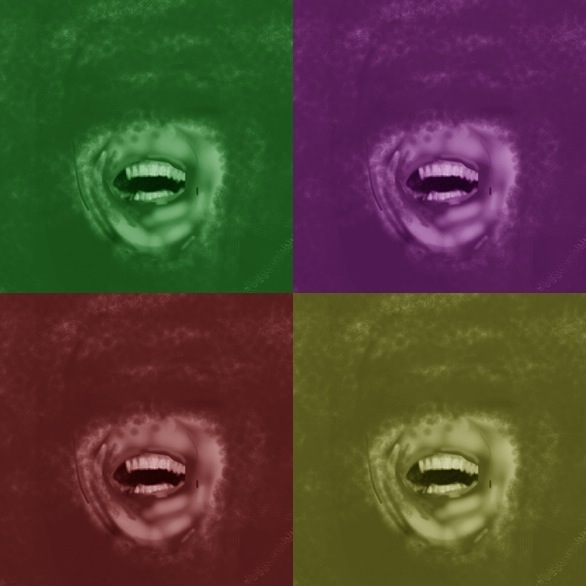
Here’s a delayed Magpie Tales, a post based on a prompt from Tess Kincaid. Tess’s prompt was a picture of Marilyn Monroe laughing, but, frankly, I’d just about as soon be shot as write about Marilyn Monroe during the week between Christmas and New Year’s, so instead, I’ve focused just on a certain aspect of the photo, which I have re-done in my own manner above. (Please note that the poem is not intended to be about Marilyn–I’m just focusing on the mouth/tooth of the picture.)

The bite of Eve

A spirit of conviviality

is often partly propped
by good strong teeth.

Eve had to bite
in
to
the apple.
How unfairly difficult it seems
for the dentally-challenged
to sink their flailing
chompers into

an open-throated laugh. That bit
of the predator that seizes
humor, shaking it above
a thrown-back head as it
proclaims inside

I got it,

somehow denied
by the decay of those
squared sharp gates, blocked by
the absent bars
of canine, those
enforcers, you know, of
a certain kind
of kiss.

20111229-075131.jpg

Open Link – Another Villanelle – Things Past and Present –

December 27, 2011

20111227-020858.jpg

The Christmas season frequently brings up the ghosts of Christmases past. (Charles Dickens really hit on something there!)  Here’s a villanelle I am posting for dVerse Poets Pub Open Link Night, which concerns that focus on the past.

As a preliminary note, I’d like to say that my mother’s mind keeps its objects in a very clear array.  (Seriously, Mom, “disarray” sounds more poetic!)   Also, the painting above, very poorly cropped in my photo, was made by one of my grandmothers.

My mother’s mind

My mother’s mind’s a disarray of lives
she tries to sort like bank statements or socks,
the memories of grandfathers, farms, old wives.

Land sold, cash lost–those tales as sharp as knives
that wound the dead–bringing anger that unlocks
my mother’s mind.  A disarray of lives

whose weave she’s sure will warp without her tithes,
her tributes to hard work (also hard knocks),
the memories of grandfathers, farms, old wives.

She rallies around their wits–ambition drives
her past more than her future-as time’s tick rocks
my mother’s mind, a disarray of lives.

Can’t bring them back; no, that’s not what she tries.
Simply to make them last, pry from pine box
those memories of grandfathers, farms, old wives–

substantiating them–so she too thrives.
Throat fills with tears she seeks, with fears she blocks–
my mother’s mind, a disarray of lives,
memories of grandfathers, farms, old wives.

(If you are interested in villanelles, check out my comic “Villain-elle” with elephants.  If you are interesting in checking out, then look up NOSE DIVE, my new comic novel, illustrated with Jonathan Segal.  A lot of fun!)

Contrast/Villanelles/”Villain-elle” (With Watercolors and Elephants)

December 22, 2011

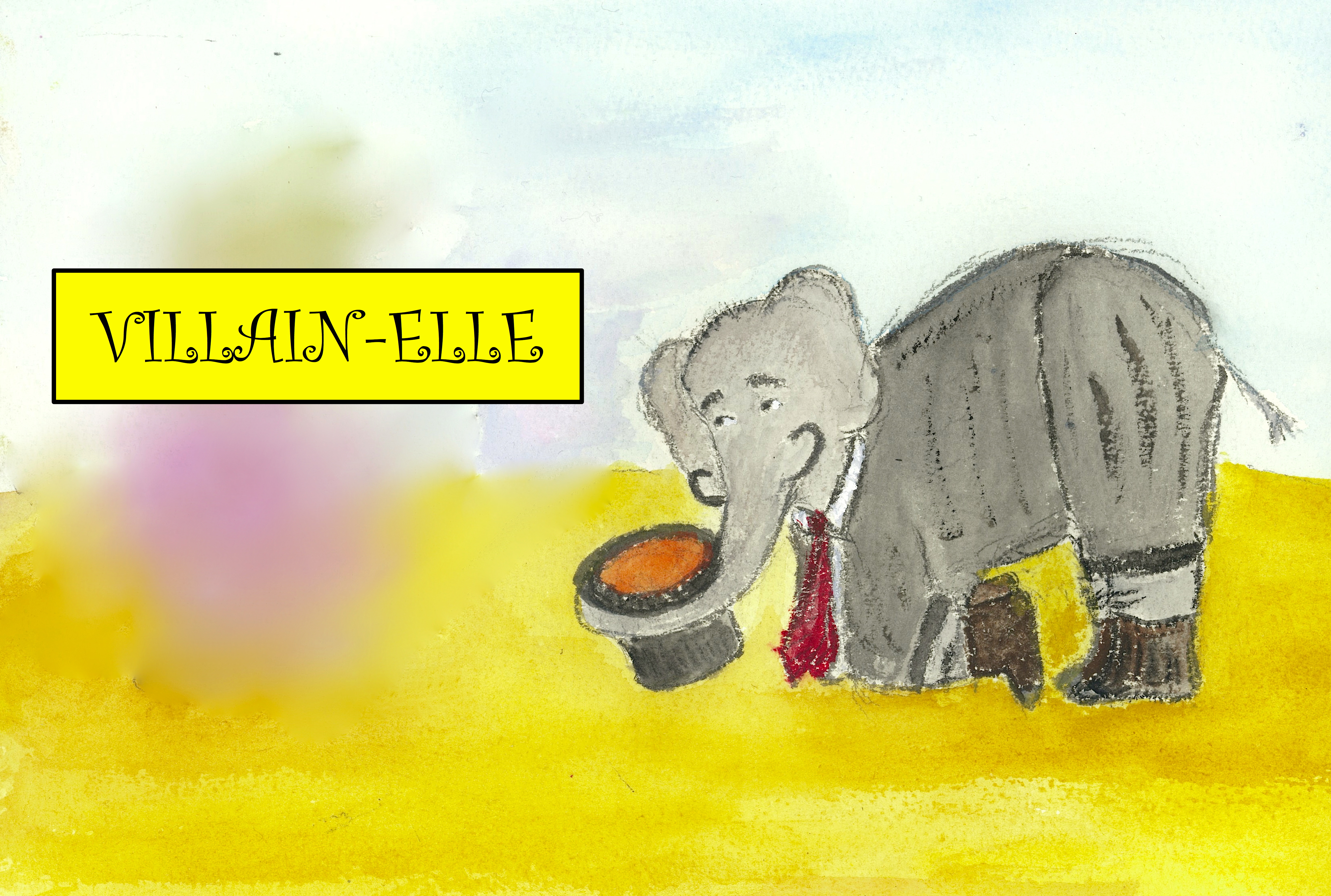
I am a great lover of villanelles.  I am reposting “Villain-elle” today because it illustrates an important tool in villanelle writing: contrast. 

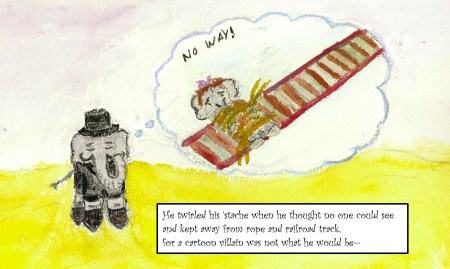
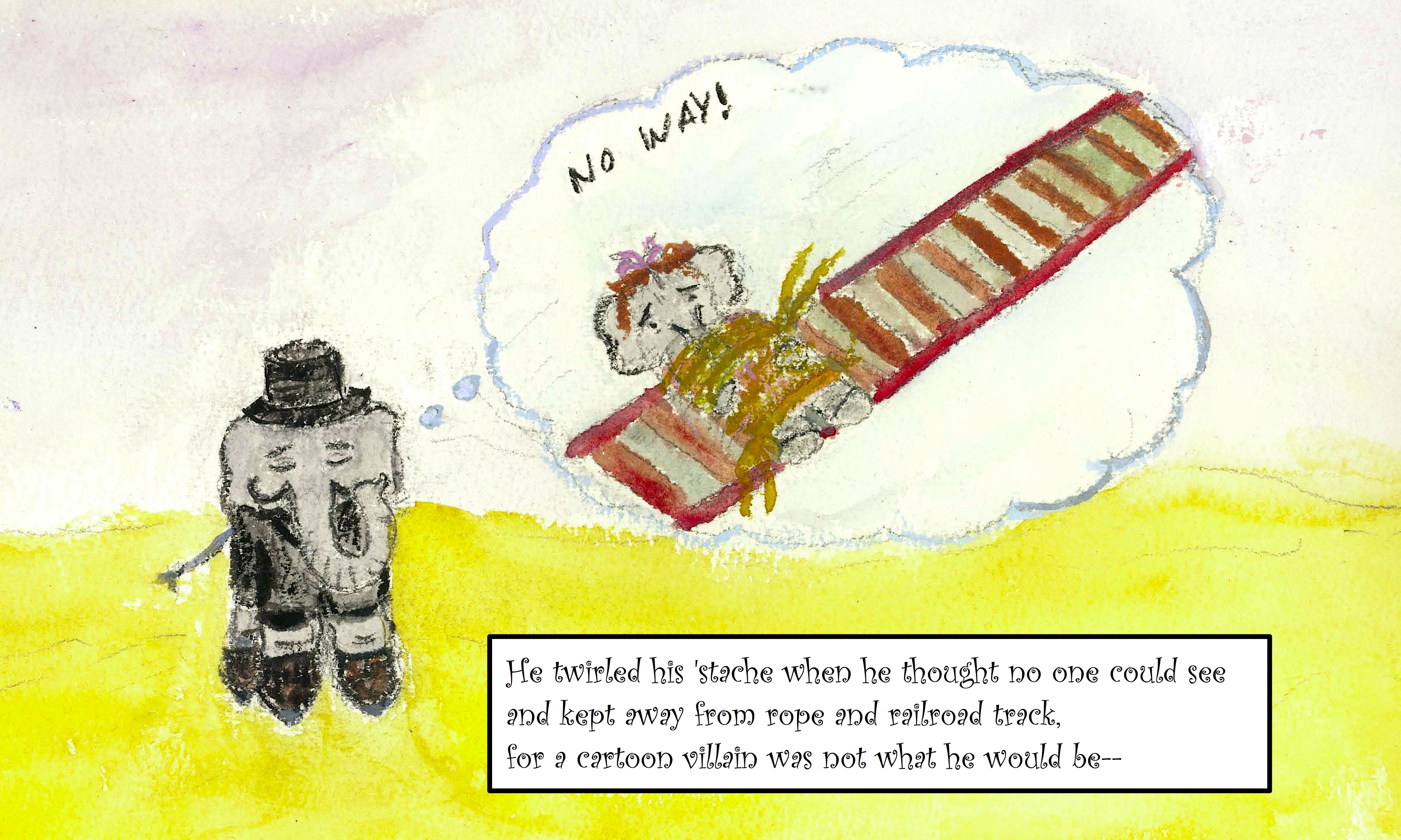
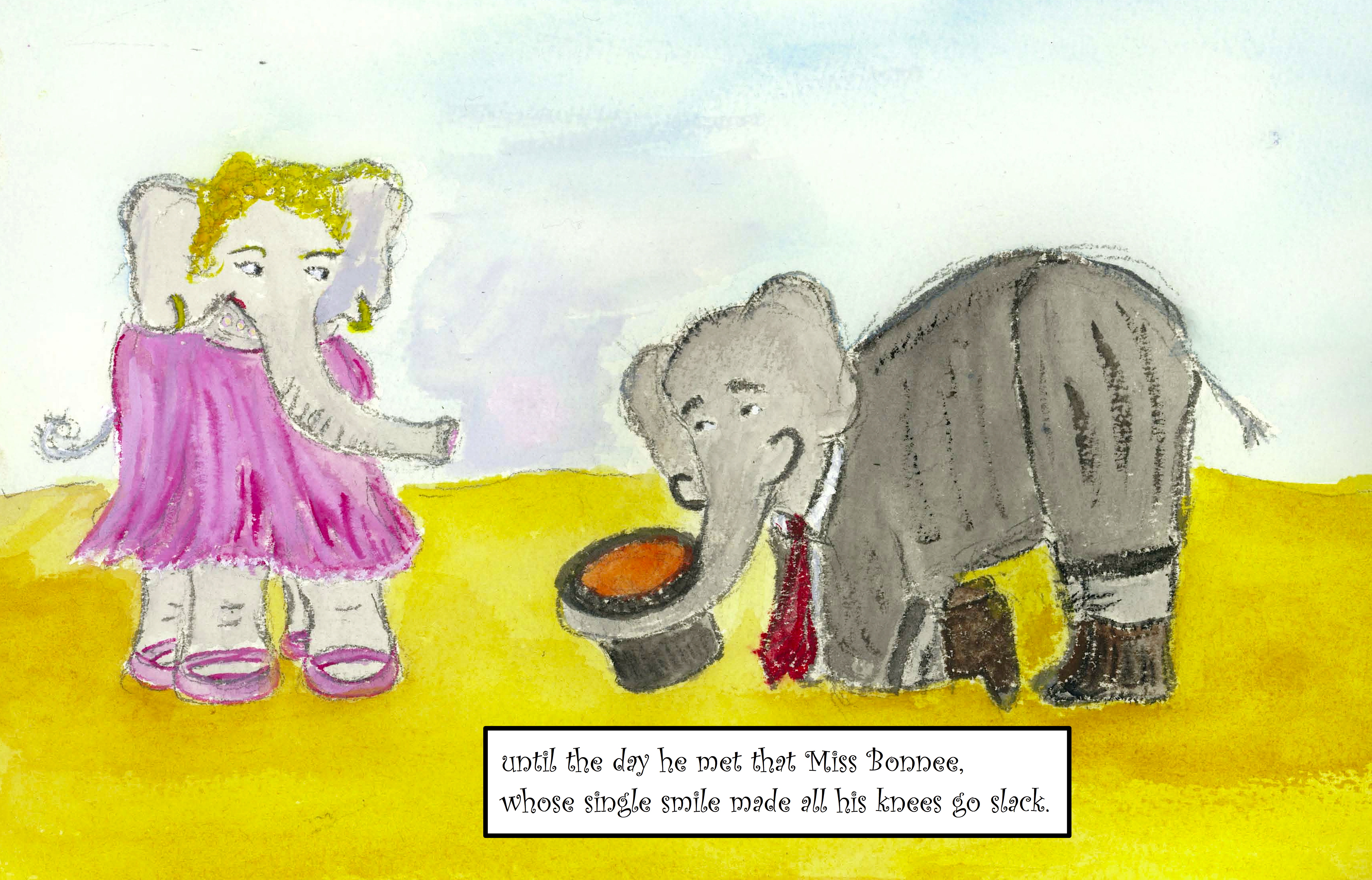
Contrast in poetry, the subject of a thoughtful prompt by Victoria C. Slotto for dVerse Poets Pub , is a useful tool for effects in all poetry, but it is especially useful in the repeating, and potentially static,  lines of a villanelle.  Contrast in a villanelle can come through changes in meaning, homonyms, enjambment (the breaking up and running over of lines), elephants.   (Note that I tried to put the lines of the poem in the drawings but they are incomplete and blurry so I’ve put them below each drawing, and the full poem below that.)  (I am also linking this poem to the poets’ rally.)

He twirled his ‘stache when he thought no one could see
and kept away from rope and railroad track,
for a cartoon villain was not what he would be–

what he sought was originality.
Wearing a hat that was not quite white, nor black,
he twirled his ‘stache when he thought no one could see,

until the day he met that Miss Bonnee,
whose single smile made all his knees go slack.

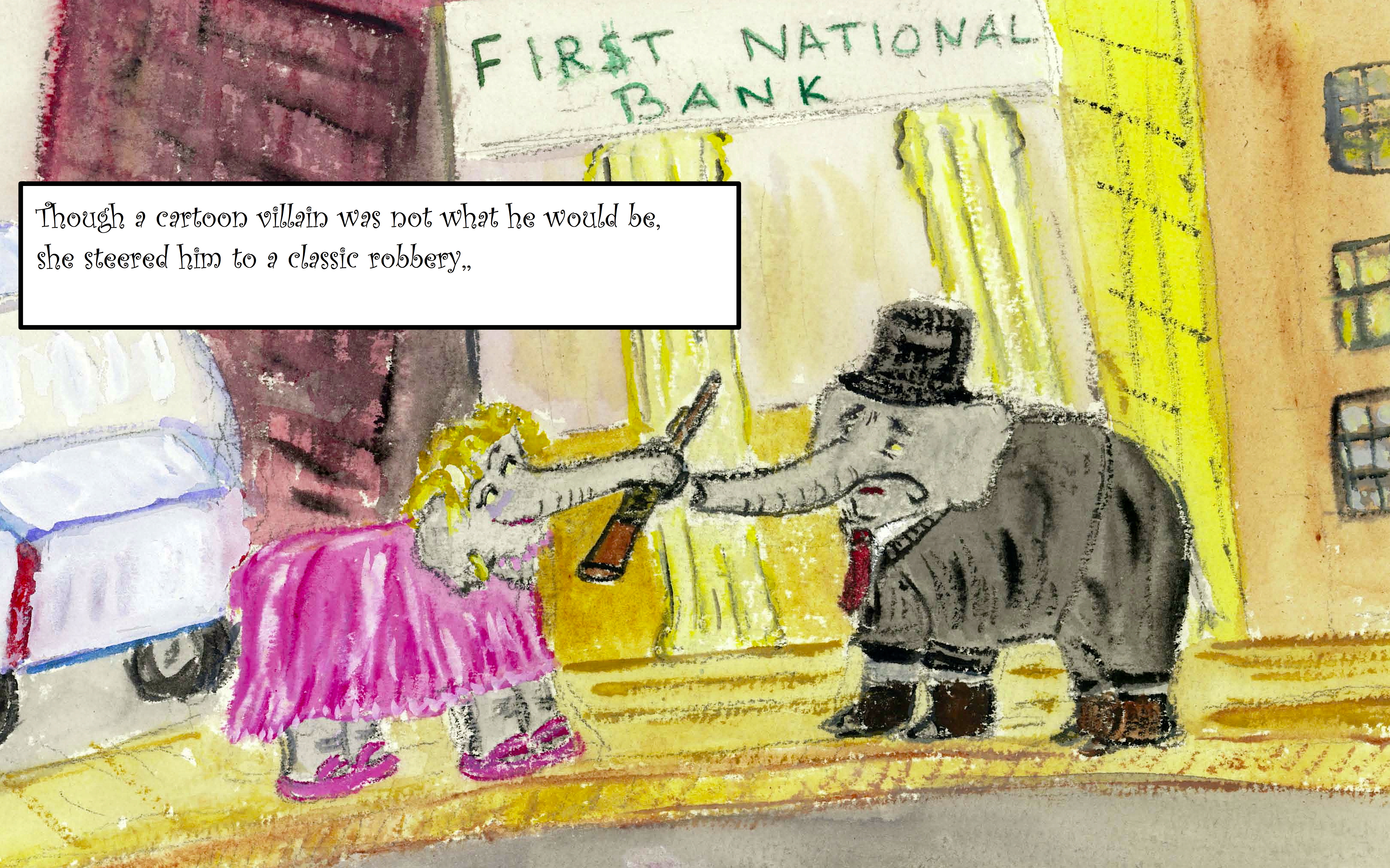
Though a cartoon villain was not what he would be,

she steered him to a classic robbery,
a bank heist with a gun, a car out back,
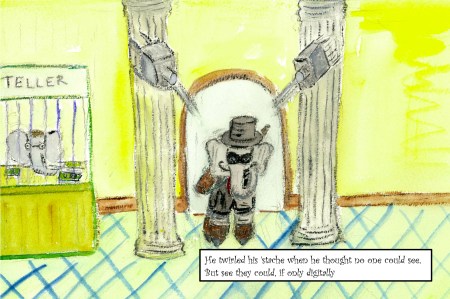
He twirled his ‘stache when he thought no one could see,

but see they could, if only digitally.
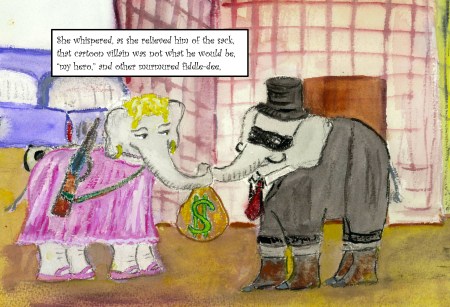
She whispered, as she relieved him of the sack,
that cartoon villain was not what he would be,

“my hero,” and other murmured fiddle-dee,


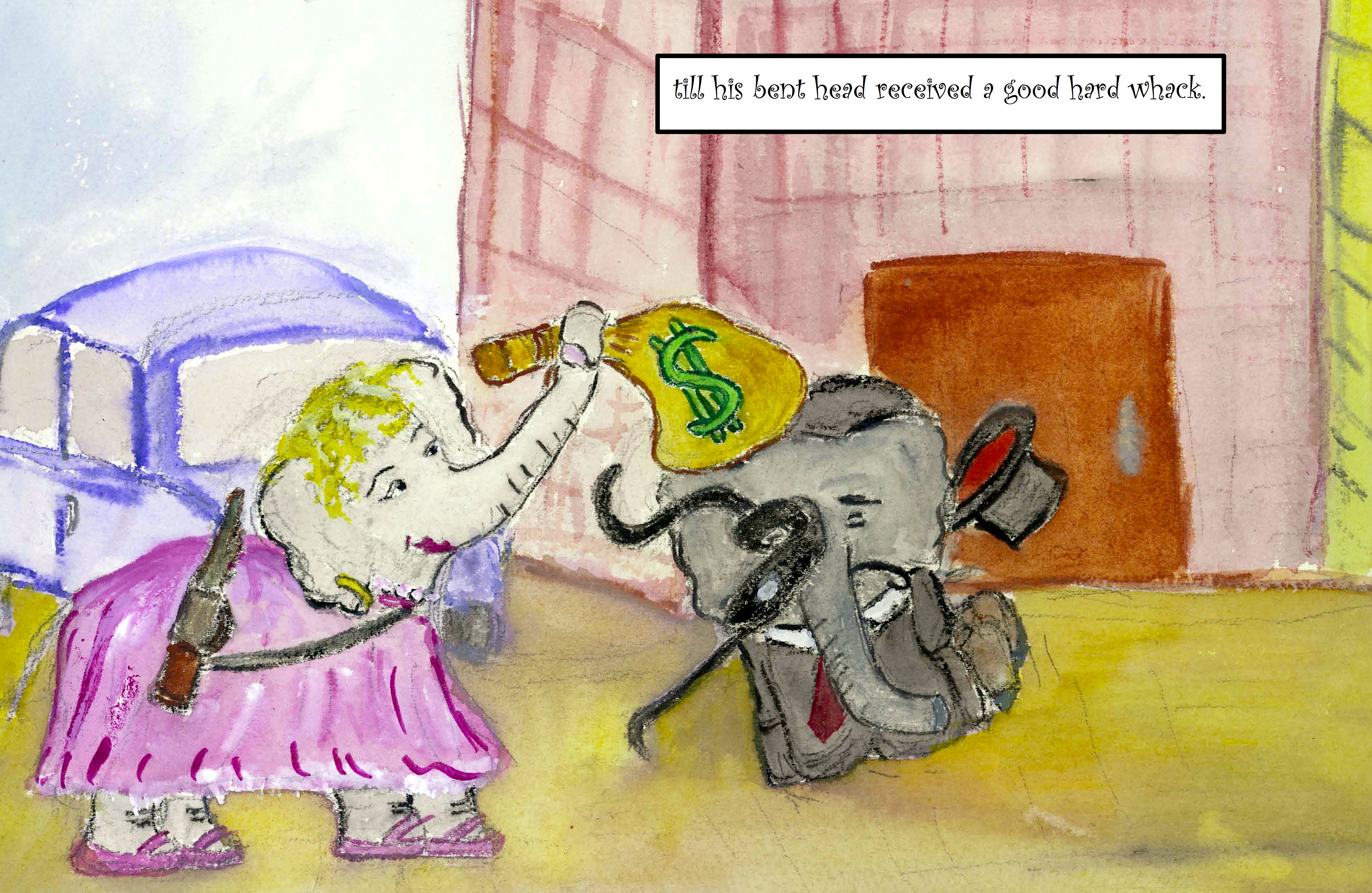
till his bent head received a good hard whack.

She twirled her stash when she thought no one could see.
A cartoon villain was not what she would be.

Here’s the poem without elephants!

VILLAIN-ELLE

He twirled his ‘stache when he thought no one could see
and kept away from rope and railroad track,
for a cartoon villain was not what he would be–

what he sought was originality.
Wearing a hat that was not quite white, nor black,
he twirled his ‘stache when he thought no one could see,

until the day he met that Miss Bonnee,
whose single smile made all his knees go slack.
Though a cartoon villain was not what he would be,

she steered him to a classic robbery,
a bank heist with a gun, a car out back,
He twirled his ‘stache when he thought no one could see,

but see they could, if only digitally.
She whispered, as she relieved him of the sack,
that cartoon villain was not what he would be,

“my hero,” and other murmured fiddle-dee,
till his bent head received a good hard whack.
She twirled her stash when she thought no one could see.
A cartoon villain was not what she would be.

HAPPY HOLIDAYS!

P.S.  If you like humor, poetry or elephants, don’t forget to check out my books NOSE DIVE, GOING ON SOMEWHERE and 1 MISSISIPPI on Amazon.  Thanks much.

P.P.S. = Accidentally dropped “Whack” painting from first posting of this.  So sorry!  (Kind of tired when posting but had a nap now!)

House Republicans (Fighting with One Hand Behind Their Backs?)

December 21, 2011

20111221-020753.jpg

In honor of the House Republicans’ refusal to agree to sign on to the Senate bill that will extend (i) payroll tax cuts and (ii) unemployment benefits, a few haiku:

“When I pledged no tax
raises, I didn’t mean…um…
for working people.”

“It’s the uncertain-
ty I hate, you know, all that
damn uncertainty. “

“I’m worried about
the working man. Can’t you see
how worried I am?”

And here’s one with a reference to Shakespeare:

Sound, fury, tales told,
idiots. “Job creators?”
Mumbo-jumbo? Hmmm…

I don’t like to be so political, but the current situation is just maddening.

I am linking this to the Sensational Haiku Wednesday (though the theme is spirit!)

MagPie 96- Wearing the Trousers in Macbeth (In English Class With Two Ringed Braids)

December 20, 2011

20111220-120726.jpg

Here is a poem for Magpie Tales 96 and also dVerse Poets Pub Open Link Night.   This is based on a photographic prompt from Tess Kincaid, which was of a woman in a shadow that appeared to be a beard.  (It’s not so clear in my version above.)  Below is my poem:

English Essay In Two Ringed Braids

In English class in post-colonial school,
the study of idioms, literature
and exposition are assayed with
diligence: “some
complain that Shakespeare is
dull as ditchwater but in
the pages of MacBeth
may be found
a rip-roaring
ride.  Lady
Macbeth wears the trousers
in the family at the
beginning of
the play, but by Act V,  Macbeth
has taken the trousers
back while the Lady
throws the baby out
with the bathwater, as it were, going mad.
Macbeth, in the meantime,
adds suspenders
to his belt, killing one and all
till he feels as certain of
the throne as Bob’s
his uncle, but he cannot
see the forest for
the trees, coming
to a very bad end.”

The girl writing the essay wears
her hair in braids, which curl into
two ravenshone rings, elastics
camouflaged, in
each case, by
a large white bow, looped
to emulate both butterfly
and lotus,
wing and bloom,
and too, the “x”
of “betwixt,” all
in one
fell swoop.

And now a question for decisive poets and readers out there–I contemplated changing the last couple of lines to refer to the “cross” in “betwixt” rather than the “x”.  That seemed a bit heavy-handed to me, but I am curious to see if anyone thinks it would be an improvement.  Also toyed with “braces” in place of suspenders, but, well, I live in NYC.  Thanks much for your thoughts.

(And please please please check out my new comic novel NOSE DIVE on Amazon if you have a mo.)